
Introduction

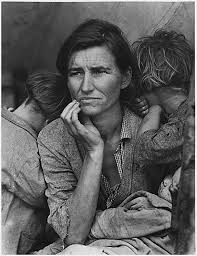
Bud, Not Buddy is a 2000 Newbery Awardwinning book written by Christopher Paul Curtis. In his book, he showed us something about what life was like during the Great Depression. We are going to write a newspaper article in which you talk about a particular topic of the Great Depression
Task
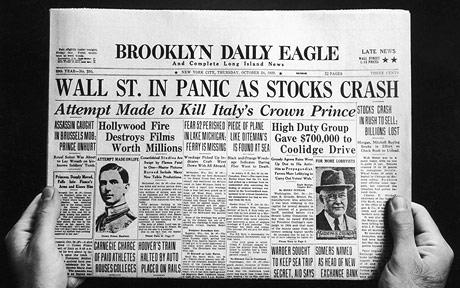
You are a reporter for a major newspaper network. You discover a time capsule from the 1930's and you find artifacts from the Great Depression. Once you get over your shock of your luck at finding this discovery you begin to uncover the documents and get the scoop on the Great Depression. You believe that as a reporter you have an obligation to report what you have found to the public.
You will:
-Research a topic from the 1930's
-On Google Docs, you will write a front page cover story complete with headliner and appropriate picture
Process
Within your assigned group:
1. Each student will be given one of the following topics:
-History: Bud finds that life is hard during the Great Depression. Describe what the Great Depression was and how it affected people in the United States. Include information about "Hoovervilles", the "towns" that Bud saw during the story.
-Business News: Bud hears about the possibility of labor strikes during the story. Give some general information about labor strikes in the 1930's as well as specific information about strikes in Flint Michigan. Include an appropriate photo.
-Entertaninment-Jazz/Swing Music: Bud hears a lot about jazz music when he stays with the Calloways Band. Write an article about jazz music (often called swing) in the 1930's. Choose a famous musican from the 1930's and include some information about his/her music and life. Include a picture of the musician.
-Railroads: The people in the 1930's used railroads to get from one place to another. Often, they 'rode the rails', which was an illegal but necessary way to travel due to the lack of money. Bud also meets a Pullman Porter during his story.
2. The resources sections has a list of several websites for your topic. Look at the websites and take notes.
3. Using the computer, type a full page article in which you report on your findings. You will need an eyecatching headline and don't forget to include your byline. If you include a picture, each picture will need a caption underneath it.
4. Be creative and make your project look like it really came from the 1930's! Use your imagination.
5. Be prepared to share your information about your topic with your tablemates.
Resources:
History:
* The Great Depression (video): http://www.history.com/topics/great-depression (Choose the first link on this page)
* The Great Depression (text): http://www.pbs.org/wgbh/americanexperience/features/general-article/dustbowl-great-depression/
* The Great Depresssion (text): http://history1900s.about.com/od/1930s/p/greatdepression.htm
* The Stock Market Crash of 1928(video): http://www.history.com/topics/1929-stock-market-crash
* Hoovervilles (video):http://www.history.com/topics/hoovervilles
Business:
* The Start of Labor Unions in the U.S. (text): http://economics.about.com/od/laborinamerica/a/early_years.htm
* Labor Unions in 1930s (text): http://www.loc.gov/teachers/classroommaterials/presentationsandactivities/presentations/timeline/depwwii/unions/
* What are Strikes? (text): http://l3d.cs.colorado.edu/systems/agentsheets/New-Vista/flint-strikes/history.html
* The Flint Sit-Down Strike (audio recordings and text): http://flint.matrix.msu.edu/organization.php
* The Flint Sit-Down Strike (video): https://www.youtube.com/watch?v=zhx9z4ZOIDU
Entertainment:
* What is Jazz Music? (text): http://www.jazzinamerica.org/lessonplan/5/1/242
* Jazz in the 1930s (text and audio recordings): http://www.pbs.org/jazz/time/time_depression.htm
* Jazz in the 1930s (text): http://www.jazzstandards.com/history/history-3.htm
* Jazz in the 1930s (audio): https://www.youtube.com/watch?v=Ag6G2GUndB0 DO NOT LISTEN TO THE ENTIRE HOUR! JUST LISTEN TO A SAMPLE FROM THE CLIP.
* Timeline of Jazz in the U.S. (text): http://www.jazzinamerica.org/JazzResources/Timeline
Railroads in the 1930s
* Railroads in the 1930s (text): http://history.howstuffworks.com/american-history/great-depression-railroads.htm
* Riding the Rails (text): http://www.livinghistoryfarm.org/farminginthe30s/water_07.html
* Riding the Rails (video): https://www.youtube.com/watch?v=pIblZmwvGww
* Pullman Porter (text): http://amhistory.si.edu/onthemove/exhibition/exhibition_9_6.html
* Pullman Porter (video): https://www.youtube.com/watch?v=6yoYSkoCp5M
Additional:
*Personal Stories of People That Lived Through the 1930s (text): http://www.thepeoplehistory.com/30s-memories.html
Evaluation
Evaluation Rubric
|
CRITERIA |
4 |
3 |
2 |
1 |
|
CONTENT AND ANALYSIS: the extent to which the essay conveys complex ideas and information clearly and accurately in order to support claims in an analysis of topics or texts |
•clearly introduce a topic in a manner that is compelling and follows logically from the task and purpose •demonstrate insightful analysis of the text(s) |
•clearly introduce a topic in a manner that follows from the task and purpose • demonstrate grade- appropriate analysis of the text(s) |
•introduce a topic in a manner that follows generally from the task and purpose • demonstrate a literal comprehension of the text(s) |
• introduce a topic in a manner that does not logically follow from the task and purpose • demonstrate little understanding of the text(s) |
|
COMMAND OF EVIDENCE: the extent to which the essay presents evidence from the provided texts to support analysis and reflection |
•develop the topic with relevant, well-chosen facts, definitions, concrete details, quotations, or other information and examples from the text(s) •sustain the use of varied, relevant evidence |
•develop the topic with relevant facts, definitions, details, quotations, or other information and examples from the text(s) •sustain the use of relevant evidence, with some lack of variety |
•partially develop the topic of the essay with the use of some textual evidence, some of which may be irrelevant •use relevant evidence inconsistently |
•demonstrate an attempt to use evidence, but only develop ideas with minimal, occasional evidence which is generally invalid or irrelevant |
|
COHERENCE, ORGANIZATION, AND STYLE: the extent to which the essay logically organizes complex ideas, concepts, and information using formal style and precise language |
• exhibit clear organization, with the skillful use of appropriate and varied transitions to create a unified whole and enhance meaning •establish and maintain a formal style, using grade- appropriate, stylistically sophisticated language anddomain-specific vocabulary with a notable sense of voice •provide a concluding statement or section that is compelling and follows clearly from the topic and information presented |
• exhibit clear organization, with the use of appropriate transitions to create a unified whole •establish and maintain a formal style using precise language and domain-specific vocabulary • provide a concluding statement or section that follows from the topic and information presented |
•exhibit some attempt at organization, with inconsistent use of transitions • establish but fail to maintain a formal style, with inconsistent use of language and domain-specific vocabulary •provide a concluding statement or section that follows generally from the topic and information presented |
• exhibit little attempt at organization, or attempts to organize are irrelevant to the task • lack a formal style, using language that is imprecise or inappropriate for the text(s) and task • provide a concluding statement or section that is illogical or unrelated to the topic and information presented |
|
CONTROL OF CONVENTIONS: the extent to which the essay demonstrates command of the conventions of standard English grammar, usage, capitalization, punctuation, and spelling |
•demonstrate grade- appropriate command of conventions, with few errors |
• demonstrate grade- appropriate command of conventions, with occasional errors that do not hinder comprehension |
• demonstrate emerging command of conventions, with some errors that may hinder comprehension |
•demonstrate a lack of command of conventions, with frequent errors that hinder comprehension |