
Introduction
This is a forensic science mystery just waiting to be solved. As a forensic investigator, you will collect and analyze evidence from a crime scene. You will need to use your scientific inquiry and logical thinking skills to help solve the mystery!
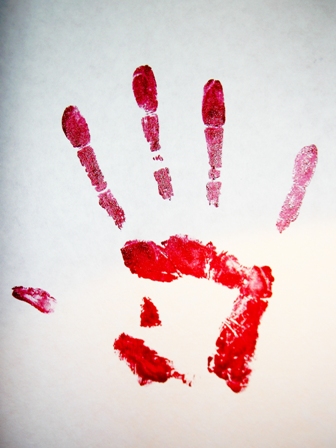
Task
You will be a forensic scientist, analyzing evidence from a crime scene and determining if it can tell you anything about the crime. You will collect the newspaper evidence, preserve blood for laboratory examination, determine if the stains are blood stains, type the blood, and hopefully, solve the crime!

Process
The Scenario
Last night Mr. Griddler and his pet potbelly pig, Porkchop, were walking down a street in their neighborhood, as they do nearly every night. Porkchop was stopping every few feet to sniff and dig up whatever he could find, and Mr. Griddler was studying the stars as they twinkled in the night sky. About ten minutes into their walk, Porkchop came upon some sheets of soiled and wrinkled newspaper and began sniffing at them them furiously. As Mr. Griddler bent down to pick up the newspapers, he noticed a dark, sticky substance on them that looked a lot like blood. He immediately took out his cell phone and dialed 911. A short time later, Detective Snow arrived to investigate. It turns out that a young woman was found that morning beaten to death in the trunk of her car. The evidence suggests that she was killed outside of the car and later placed in the trunk. It also provides broad clues that point to three possible suspects. Nothing on her body linked the crime to any of the suspects, but hopefully this new evidence will! Detective Snow decides to call in the team of experts, CSI.
The following links lead you to sites where you can read about and practice some of the skills you need will need to analyze the evidence and solve the case. Go to each site, read the information or perform the task, and then answer the associated questions on your worksheet. Have fun!!
Collection and preservation of evidence with blood:
First you need to understand the importance of blood evidence. Read about the science behind blood (slides 1 - 7 and 24 - 37) using the PowerPoint posted to Edmodo.
Now the evidence must be collected and preserved so that it can be tested. Read about the collection and preservation processes and answer the questions on the worksheet. Don't forget to read closely and answer the questions thoroughly, you are working to become an expert! Preservation and Collection of Biological Evidence
Now how can you tell if there is any blood left behind at the crime scene that is not visible to the naked eye? You can't collect the blood if you can't find it, so maybe you should find out how to detect the hidden blood! Luminol
Testing sample for presence of human blood:
Once you have collected the evidence you will need to take it back to the lab and test it for the presence of blood. Go back to the information on blood and find out how to test for the presence of blood (slides 8 - 17) using the PowerPoint posted to Edmodo.
Determining blood type:
Finally, it is time to learn how to determine blood type. Read through the material and answer the questions on the worksheet. When you have read through to the end of the information, click on "Play the blood typing game" and work your way through the entire simulation. Answer the associated questions on the worksheet. Blood Groups, Blood Typing and Blood Transfusions (The game does not work on iPads, but the rest of the information is helpful. Play the game from a computer! It is really fun and tests your understanding of blood types).
The final step:
It is now time to go to the final step, so move on and solve the mystery!
.... and now the final task, solve the mystery!!
You bring the evidence back to the lab get ready to start your analysis. The first thing you decide to do is to analyze the stains and determine if they are blood. Go up to Ms. Ortega's computer. Run the simulation on it to see if your "sample" is actually blood. Answer the questions on the worksheet.
Ok, so have you determined that it is blood? Good! While you were running your tests, your partner ran DNA tests on several samples from the newspaper. Not only did he confirm the presence of human blood, he found there was blood from two different sources. You may have just found a link to the killer! Your partner tells you that on of the samples of blood on the newspaper is type A- and the other is O+. You decide to go and determine the blood type of the victim and the three suspects. The following is a summary of the results from your tests. Use this information to answer the questions on the worksheet.
Head up to the front desk and test the blood samples from each of the suspects to try and determine their blood type. Make a similar table (as the one below) on a separate sheet of paper to record your answers and turn it in with your worksheet.
This is what it means by "clumping" and "no clumping"

|
Individual |
anti - A antibody |
anti - B antibody |
anti - Rh antibody |
|---|---|---|---|
|
Victim |
clump |
no clump |
no clump |
|
Suspect 1 |
|
|
clump |
|
Suspect 2 |
|
|
clump |
|
Suspect 3 |
|
|
no clump |
So, do you have a match? Yes? Great! While it is certainly a good start to match the blood types, it is not enough to convict the suspect. You take a sample of the suspect's blood to your partner to do DNA analysis, but he is really backlogged. While you wait for him to get to the test, you go to the suspect's house to see what you can find. The police did not find any blood, but you know there was not a lot of blood found in the trunk of the car with the body, so she must have been killed somewhere else. You are hoping that the Luminol test will find something. You go into the suspect's kitchen and see that the floor has recently been cleaned. You perform the Luminol test on the kitchen floor, turn of the lights and see that all too familiar glow. Looks like you have found your murderer. You take a swab of the site for your partner to test, but I'd say case closed!
On your separate sheet of paper where you recorded your results from the blood typing, include 10-15 complete sentences on what you learned from this Webquest.
Evaluation
The evaluation of this webquest will be based on your performance on the associated worksheet. Each question must be answered with a high level of accuracy and attention to detail for full credit.
Conclusion
So by now you should have used what you have learned about luminol, testing for blood, collecting evidence and blood typing to solve the murder. Good job! Make sure your worksheet is complete and all of the questions have been answered thoroughly. Now on to the next topic in Forensics....
Credits
Author Biography
Jennifer Landry
North Cross School Science and Math Faculty
Permissions
We all benefit by being generous with our work. Permission is granted for others to use and modify this WebQuest for educational, non-commercial purposes as long as the original authorship is credited. The modified WebQuest may be shared only under the same conditions. See the Creative Commons Attribution • Non-Commercial• Share-Alike license for details.
Modified by: Heather Ortega, Northwestern High School Science Faculty