
Introduction
Ballet comes from the French and was borrowed into English around 1630. The French word in turn has its origin in Italian balletto, a diminutive of ballo (dance) which comes from Latin ballo, ballare, meaning "to dance" Ballet was rich in representing of once culture by executing dance. It was one of many contributions of european countries to our countries and to others. When it was introduce in the philippines it was one genre in making the musical to become more facinating. In fact many studios of ballet arouse in the country. Ballet became modern where they called contemporary. Many variations and style of dancing came popular not only ballet . For giving new touch for one dance.
Students nowadays wants more to discover things out of curiousity. As we go on, the students would be able to become more dicipline and responsible. it takes more dicipline in ballet. They will be more flexible and confident in what they are doing. They will come up with creative variations of dance using ballet.
Task
The student will be having their warm up exercise with their partner. doing the activity with partner makes the student be actiive. Doing the warm up at the same time makes it more fun.
Execute the basic position after the warm up exercises.
First, the foot position then the arm position.
Face each other to execute the basic position for them to concentrate and for them to focus.
After doing that, out of the basic position the you make your own variation.
Please proceed on the process for guidance!
Process
WARM UP EXERCISE FOR BALLET1. Warm up every muscle in your legs. Warming up is going to take about twenty minutes.If you don't stretch you could pull a muscle. Warming up for dance class is one of the most important parts of the process.
- OPTIONAL: Put on some classical ballet music to do the warm-up.
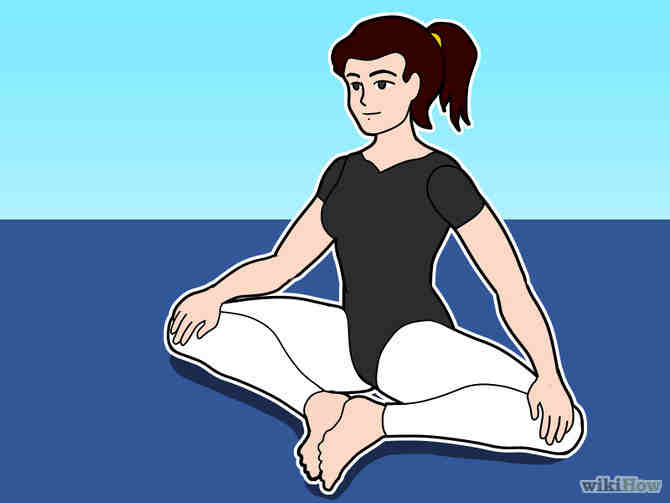 2. Start off with going through all five positions. In first positions, which is where your legs are together and they are turned out, have your hand on the barre, and do a demi-plié, and then go back up. Then another demi, and then a full grande plié, going all the way down, and back up
Do this after a Port de bras, which means "carriage of the arms". Your arm either to the side or above you, go slowly down to floor, bending your back.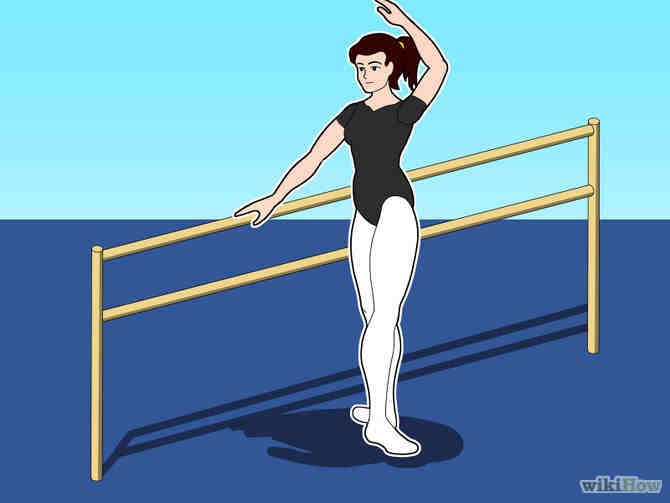
Try to go as far as you can, and make sure your head faces your belly-button.Make sure as you come up, your arm and head are aligned.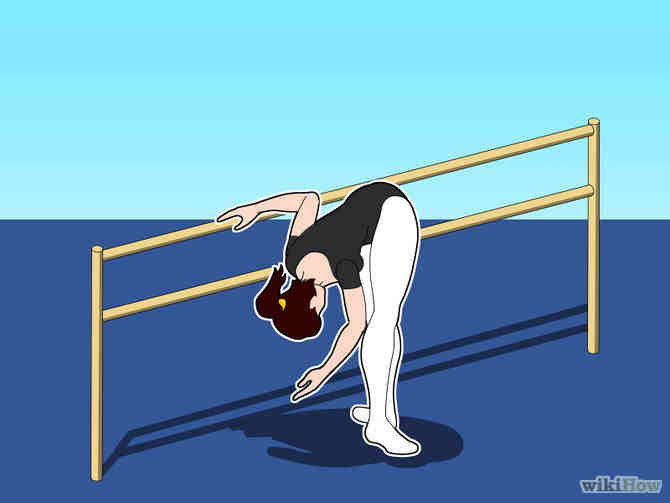 Put your arm to the side, part your feet to second position, and repeat.
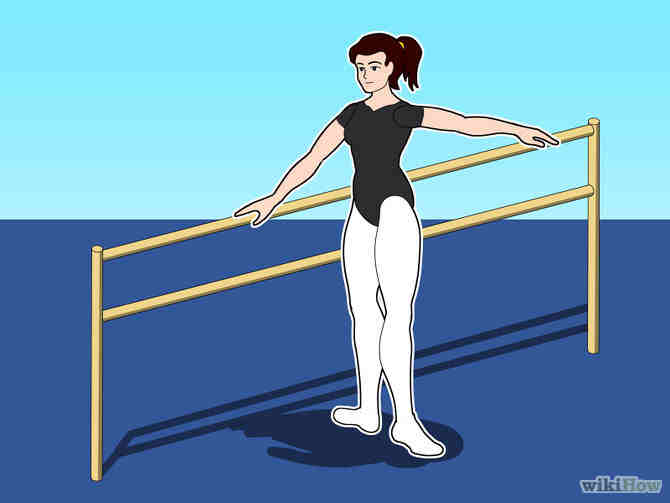 Repeat these for all positions, except when you come up from the port de bras on fifth position, go on relevé, which is on the ball of your foot, what people call, "on your tippy toes".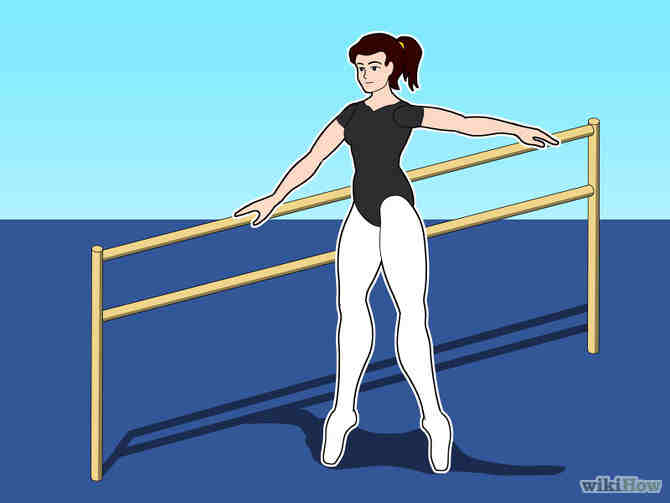
Now move on to stretching your leg. First do coupé, then possé, the put your leg on the barre, and just bend your back and stretch your leg. Remember to point your foot on the barre. Plié your leg that is on the ground. Stay for 16 counts or seconds(same thing
- Rond de jambes, which is your toe on the floor, moving either on the outside of your body or the inside. Do some slow rond de jambes, then quick ones. As you end your rond de jambe, feel free to put a few battements here and there.
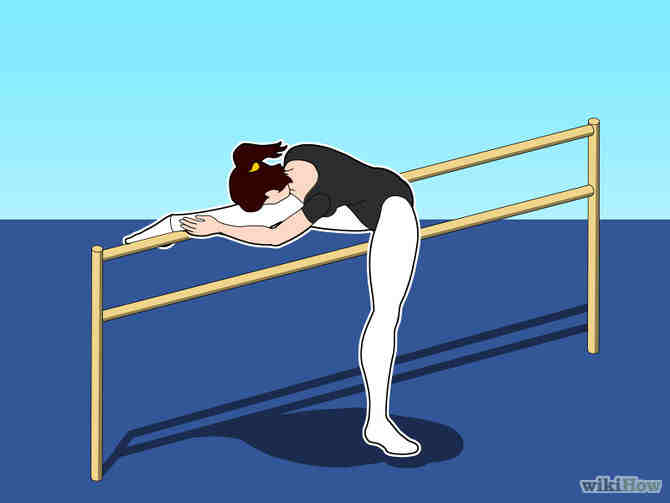
Finish with plié relevés! 16 in first position, 16 on the right leg with your left leg behind it in coupé, the same except on your left.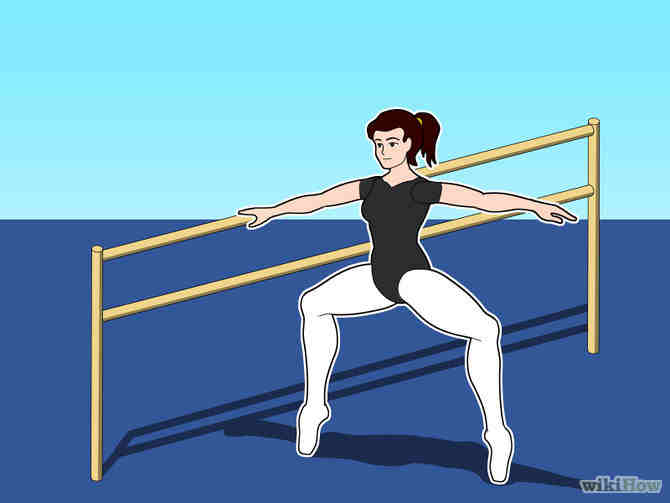 These are the basics of warming up. As you grow into it, feel free to add more to your warm-up and stretches.
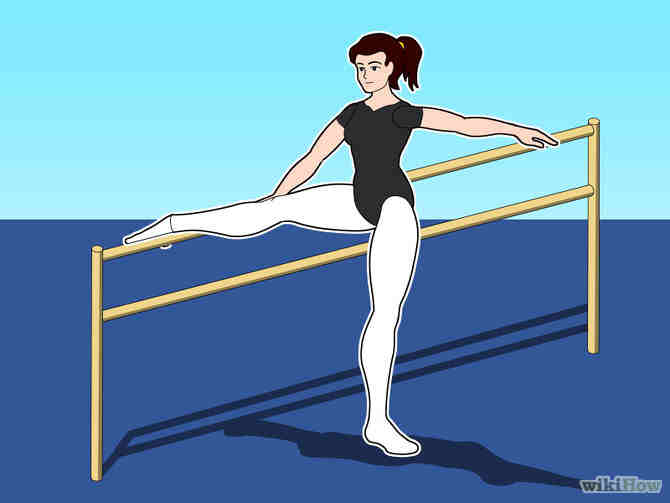 FIVE BASIC POSITION LEG and ARM position
_0.jpg) 1st Position
1st Position
This is the main Ballet position of the arms for beginners. Keep your arms nice and relaxed, and roughly the width of your face apart. Your hands shouldn't be touching your thighs. Keep them just an inch or so in front of you. our front foot so far across your back foot, that you can't see the one at the back. You are so turned out that you are standing front toe to back heel, and back toe to front heel. But to execute this perfectly takes years of training.2nd Position
Your arms out to the side should form a smooth line. Don't do the 'Dead Bird' thing here. Your elbows should be facing the back of the room. Extend your hand comfortably and keep it relaxed – no pointing! our front foot so far across your back foot, that you can't see the one at the back. You are so turned out that you are standing front toe to back heel, and back toe to front heel. But to execute this perfectly takes years of training.3rd Position
This is bringing one arm only in front of you, leaving the other in second position. the room. 4th Position
This is one arm raised and one arm in second. The arm that is raised should be opposite to the foot you have in front. So if your right foot is in front, you raise your left arm. 5th Position
Finally, raise both arms. As with all these positions, make sure that it is your arms that are raised, and NOT your shoulders. Arms should be look smooth with your elbows and hands softly rounded (and definitely no pointing). You are executing Ballet positions, not directing traffic! Basic Position with Variations[video:https://www.youtube.com/watch?v=JE4g4dL2LrA]
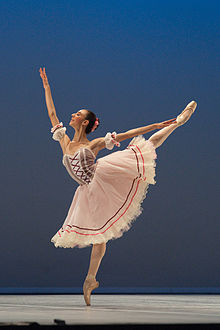
Arabesque (aa-rah-besk; literally, "in Arabic fashion") is a body position in which a dancer stands on one leg (the supporting leg) with the other leg (the working leg) turned out and extended behind the body, with both legs held straight. In classical ballet, an arabesque can be executed with the supporting leg en pointe or demi pointe or with foot flat on the floor.
For Professional
 For Biginners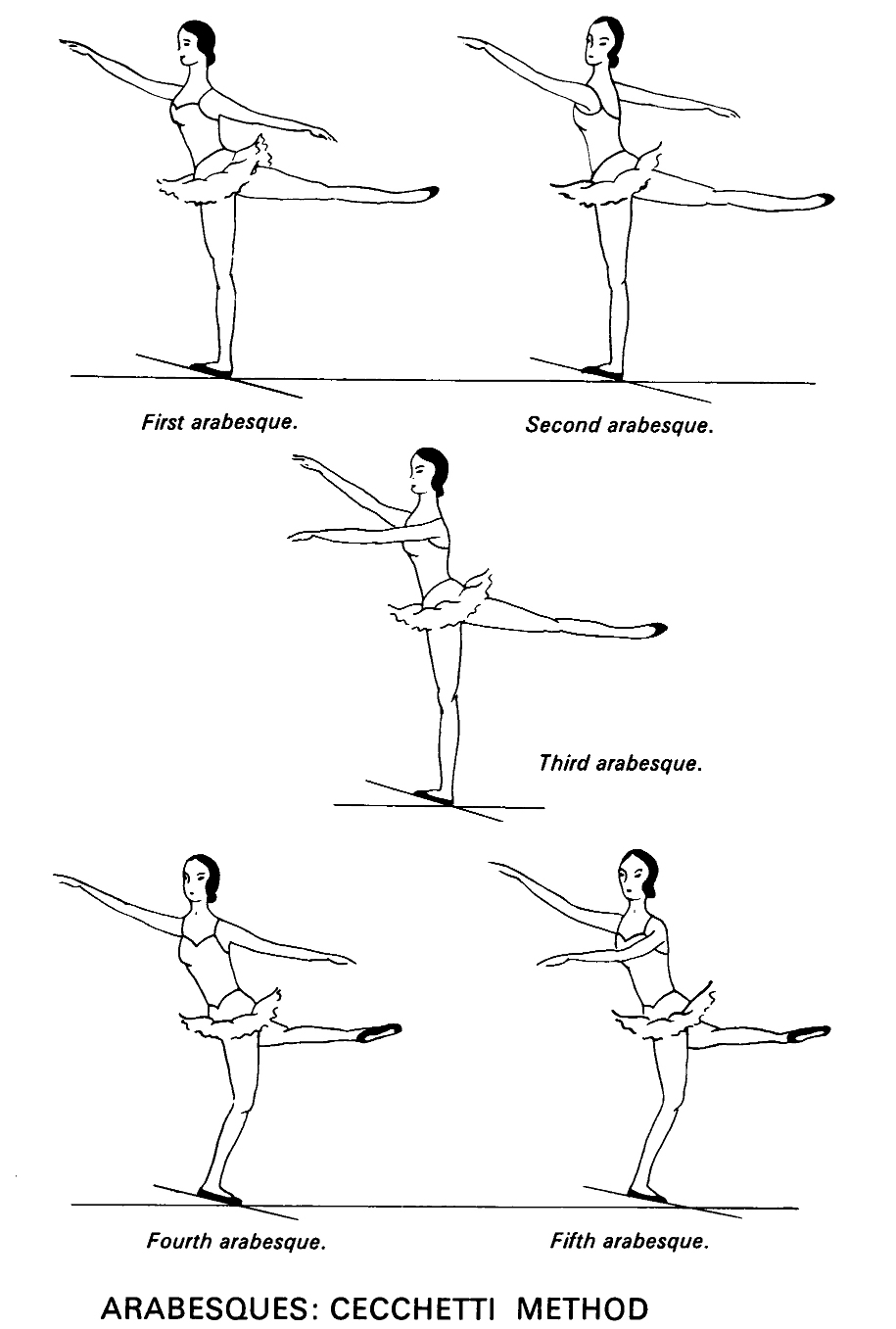
Let us start with some French vocabulary
Devant: To the front
Derrière: To the back (close to the rear)
Croisé: Crossed alignment
Seconde: To the second position (lateral)
Ècarté: Separated or thrown wide apart
Effacé: Shaded
Epaulé: Shouldered (so when people talk about épaulement, they really are referring to the position of the upper body starting from the shoulders and the upper back)
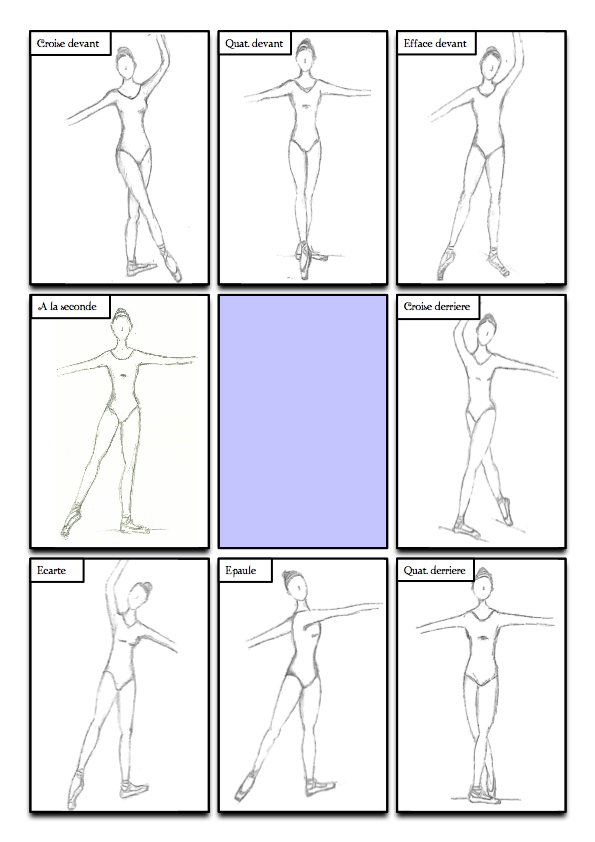
Now one creates positions mixing the different components. Let us explain them carefully
1. Croisé Devant
Standing at an oblique angle to the audience (facing a corner), the leg nearer to the audience is the working leg and is extended in fourth position, pointing on tendú (=stretched) to the front. The arms are placed in (open) fourth position, such that the lower arm is on the same side as the extended leg.

2. Quatrième Devant
Facing the audience, the working leg is extended to fourth position, pointing on tendú to the front, with the arms in second position (open) and the head facing the audience.
3. Effacé Devant
Standing at an oblique angle to the audience (facing a corner), such as that part of the body is hidden. The leg further from the audience becomes the working leg and is extended in fourth position, pointing on tendú to the front. The arms are placed in (open) fourth position such that the lower arm is on the same side as the extended leg.
4. à la Seconde
Facing the audience, the working leg is extended to second position, pointing on tendú to the side, with the arms in second position (open) and the head facing the audience. It is also referred as à la seconde en face.
5. Croisé Derriere
Standing at an oblique angle to the audience (facing a corner). The leg further from the audience becomes the working leg and is extended in fourth position, pointing on tendú to the back. The arms are placed in (open) fourth position such that the lower arm is on the same side as the extended leg.
6. Ecarté
Facing any corner, the leg nearer to the audience becomes the working leg and is extended in second position, pointing on tendú to the side. The arms are in (open) fourth position so the highest arm is on the same side as the extended leg. The head is raised slighlty and turned toward the raised arm, so the eyes look into the hand.
7. Epaulé
Standing at an oblique angle to the audience, the dancer stands in arabesque facing one of the corners (the working leg is the one closest to the audience and is extended to the back in fourth position). The arm closest to the audience is extended forward, and the head is inclined and turned towards the audience.
8. Quatrième Derrière
Facing the audience, the working leg is extended to fourth position, pointing on tendú to the back, with the arms in second position (open) and the head facing the audience.
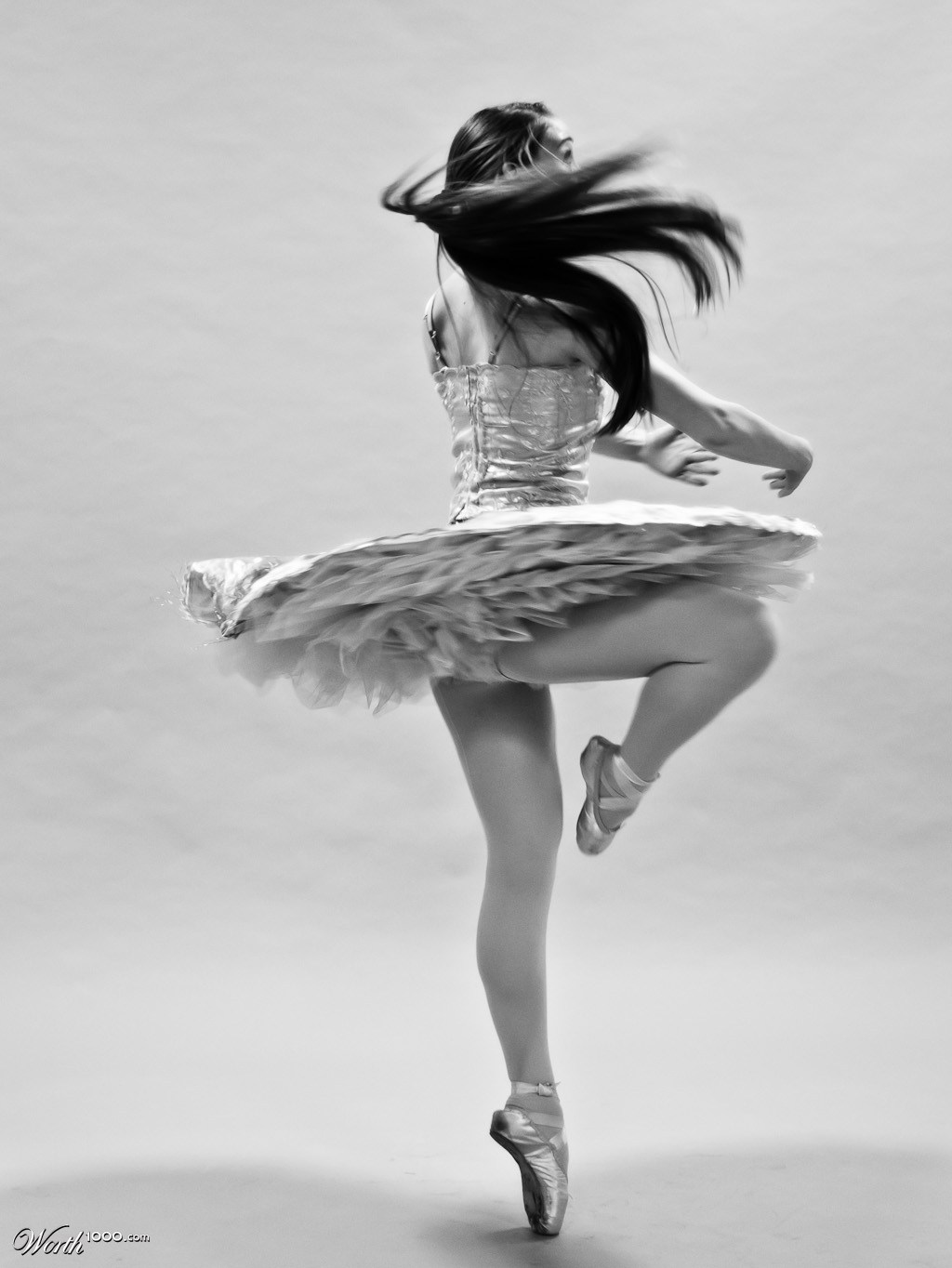
 [video:https://www.youtube.com/watch?v=vxUs3ky8EDc]Piroutte - an act of spinning on one foot, typically with the raised foot touching the knee of the supporting leg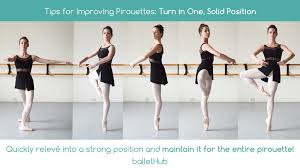
 In order for them to do that they will be needing the following materials below; NOTE: Stated below is used by the professional. Commonly use for rehearsals are tights and leotards. Ballet shoe, or ballet slipper, is a lightweight shoe designed specifically for ballet dancing. It may be made from soft leather, canvas, or satin, and has flexible, thin soles.
 .jpg) Tutu is a skirt worn as a costume in a ballet performance, often with attached bodice. It consists of a basque(or waistband, as it can either be part of the bodice or a separate band) and the skirt itself might be single layer, hanging down, or multiple layers starched and jutting out.
Tutu is a skirt worn as a costume in a ballet performance, often with attached bodice. It consists of a basque(or waistband, as it can either be part of the bodice or a separate band) and the skirt itself might be single layer, hanging down, or multiple layers starched and jutting out.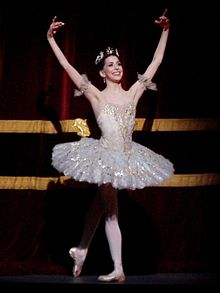 barre is a stationary handrail that provides support for people during various types of exercise. Barres are used extensively in ballet training and warm up exercises, where such exercises are commonly referred to as barre work.
 _0.jpg)
Evaluation
PRACTICUM
CRITERIA:
Performance/ Movement - 50%
Creativity - 30%
Apperance - _20%_
Total - 100%
* One on One performance ( Student and teacher)
* The student will perform the basic position with the cue of the teacher. The students will only execute what the teacher say.
Teacher to student
* Show me the fifth position, third position & the first position
* Land your feet on the fifth position and move your hands to second position
* Show me one piroutte and land your feet into fourth position
* Execute 45% arabesque
* Execute the five basic of arm and feet position without cut
* show a one full piroutte
* Show me atleast 30 second of impromptu performance using different variations and the position in ballet ( have your own story)
Conclusion
Congratulations!! Well done...
You made it to execute the basic position not only that you also made your own variations. Your flexibility showed your movements to be precised.
This shows that the dicipline in you built already. Believing in yourself make it be more beautiful and feelings.
You're on your way to become good ballerina..
Credits
http://www.wikihow.com/Warm-up-for-Ballet
http://en.wikipedia.org/wiki/Ballet
https://www.google.com.ph/search?q=ballet&biw=1024&bih=677&source=lnms&…
https://www.google.com.ph/search?q=ballet&biw=1024&bih=677&source=lnms&…
https://www.google.com.ph/search?q=romantic+ballet&biw=1024&bih=677&tbm…-
pxKpfDRr8%3D&ved=0CCMQyjc&ei=PQUQVaSBEIem8AWf4YGoDg#tbm=isch&q=classical+ballet&imgdii=_
https://www.google.com.ph/search?q=pirouette&biw=1366&bih=624&source=ln…