
Introduction
What is an Argument?

According to the American Heritage Dictionary, an Argument (n.) is:
1.
a. A discussion in which the parties involved express disagreement with one another; a debate: philosophical arguments over the nature of existence.
b. An angry discussion involving disagreement among the participants; a quarrel:The roommates had an argument about whose turn it was to wash the dishes.2.a. A course of reasoning aimed at demonstrating truth or falsehood: presented a strong argument for the arts in education.b. A fact or statement put forth as proof or evidence; a reason: The current low mortgage rates are an argument for buying a house now.c. A set of statements in which one follows logically as a conclusion from the others.
Today we'll be discussing Argument in the context of 2a-c. Arguments are a tool you can use to appeal to a specific audience-- and with this Webquest, you'll be learning how to develop your own argument. What you learn today will be the foundation for your summative assessment-- a researched argumentative essay.
Task
Learning Goal: Students will be able to identify the elements of a strong argument and understand how an argument essay is structured.
Content Standards: CCSS.ELA-LITERACY.W.11-12.1, CCSS.ELA-LITERACY.W.11-12.4, CCSS.ELA-LITERACY.RI.11-12.5, CCSS.ELA-LITERACY.RI.11-12.6,
Time Period: You have the entire block period to explore this WebQuest!
Task: Students will use a graphic organizer (attached to the Process page of this WebQuest) to take notes on Argument topics from this WebQuest to meet or work towards the following objectives:
- Understand the elements of an argument and counterargument.
- Apply the elements of a argument to an argumentative essay.
- Analyze claims from a rhetorical or fallacy perspective
- Evaluate the strength of arguments and counterarguments.
- Analyze an issue and evaluate it to develop claims for their own argument.
- Create their own argument essay using researched evidence and strong rhetorical devices.
Process
The Process
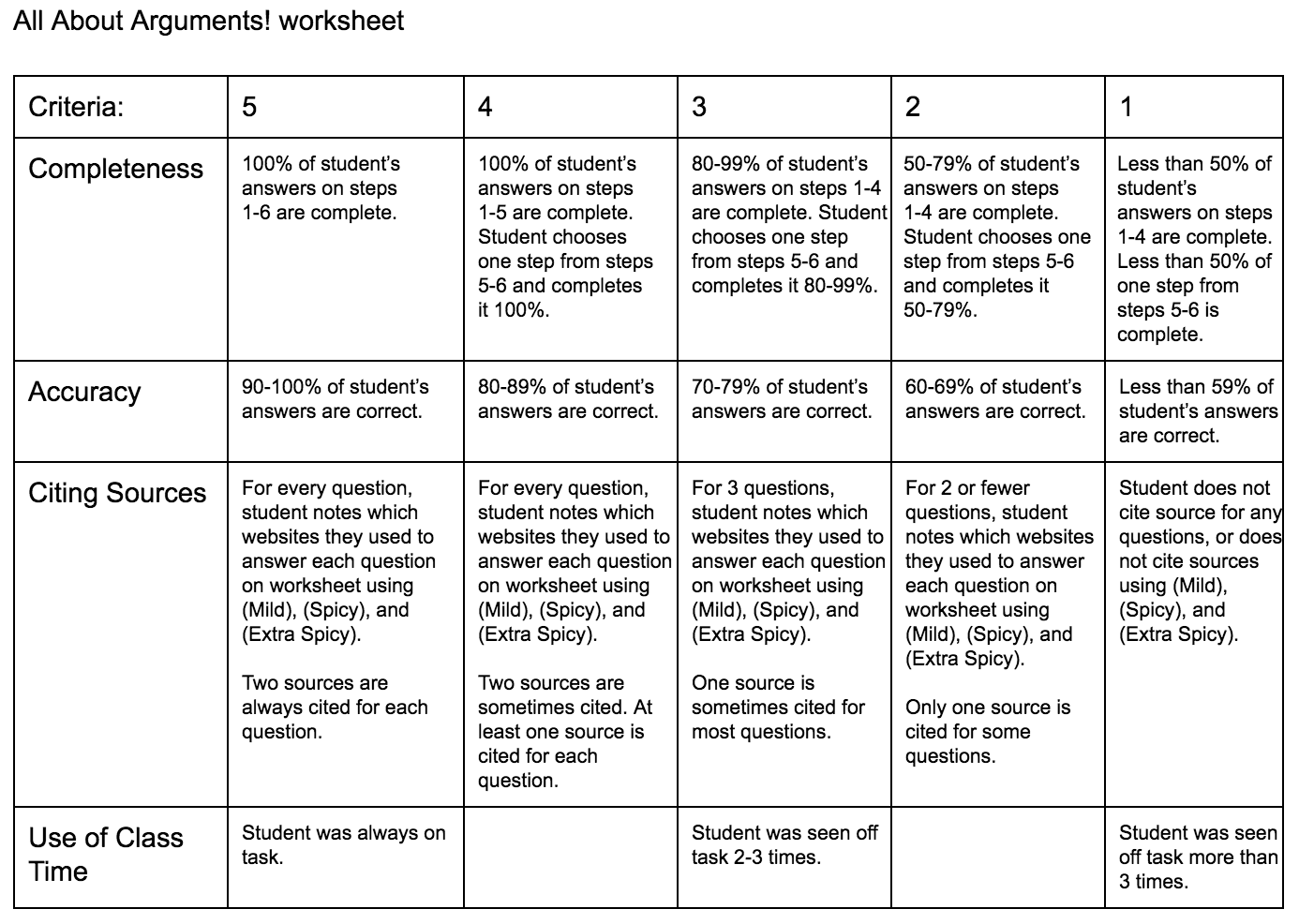
Use the graphic organizer handout to help you remember the knowledge you've gained on this WebQuest! Everyone must complete steps 1-4. Everyone must also choose to complete at least one step from steps 5-6. Finally, everyone must complete step 7.
1. ELEMENTS OF AN ARGUMENT
Learn about the essential elements of an argument from at least two of the links in this section. As you fill out the worksheet, cite the sources from where you got your information as (Mild), (Spicy), and (Extra Spicy).
Mild: https://www.mesacc.edu/~paoih30491/ArgumentsPapa.html
Spicy: http://grammar.ccc.commnet.edu/GRAMMAR/composition/argument.htm
Extra Spicy: http://writingcenter.fas.harvard.edu/pages/counter-argument
2. DEVELOPING AN ARGUMENT
Then, visit at least two of the links in this section to learn how to develop your position into claims. As you fill out the worksheet, cite the sources from where you got your information as (Mild), (Spicy), and (Extra Spicy).
Mild: https://www.mesacc.edu/~paoih30491/HowtoCreateanEffectiveArgument.html
Spicy: http://library.bcu.ac.uk/learner/writingguides/1.15.htm
Extra Spicy: https://owl.english.purdue.edu/owl/resource/659/02/
3. ORGANIZING AN ARGUMENT ESSAY
Learn about organizing your claims into an argument essay from at least two of the links in this section. As you fill out the worksheet, cite the sources from where you got your information as (Mild), (Spicy), and (Extra Spicy).
Mild: https://www.mesacc.edu/~paoih30491/ArgumentsOutline.html
Spicy: http://universitycollege.illinoisstate.edu/downloads/elements_argumentative_essay.pdf
Extra Spicy: https://owl.english.purdue.edu/owl/resource/588/03/
4. THE MODES OF PERSUASION
Visit the following website and watch the youtube video to learn about the three modes of persuasion. Fill out the worksheet, giving definitions for logos, ethos, and pathos.
https://owl.english.purdue.edu/owl/resource/588/04/
[video: https://youtu.be/oKtQEnERhSY width:640px height:360px]
-- Complete at least one of the following steps. Each step is a jumpstart to a lesson we'll have later this week. Complete both steps for full credit! --
5. LOGICAL AND FALLACIOUS CLAIMS
Visit the following websites to learn about different types of fallacious claims:
(1) https://www.mesacc.edu/~paoih30491/ArgumentsFallaciesQ.html
(2) http://grammar.ccc.commnet.edu/GRAMMAR/composition/argument_logic.htm
(3) https://owl.english.purdue.edu/owl/resource/588/04/
5a. Fill in the three blanks under #5 with three types of fallacious claims. Cite your sources here as (1) or (2)
5b. Then, write an example of each type of fallacious claim! Don't use the ones on the website-- it can be your own, or you can find a real world example using a web search! Be sure to cite your source.
6. WRITING AN ARGUMENTATIVE THESIS
Visit the following websites for a refresher about how claims are connected to the thesis:
(1) https://www.mesacc.edu/~paoih30491/ArgumentClaims.html
(2) https://owl.english.purdue.edu/owl/resource/588/1/
6a. Fill in the blanks under #6.
6b. If you're still stuck, visit the following website to see one way to put your thesis together. If you use this website to write your thesis, cite your source as (Thesis Builder):
http://www.tommarch.com/electraguide/thesis.php
Everyone must complete step 7!
7. DEVELOPING YOUR OWN ARGUMENT
7a. Visit The New York Times' 301 Prompts for Argumentative Writing and find a prompt/issue that interests you. Read it all the way through.
7b. Use your opinion on that issue to develop an argument. Refer back to your graphic organizer steps 1 and 2 if you need help!
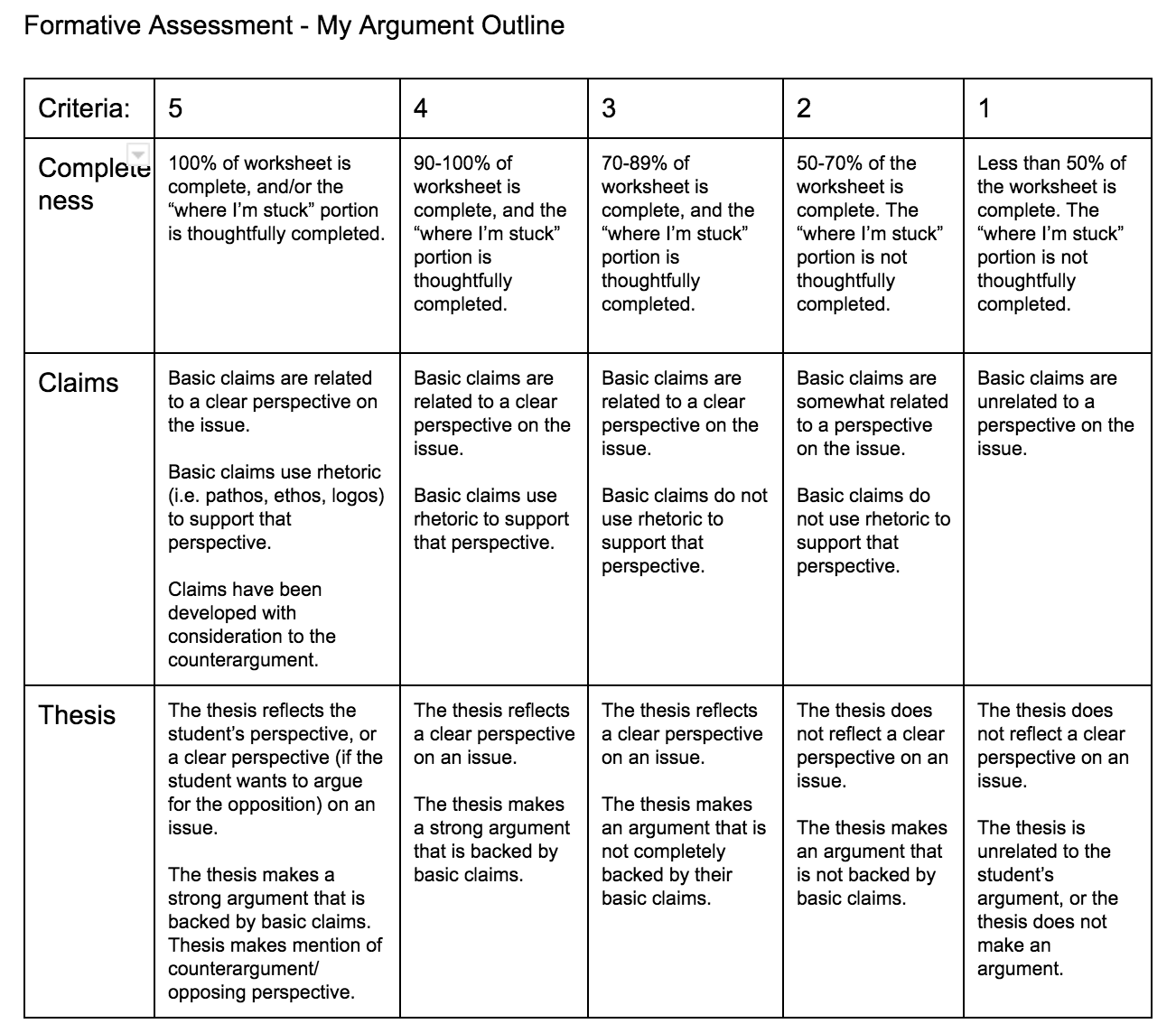
7c. Fill in the My Argument Outline worksheet. If you're having trouble writing a thesis, refer to step 5.
Once you're finished, please hand in your worksheets to me. If you cannot hand in your worksheets, the remaining work should be completed before tomorrow's class! :)
Evaluation
Conclusion
Congratulations! You have finished the "All About Arguments" WebQuest, and should have a good understanding of argument elements, development, and essay organization. You should also have two complete handouts: a Arguments graphic organizer, and a My Argument Outline worksheet.
Please make sure you have turned in your worksheets to me at the end of class-- if you are not finished, please complete it for homework and turn it into me at the start of class tomorrow.
Credits
- Calvin and Hobbes 'Argument' clipart: http://www.clipartkid.com/why-i-let-my-students-argue-for-their-grades-…
- Evaluation Rubric inspired by and adapted from: http://study.com/academy/lesson/webquest-rubric.html

Teacher Page
Teachers,
Find links to the two handouts here (read-only Google Docs, my intellectual property but free for you to use with credit):
1. All About Arguments! Graphic Organizer
These forms can be printed and used in class, or used digitally with Google Classroom, Email, etc.