
Introduction
Aboriginal and Torres Strait Islander Peoples have lived in Australia for tens of thousands of years and experiences can be viewed through historical, social and political lenses.
Background information:
As a class we have looked at how Aboriginal life is uniquely expressed and we have looked at the many language groups that exist. Aboriginal and Torres Strait Islander peoples were greatly impacted by white settlement in the 18th century and this task will allow you to examine their experiences from different perspectives:
- Historical
- Social
- Political
It is important that we understand the impact white settlement has had on Aboriginal culture so that we can develop understanding and respect for the hardships Aboriginal and Torres Strait Islanders have faced.
**Note: This webquest may contain images of Aboriginal people who have passed away which may cause distress and/or sadness to Aboriginal and Torres Strait Islanders**
Task
Within this webquest you will be completing a number of different activities. Each activity will allow you to develop a deeper understanding about the Aboriginal peoples in relation to their persepctives on the historical, political and social experiences.
The activities you will complete include:
- Acrostic Poem
- Poster
- Journal Entry
- Quiz (extension activity)
These activities can be completed in any order, they must be finished at the end of 3 lessons.
Process
ACTIVITY 1:Historical Lense
Read the following extracts and write an acrostic poem for Aboriginal that describes their history.
A
B
O
R
I
G
I
N
A
L
If it wasn’t for the footprints…
If it wasn't for the footprints, we would not know about 'before',
And Australia's history we have today would not make sense anymore.
If it wasn't for the footsteps, which created the path we share,
Our survival in this landscape would lead us to nowhere.
If it wasn't for the footpaths still here from that long ago,
Our heritage in writing would only reflect our woes.
If it wasn't for the footprints which were made into the sand,
The ones left by ancestors, our Aboriginal clans;
If it wasn't for their footsteps which carved the land and lore,
Australians would not know about these footprints from 'before'.
Poem by Z Quakawoot
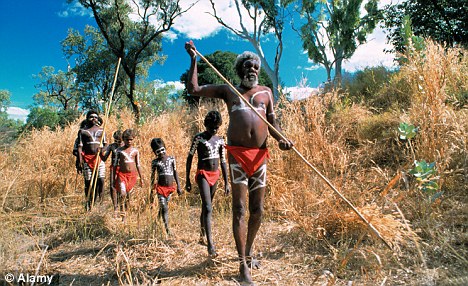
Extract from: Going bush with Catherine Freeman and Deborah Mailman
The Dreaming: Spiritual Links to the Land
Aboriginal Australia has its roots in the Dreaming, when ancestral spirit beings travelled across the country creating humanity and the natural environment, customs and laws, songs and stories. As the Dreaming ancestors travelled, they sang into creation rocks, mountains, trees and rivers. The ancestor spirits cried and made natural springs from their tears. They took the form of humans and animals and travelled everywhere, entering the earth and sculpting the landscape, creating natural features we see today.
The great snake travelled all over the land, forming great life-giving underground and inland rivers. As the great fish travelled to where the river meets the sea, it splashed the water and swished its huge tail making bends in the river. These Dreaming stories crisscross every part of this country in a web of ‘songlines’.
Just as hundreds of different Aboriginal languages were spoken across Australia, there were also hundreds of different Aboriginal cultures and spiritual beliefs. However, all Aboriginal people have a common belief in the Dreaming/Creation. They believe they are descended from the creator beings of the Dreaming and that their ancestors teach them about the unity they share with all things in the natural world. In Aboriginal spirituality all animals and plants are equal. Humankind is just one part of the overall cycle of life. For indigenous Australians, the Dreaming is continuous time – past, present and future – not a time in the past.
Just as they care for members of family, indigenous Australians must also care for their ancestors dwelling in the land which is sacred. It carries footsteps of spirit ancestors who walked every part of it, laying tracks and spiritual songs. The land is sacred because the essence of Aboriginal spirituality lies in the earth. Spirit guides rest in mountains, in rocks, in rivers. Significant Dreaming places are sacred sites.
If the ancestors, whose creative powers influence all things, are disturbed, so is the cycle of life and natural order. Aboriginal Australians believe that destroying sacred sites disturbs their ancestors who will no longer protect or provide for the people. A damaged or destroyed sacred site may result in natural disaster. Sickness may afflict communities who have not fulfilled their cultural obligations as custodians. Indigenous Australians believe that neglect
of their spiritual and cultural obligations brings disharmony to the country and community.
For Aboriginal Australians, the idea of the land being terra nullius, or a vast empty space across which people wander, is a myth. They know the land intimately. Every rock and river has a name and is remembered in the Dreaming, as it is remembered today. To own land as a piece of real estate, as ‘property’, is an idea remote to indigenous people. Their relationship to the land is much more complex. Aboriginal ownership rests in a group of people, and the owned object is not seen as a commodity that can be traded or sold. The role of indigenous Australians is that of traditional owner and custodian of the land, and carries with it both rights and responsibilities.
The land and everything in it must be protected and sustained; for example, there may be a particular obligation not to kill females of a certain animal species, in order to preserve the species. When traditional custodians approach their country they communicate with its spirit ancestors telling them who they are and introducing anyone they have brought with them. When the people take food from the land, they give thanks to the ancestors. Nothing is taken for granted – not even the next meal. Boundaries between different Aboriginal clans or nations are not straight lines but may be footsteps and tracks of ancestors or marked by bends in the creek or river, the rain shadow, trees and rocks. Different Aboriginal peoples shared some regions while others were restricted. Aboriginal Australians always seek permission from the spirit world for their actions, for instance, they seek permission to travel across the country.
Aboriginal laws, spiritual beliefs, rights and responsibilities are not written down but passed from one generation to the next through dances, songs, stories, dreams and paintings. These are a record of their culture, their history, their laws, and lay a path to follow. Singing of songs ensures continuity of life, abundance and harmony.
Ceremonies integrate song, dance, art and mime. The best dancers and singers become ancestral beings and re-enact activities of the ancestors. Ceremonies honour and celebrate the ancestors and the Dreaming, offering opportunities to maintain and protect their spirit places. Ceremonies regenerate Aboriginal communities, acting as reminders of their roots and expected behaviours as set down in law by the ancestors. Ceremonies provide a forum for settling disputes that may arise over land, marriages, hunting and gathering rights, and a whole range of community conflicts. Ceremonies are also a celebration for the renewal of life, and the changing seasons.
Aboriginal law and spirituality is a layered system of knowledge. Some knowledge can be made public, while other layers of information and knowledge are secret and sacred. Men and women initiated in ceremonies, or those who have had knowledge passed directly to them, keep sacred knowledge. Some men’s ceremonial business is never revealed to women, and some ceremonial business of women’s law is never revealed to men or to the public. Secrecy provides a means of protecting and maintaining knowledge of the law and spirituality in a respectful way in accordance with Aboriginal protocols.
In Aboriginal eyes, law, culture, spirituality and the land are seen as one. Spirituality comes from the Dreaming ancestors whose spirits are alive in the land. Their spirituality was sung to them in the Dreaming and is still sung across the country today, by ancestors, with the rising of the sun. Law, culture and spirituality that is sung is alive in all things. Aboriginal spirituality, land, life, and laws, are all interconnected: all is one and one is all.
From Going bush – adventures across Indigenous Australia, with Catherine Freeman and Deborah Mailman, pp 16 – 19 (abridged), Lonely Planet Publications, Melbourne, 2006.
Below are links to the dreaming stories:
- https://www.youtube.com/watch?v=Sle62XV0BO0
- https://www.youtube.com/watch?v=0y3Ta5xcKV4
- https://www.youtube.com/watch?v=cLktDAY-bz0
ACTIVITY 2: Political Lense
- Watch the link provided individually using headphones http://www.abc.net.au/btn/story/s3744556.htm
- Visit the Aboriginal timeline- (focus on the dates 1914, 1939 & 1942)
http://www.creativespirits.info/aboriginalculture/history/aboriginal-hi…
Create a poster about the change in attitudes towards Aboriginal and Torres Strait Islander peoples.
- How has white Australian perspectives changed over time?
- Describe how Aboriginal people were treated as soldiers in the war.
Useful resources
- http://www.alrc.gov.au/publications/3.%20Aboriginal%20Societies%3A%20Th…
- http://www.australia.gov.au/about-australia/australian-story/austn-indi…
- http://www.abc.net.au/btn/story/s3744556.htm
ACTIVITY 3: Social Lense
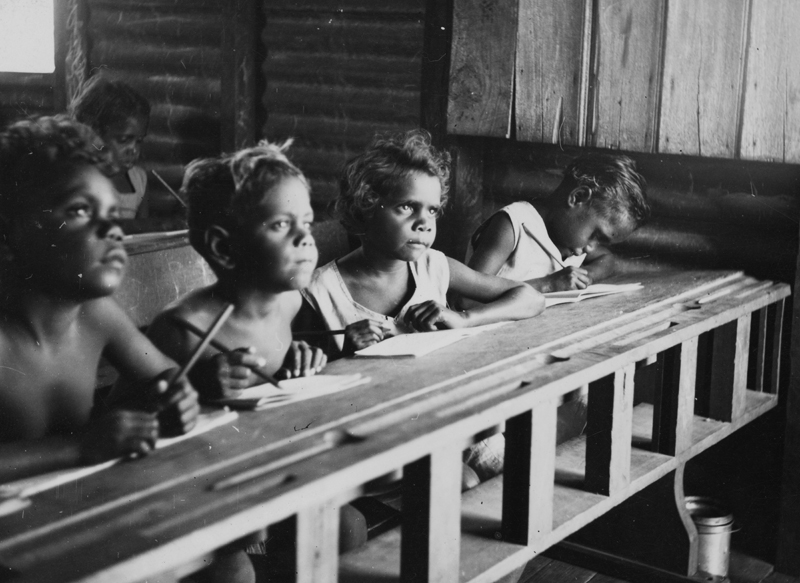
Due to the white settlement, the Aboriginal people had to adjust their whole lives to fit into the new community. This white settlement caused many problems for the Aboriginal people and affect their lives in many ways. Similar to the book we read 'Djarmbi: The Different Kookaburra', the Aboriginal people did not fit in either.
Go to this link:
http://www.creativespirits.info/aboriginalculture/people/aboriginal-com…;
Now that you have some knowledge about what happened to the Aboriginal people during the time of white settlement, I want you to write a journal entry from the persepctive of an Aboriginal person. You may choose to be an elder, a young child or a parent.
You must include:
- What happened to you and/or your family
- How you had to change your life to fit in with the white people
- What issues affected you and your community
- How you felt about all these changes happening
Write a draft of a minimum 1A4 page. Once they have been checked you will then publish your work onto the computer and print them out to place around the room.
EXTENSTION ACTIVITY: Aboriginal Australia Quiz 
Go to the link below and do the quiz. After you find out what ones you got wrong, research the correct answers.
http://www.creativespirits.info/aboriginalculture/aboriginal-australia-…
Evaluation
Sharing and Evaluating
In small groups students will share their new findings with their peers. Students will be seated in a circle and will take turns to share their responses.This discussion time will allow students to clarify key concepts and also allows students to share the information they discovered.
Students may ask questions such as:
- What area did you find most interesting during the webquest and why?
- Has your attitude towards Aboriginal and Torres Strait Islander's changed after learning more information about their experiences?
- How has the treatment of Aboriginal peoples changed since the time of white settlement?
- Is there a particular area which you would like to dicscover more why/why not?
- What was an interesting fact you learnt whilst completeing the webquest?
Conclusion
Whole Class Activity
Students will gather as a class in front of the IWB. The teacher will have 3 blank slides prepared for each of the lenses political, social and historical. Students will take turns to write their answers on the board for each lens. Students should be prepared to have at least one answer for each and will be called upon to share their understandings with the class.
| Political | Social |
Historical |
*The teacher can use this time to write down anecdotal notes and also use the information to guide future programming for the students*
(Allow 10 mins for this activity)