
Introduction
In this WebQuest students will investigate how extreme weather events driven by Climate Change impact ecosystems and biodiversity. They will analyze the interconnectedness of the natural environment and explore nature-based solutions that can help address these challenges.
Task
By the end of this Webquest students will:
- Identify various types of extreme weather events caused by Climate Change.
- Describe the concept of biodiversity and its importance for ecosystem health and stability.
- Analyze the ways climate change affects biodiversity within various ecosystems.
- Conduct research using provided and additional resources to gather information on the impact of climate change on biodiversity.
- Synthesize research findings into a creative and informative poster or infographic.
- Reflect and comment on the use of nature-based as a solution to Climate Change.
Process
Step 1: Discover Extreme Weather Events Caused by Climate Change
As the Earth's climate changes, extreme weather events such as record-breaking heat waves, torrential rains, severe floods, prolonged droughts, extreme wildfires, and hurricanes are becoming more frequent and intense.
Visit the Genially presentation on the effects of extreme weather events and complete the quiz included within it:
Useful link:
https://www.bbc.com/news/science-environment-58073295
Step 2: Examine Ecosystems and Biodiversity
Ecosystems are networks of living organisms, including plants, animals and microorganisms, that interact with each other and their physical surroundings. They can vary in size, ranging from large ecosystems like the Amazon Rainforest, to small ones such as a single fallen tree. Ecosystems can overlap or be components of larger ecosystems, and these interconnections make them interdependent, not just reliant on the organisms within them.
Biodiversity is the name given to the variety of ecosystems, species and genes in the world. Humans rely on ecosystems for various resources, including food, water, clean air, building materials, and recreational opportunities.
Biodiversity is essential to all ecosystems' existence and proper functioning. When an ecosystem loses biodiversity, it doesn’t function as well. So, scientists often look at how complete an ecosystem’s biodiversity is to measure the ecosystem’s health.
In the following Mentimeter link https://www.menti.com/alyj75u62zn5 observe the variety of plant and animal life and comment on it’s health (photo retrieved from https://tualatinswcd.org/what-is-biodiversity-and-why-does-it-matter-fo…)
Useful links:
https://tualatinswcd.org/what-is-biodiversity-and-why-does-it-matter-for-you/
https://youmatter.world/en/definitions/ecosystem-definition-example/
Step 3: Investigate the Impact of Climate Change on Biodiversity
Climate change significantly threatens biodiversity by affecting ecosystems and species in various ways.
Using the provided 'useful links' and their own web research, students address the question: ‘In what specific ways does climate change alter biodiversity within various ecosystems?’ Then, create a poster or infographic about the impacts of climate change on biodiversity and add their work to the following Padlet:
https://padlet.com/meddiet4health/impacts-of-climate-change-on-biodiversity-z46ptpi69blvibwp
Useful links:
https://www.epa.gov/climateimpacts/climate-change-impacts-ecosystems
https://www.greenpeace.org.uk/challenges/wildlife-and-biodiversity/climate-change-biodiversity/
https://www.nhm.ac.uk/discover/how-are-climate-change-and-biodiversity-loss-linked.html
Step 4: Explore Nature-Based Solutions
Nature-based solutions involve actions to protect, sustainably manage, or restore natural ecosystems to address societal challenges, such as climate change, while providing human and biodiversity benefits.
Watch the video at the following link
video summary here: https://docs.google.com/document/d/1GEtYPtUhaTGYruGTdrauGbrwWEWsiWq3jx9kuubsHjs/edit?tab=t.0
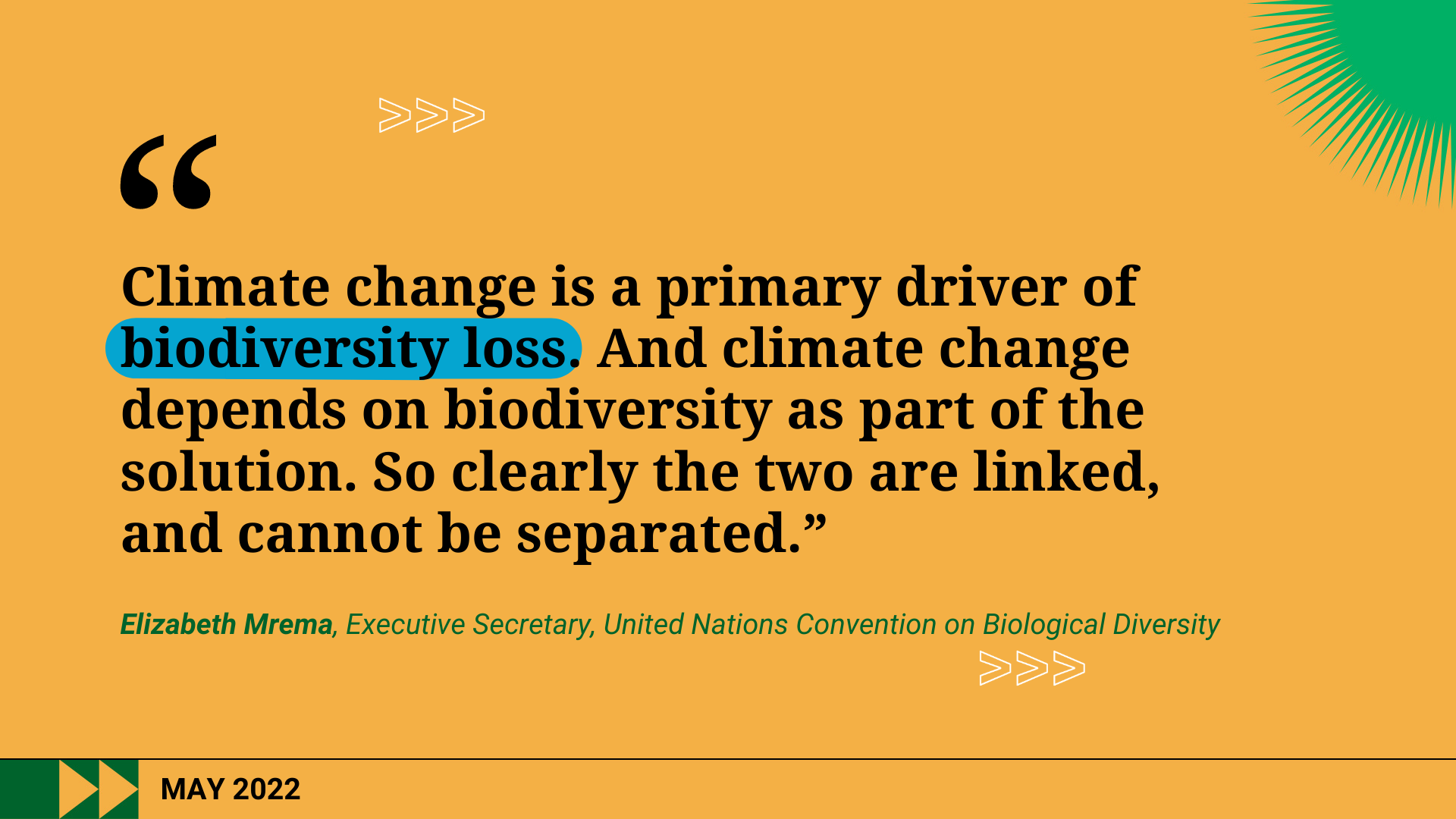
and comment on this Tricider https://www.tricider.com/brainstorming/3AY1B22wfS7 the following quote:
https://www.un.org/sites/un2.un.org/files/voices_of_change_video_slates.png
Useful links:
Evaluation
- Webquest evaluation: https://docs.google.com/forms/d/e/1FAIpQLSe94EvVK1XJsENM8asGTdQsd0pDf4zOuhLS9_R3bLEJjQFPsg/viewform?usp=sf_link
- Students evaluation: data collected from the quiz in genial.ly, the posters they create, their comments in tricider and also the following rubric:
| Criteria | Excellent | Good | Satisfactory | Needs Improvement | Unsatisfactory |
|---|---|---|---|---|---|
| Discover Extreme Weather Events Caused by Climate Change | Thoroughly explores and demonstrates deep understanding of the effects of extreme weather events caused by climate change. Provides insightful analysis and specific examples. | Explores the effects of extreme weather events caused by climate change and provides relevant examples. | Addresses the effects of extreme weather events caused by climate change, but analysis is limited or lacks specificity. | Superficial understanding of the effects of extreme weather events caused by climate change. Minimal examples provided. | Little to no understanding of the effects of extreme weather events caused by climate change. Lacks specific examples. |
| Examine Ecosystems and Biodiversity | Demonstrates a comprehensive understanding of ecosystems and biodiversity, including their interconnectedness and the impact of climate change. Provides detailed observations and insightful comments on the health of the observed ecosystem. | Demonstrates a good understanding of ecosystems and biodiversity, including the impact of climate change. Provides relevant observations and comments on the health of the observed ecosystem. | Addresses ecosystems and biodiversity, including the impact of climate change, but the understanding is somewhat limited. Observations and comments on the health of the observed ecosystem are basic. | Superficial understanding of ecosystems and biodiversity, including the impact of climate change. Observations and comments on the health of the observed ecosystem are limited or lacking. | Little to no understanding of ecosystems and biodiversity, including the impact of climate change. Fails to provide meaningful observations or comments on the health of the observed ecosystem. |
| Investigate the Impact of Climate Change on Biodiversity | Thoroughly investigates and demonstrates a deep understanding of the specific ways climate change alters biodiversity within various ecosystems. The poster/infographic is well-designed, informative, and effectively communicates the impacts. | Investigates the impact of climate change on biodiversity and provides relevant examples. The poster/infographic is well-designed and communicates the impacts effectively. | Addresses the impact of climate change on biodiversity, but the investigation and examples are somewhat limited. The poster/infographic is satisfactory but could be more informative or visually engaging. | Superficial understanding of the impact of climate change on biodiversity. The poster/infographic lacks depth and fails to effectively communicate the impacts. | Little to no understanding of the impact of climate change on biodiversity. The poster/infographic is poorly designed and does not communicate the impacts. |
| Explore Nature-Based Solutions | Demonstrates a comprehensive understanding of nature-based solutions, including their benefits, cost-efficiency, and the importance of co-creation and complementary approaches. Provides insightful comments and analysis on the provided quote. | Demonstrates a good understanding of nature-based solutions, including their benefits and the importance of co-creation and complementary approaches. Provides relevant comments and analysis on the provided quote. | Addresses nature-based solutions, but the understanding is somewhat limited. Comments and analysis on the provided quote are basic. | Superficial understanding of nature-based solutions. Comments and analysis on the provided quote are limited or lacking. | Little to no understanding of nature-based solutions. Fails to provide meaningful comments or analysis on the provided quote. |
| Overall Webquest Completion | Thoroughly completes all steps of the webquest, demonstrating a deep understanding of the topics and providing high-quality work. | Completes all steps of the webquest, demonstrating a good understanding of the topics and providing quality work. | Completes the webquest, but the understanding of the topics and/or the quality of work is somewhat limited. | Partially completes the webquest, with limited understanding of the topics and/or poor quality of work. | Fails to complete the webquest or demonstrates a lack of understanding of the topics and poor quality of work. |
Conclusion
Through this WebQuest, students have investigated the effects of climate change on our planet and explained how it intensifies extreme weather events such as heatwaves, floods, and wildfires. They have analyzed the role of ecosystems and biodiversity, recognized how climate change disrupts these systems, and identified the consequences of biodiversity loss. Their research and creative projects have illustrated concrete examples of these impacts, while their exploration of nature-based solutions has demonstrated how natural systems can support climate resilience, safeguard biodiversity and promote human well-being.
Credits
https://www.bbc.com/news/science-environment-58073295
https://tualatinswcd.org/what-is-biodiversity-and-why-does-it-matter-for-you/
https://youmatter.world/en/definitions/ecosystem-definition-example/
https://www.epa.gov/climateimpacts/climate-change-impacts-ecosystems
https://www.greenpeace.org.uk/challenges/wildlife-and-biodiversity/climate-change-biodiversity/
https://www.nhm.ac.uk/discover/how-are-climate-change-and-biodiversity-loss-linked.html
https://science.nasa.gov/climate-change/extreme-weather/
https://www.eea.europa.eu/themes/biodiversity/intro
https://tualatinswcd.org/what-is-biodiversity-and-why-does-it-matter-for-you/
https://www.green.earth/blog/the-importance-of-biodiversity-for-healthy-ecosystems-and-human-life
Teacher Page
This WebQuest was edited by a teacher of 2o Esperino EPAL Acharnon (Greece) as part of the activities of the "Mediterranean Diet for Overall Health" (MedDiet4Health) Erasmus+ project (Project number: 2023-2-EL01-KA210-VET-000183592).
Through this WebQuest, students in food technology vocational education will gain essential skills. They will understand the impact of climate change on agriculture and ecosystems, learning how extreme weather events affect food production. Students will enhance their research skills, critically analyze biodiversity changes, and evaluate nature-based solutions. Using digital tools like Genially, Mentimeter, and Padlet, they will collaborate, create presentations and communicate their findings effectively. Additionally, they will develop problem-solving skills by proposing sustainable solutions and reflect on the long-term effects of climate change on agriculture.
This WebQuest reflects only the author’s views. The European Commission’s support for the production of this WebQuest does not constitute an endorsement of the contents which reflects the views only of the authors, and the Commission cannot be held responsible for any use which may be made of the information contained therein.