
Introduction
In this WebQuest students explore traditional and modern farming practices,assess agriculture’s environmental impact through the ecological footprint and analyze how agriculture contributes to the Sustainable Development Goals (SDGs). This exploration will deepen your understanding of agriculture's crucial role in achieving a sustainable future.
Task
By the end of this WebQuest students will:
1. Explore Traditional and Modern Farming Practices
2. Assess Agricultural Environmental Impact by analyzing carbon, water and land footprints and compare these impacts across countries.
3. Discover how agriculture supports and influences the Sustainable Development Goals (SDGs) for a better future.
Process
STEP 1: Exploring Traditional and Modern Farming Practices
Agriculture, both an art and a science, involves cultivating land for crop production and raising livestock. It is a vital element of Food Systems, acting as the main source of food production.
Within agriculture, traditional and modern farming practices play significant roles. Traditional agriculture typically relies on time-tested methods such as crop rotation, organic fertilization and diverse planting, which can enhance soil health and sustainability. In contrast, modern agriculture often employs advanced technologies, chemical fertilizers and monoculture practices to increase efficiency and yield. Both approaches influence the food system by determining how food is grown, processed and distributed. Integrating sustainable practices from both traditional and modern agriculture can help create a more resilient and environmentally friendly food system.
- View the following presentation on ‘Traditional and Modern Farming Practices’ in Genial.ly and complete the accompanying quiz.https://view.genially.com/669bdb8bcc23945d0e338ead/presentation-traditional-and-modern-farming-practices
- Read the story of Anna, a 50-year-old farmer from a small Polish village, who operates a family-owned wheat farm using traditional methods. Discuss the environmental benefits and drawbacks of her traditional farming practices and explore possible improvements.https://padlet.com/meddiet4health/growing-wheat-with-traditional-practices-qmts22rjtw45cyme
STEP 2: Assessing Agricultural Environmental Impact
Agriculture significantly impacts the environment by consuming large amounts of fresh water, contributing to water stress and pollution, driving climate change with around one-quarter of global greenhouse gas emissions and using half of the world's habitable land.

https://ourworldindata.org/images/published/Global-land-use-breakdown_850.png
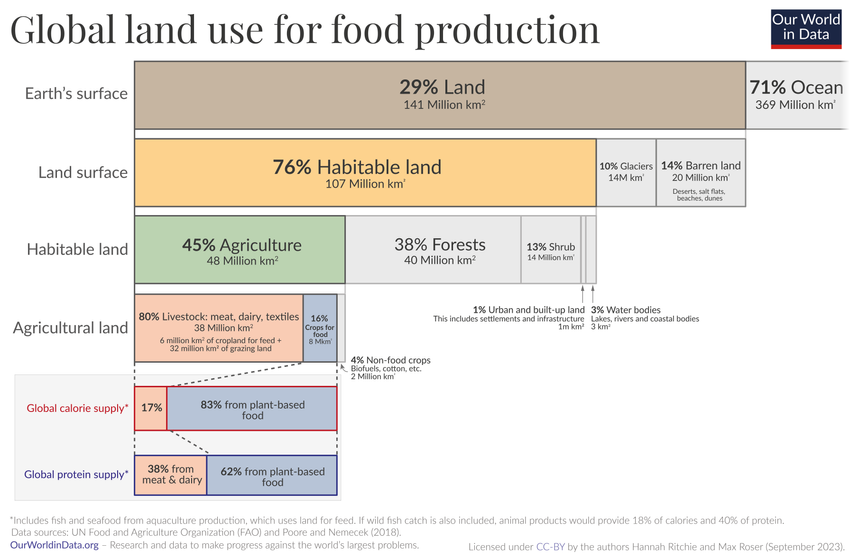
The ecological footprint measures the environmental impact of human activities by quantifying the land and water needed to produce resources and manage waste. It includes factors like carbon emissions, water use, and land use. Agriculture significantly contributes to the ecological footprint through its extensive use of natural resources and impact on ecosystems. Key components include carbon, water, and land footprints.
- The carbon footprint refers to the amount of greenhouse gases, primarily carbon dioxide, released into the atmosphere as a result of agricultural activities. Modern practices, with heavy fossil fuel use and synthetic inputs, have a higher carbon footprint, while traditional methods generally produce fewer emissions.
- The water footprint measures the total volume of fresh water used directly and indirectly by agricultural practices. Agriculture is a major consumer of water, especially through extensive irrigation systems in modern farming. This heavy reliance on irrigation can deplete water resources, particularly in arid regions and lead to water pollution from runoff containing fertilizers and pesticides. Traditional agriculture often uses rain-fed systems or small-scale irrigation, which are generally more sustainable but may face challenges in water-scarce areas.
- The land footprint indicates the amount of land required for agricultural activities. Agriculture occupies about half of the world’s habitable land, making it a significant driver of land use change. Traditional agricultural systems, which include diverse crops and livestock, can help maintain soil fertility and biodiversity. However, improper management can lead to deforestation and land degradation. Modern agriculture, characterized by monocropping and large-scale farming, often results in habitat destruction, loss of biodiversity, and soil erosion.
By adopting sustainable practices, reducing reliance on fossil fuels and implementing efficient resource management, the agricultural sector can minimize its environmental impact and contribute to a more sustainable future.
1. Students will be divided into three groups, each tasked with comparing the ecological footprint of two countries using the Global Footprint Network (https://data.footprintnetwork.org/#/compareCountries?type=EFCpc&cn=undefined&yr=2022):
- Group 1- Compare Slovakia and Turkey
- Group 2- Compare Greece and Slovakia
- Group 3- Compare Turkey and Greece
2. Each groups examines the carbon, water and land footprints of your assigned countries, making notes and taking screenshots as needed. Interact with your peers and agree on a common answer to the following questions:
- How did the ecological footprints of the two countries you compared vary regarding carbon, water, and land use? What were the most notable differences you found?
- What factors do you believe contribute to these differences? Consider elements such as agricultural practices, climate, and economic development.
Findings and common answers are uploaded to the following padlet https://padlet.com/meddiet4health/assessing-agricultural-environmental-impact-23h1jq7l8o8jirhc and presented in the classroom.
Useful links:
https://www.footprintnetwork.org/our-work/ecological-footprint/
Step 3: Mapping Agriculture's Impact on the Sustainable Development Goals (SDGs)
The Sustainable Development Goals (SDGs), established by the United Nations in 2015, aim to eradicate poverty, safeguard the environment, and promote global peace and prosperity by 2030. The 17 interconnected SDGs emphasize the importance of balanced progress across social, economic, and environmental aspects. Agriculture is crucial in this effort, impacting and supporting many of the SDGs.
Video summary: https://docs.google.com/document/d/1Awn3ZqR0Z3lUfIg5qTpOO9XwVkRAVDhQWI8Vu1DP8h8/edit?tab=t.0
Useful link: https://www.undp.org/sustainable-development-goals
- Teacher gives students access to the following Coggle map to enrich: https://coggle.it/diagram/YBaY_sDXIoSbfizv/t/sdgs-and-food-system/2850c9ab6394fc8a2851ae3286010512d758baf0fb62794decb2c75247d99ed6
- Students make online research for the SDGs and their relevance to agriculture, focusing on understanding how agriculture influences or supports each SDG.
- Students present the mindmap in the classroom
Evaluation
- Webquest evaluation: https://docs.google.com/forms/d/e/1FAIpQLSf1lACx4WoU8kf9dl_5_bLOh6DfKZ5TzmfQxzntP_fHcEf0GQ/viewform?usp=sf_link
- Students evaluation: dat collected from the quiz on genial.ly, discussion on the environmental benefits and drawbacks of her traditional farming practices on Padlet, comparing the ecological footprint on padlet, coggle map about SDG's and their relevance to agriculture and also the following rubric:
|
Criteria |
5 - Excellent |
4 - Proficient |
3 - Satisfactory |
2 - Needs Improvement |
1 - Unsatisfactory |
|
Exploration of Traditional and Modern Farming Practices |
Provides thorough and insightful explanations of both traditional and modern practices, including benefits, drawbacks, and integration for sustainability. Uses specific examples from resources. |
Explains traditional and modern practices clearly with some examples; identifies benefits and drawbacks. |
Describes traditional and modern practices with basic understanding; limited examples or details. |
Provides incomplete or unclear descriptions; few or inaccurate examples; minimal understanding of impact. |
Fails to describe farming practices accurately; no examples or misconceptions evident. |
|
Assessment of Agricultural Environmental Impact |
Accurately analyzes carbon, water, and land footprints with detailed comparisons between assigned countries; identifies key factors influencing differences with strong evidence. |
Analyzes carbon, water, and land footprints with clear comparisons; identifies most contributing factors. |
Provides general analysis of footprints; comparisons lack depth; factors influencing differences somewhat identified. |
Attempts analysis but lacks clarity or accuracy; comparisons superficial; factors not well supported. |
No meaningful analysis or comparison; fails to identify relevant environmental impacts or factors. |
|
Group Presentation and Collaboration |
Presentation is well-organized, engaging, and incorporates peer interaction effectively; group demonstrates consensus and clear communication of findings. |
Presentation is organized and clear; group collaborates well with some peer interaction; findings mostly agreed upon. |
Presentation communicates basic findings; group collaboration evident but uneven; limited peer interaction. |
Presentation lacks organization or clarity; group collaboration minimal; little peer interaction. |
Presentation incomplete or disorganized; no evidence of group collaboration or peer engagement. |
|
Connection to Sustainable Development Goals (SDGs) |
Demonstrates deep understanding of how agriculture supports multiple SDGs; mindmap is detailed, well-researched, and clearly presented. |
Shows clear understanding of agriculture’s link to SDGs; mindmap includes relevant information and is presented adequately. |
Provides basic connections between agriculture and SDGs; mindmap is somewhat complete but lacks detail. |
Shows limited understanding of SDG links; mindmap incomplete or poorly organized; presentation unclear. |
Fails to connect agriculture to SDGs; mindmap missing or irrelevant; no clear presentation. |
|
Use of Resources and Research Quality |
Effectively integrates multiple credible sources; uses data, screenshots, and references accurately to support all sections of the webquest. |
Uses credible sources with some integration of data and references; mostly supports webquest content. |
Uses some sources with occasional inaccuracies; limited use of data or references; basic support provided. |
Uses few or questionable sources; data and references are minimal or incorrectly used; weak support. |
Does not use credible sources; no data or references; unsupported or inaccurate content throughout. |
Conclusion
In this webquest, students explored how traditional and modern farming practices affect the environment and contribute to the ecological footprint. They compared carbon, water and land impacts across different countries and connected agriculture to the Sustainable Development Goals (SDGs). This WebQuest highlighted the importance of sustainable agricultural practices in addressing global challenges like climate change, water use, and food security.
Credits
https://www.youtube.com/watch?v=0XTBYMfZyrM
https://agrierp.com/blog/types-of-agriculture/
https://issuu.com/noamanafzal/docs/traditional_and_modern_agriculture-exploring_the_d/s/22881891
https://www.krmangalam.edu.in/difference-between-modern-farming-and-traditional-farming/
https://orgprints.org/id/eprint/43280/1/sabir-etal-2021-Rural21-No2-p27-29.pdf
https://orgprints.org/id/eprint/43280/1/sabir-etal-2021-Rural21-No2-p27-29.pdf
https://ourworldindata.org/images/published/Global-land-use-breakdown_850.png
https://www.undp.org/sustainable-development-goals
Teacher Page
This WebQuest was edited by a teacher of 2o Esperino EPAL Acharnon (Greece) as part of the activities of the "Mediterranean Diet for Overall Health" (MedDiet4Health) Erasmus+ project (Project number: 2023-2-EL01-KA210-VET-000183592).
It contributes to the Vocational Education of students studying Food Technology by providing a comprehensive understanding of agricultural practices and their environmental impact. Through exploring traditional and modern farming methods, students gain insights into sustainable agriculture, which is critical for food production. Assessing the ecological footprint of agriculture teaches students about resource management and environmental conservation. Finally, mapping agriculture's impact on the Sustainable Development Goals (SDGs) connects their studies to global efforts in sustainability, preparing them for future roles in creating a more resilient and sustainable food system.
This WebQuest reflects only the author’s views. The European Commission’s support for the production of this WebQuest does not constitute an endorsement of the contents which reflects the views only of the authors, and the Commission cannot be held responsible for any use which may be made of the information contained therein.