
Introduction
- Building Bridges Webquest.

At some point in your lives either walked, driven or ridden over a bridge in Calgary. When hiking in the mountains have you ever laid a log or plank accross a stream or pond to stop getting wet? If so then you've even constructed a bridge!
A bridge provides passage over some sort of obstacle: a river, a valley, a road, a set of railroad tracks, and more.
Bridges in Calgary and around the world come in different shapes and sizes.
When designing and building a bridge, engineers need consider many factors such as:
- Where will the bridge be built - over water or land? - The Envirnonment
- What kind of materials will be used to create the bridge, and how will the material choice affect the bridge's strength or weakness?
- Will the bridge be long or short?
BRIDGE FAILURES:
If bridges are not designed correctly they can collapse and injure people who use them, so when creating a bridge a lot of time is spent on designing and then testing the materials before the bridge is complete and open. Look at this page http://www.pbs.org/wgbh/nova/tech/bridge-collapse.html for information on some famous bridge designing mistakes.
CALGARY THE $6 MILLION MISTAKE CAUSED BY 11 CENTIMETERS!
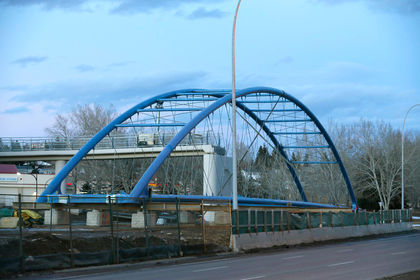
Do you live in NW Calgary? Then you may have seen this feature sitting on the side of the road.
Read this article to find out how important inches and centimeters are in bridge design. Always remember to "measure twice and cut once"
http://calgaryherald.com/news/local-news/shaganappi-bridge-delay
Sometimes, mother nature takes an upper hand and causes bridges to fail due to it's immense forces. Take for example the pedestrian bridge in Calgary that crosses the Elbow River that got washed away by the 2013 floods.
Task

The Task
The Mayor of Calgary needs your help!
Two bridges have collapsed in and around Calgary due to the historic flood of 2013.

You have been hired as the Constructional Engineers to work in groups and design and create prototype for a bridge that best suits the needs of the City of Calgary.
You will be assigned to groups to complete this webquest. You will explore various webpages to get information about different types of bridges.
As you do your research consider these questions:
What Engineering techniques are used to build the bridges?
What are the strengths and weaknesses of each bridge?
What forces act upon the bridges?
Experiment with Bridge Building.
In doing your research you will use this document to record your findings and observations https://sites.google.com/site/schellenbergjason/BLM.pdf
With your research and knowledge you will design and construct a bridge. Each group's bridge will then be tested for strength using pennies. Each group will present their findings in class.
Process

The Process
Each Group will be assigned a bridge to rebuild either A or B. Your teacher will assign you to the groups. You will document your research, then draw a design with clear labels and and the build a bridge using the list of materials provided. Once built your bridge will undergo a strength test with pennies and then your group will present their bridge and research to the Mayor (Your teacher).
GROUP A:
Bridge Details:
Length of Bridge: 90 feet (short)
Crossing: Elbow River (narrow)
Connects what: Small walking path
You will build a bridge for walkers, bikers, and rollerbladers. We need a bridge that is simple, and easy to build. This bridge is short and must be strong enough to withstand flooding.
GROUP B
Bridge Details
Length of Bridge: 300m
Crossing: Bow River (wide)
Connects: two land masses
You will build a bridge that can hold railway tracks for long large volume moving trains. The bridge must be strong enough to withstand heavy moving water and ice as well as a strong support to hold the weight of heavy railcars.
RESEARCH TYPES OF BRIDGES AND THEIR FUNCTIONS - use these websites to help you:
1. Learn the different Types of Bridges and their characteristics at this website:
http://www.pbs.org/wgbh/nova/tech/build-bridge-p1.html
2. Learn about the basics of building the different bridges at this website:
http://www.pbs.org/wgbh/buildingbig/bridge/basics.html
3. It is important to know how geometry and shapes help in bridge building. These websites can tell you more about squares, rectangles and triangles, click to find out!
http://www.faculty.fairfield.edu/jmac/rs/bridges.htm
http://www.pbs.org/wgbh/buildingbig/lab/shapes.html
4. What are the forces (bending, twisting, pulling) that act on a bridge and why would they fail? Find out how to prevent your bridge from collapsing on you by learning more at:
http://www.pbs.org/wgbh/buildingbig/lab/forces.html
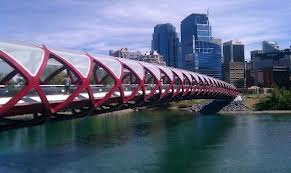
PEACE BRIDGE CALGARY:
How design can create art.
Peace bridge was built around a lot of controversay. Now it is a city icon.
See the adverts:
http://calgaryherald.com/news/local-news/peace-bridge-travel-alberta
This is a good example of how vision and ideas can win over even your harshest critics. So be bold Engineers and create a masterpiece!
INSTRUCTIONS FOR GROUP A and GROUP B
Engineers, using the researched designs, construct a bridge in your group, that will suit your purposes and support the most mass and will span a gap of 30cm.
Materials Needed
Cardboard variety of paper sizes and strengths
Paper rolls variety of cardboard boxes
Straws pipecleaners
Paper clips plasticine
Toothpicks popsicle sticks
Milk cartons thick string
Masking tape glue
Scissors rule (to measure gap)
Masses: (soup cans, bags of rocks, sand, milk cartons filled with water, sand, etc.)
Documentation and analysis research paper (As refered to in the Task section)
Evaluation

Evalutation!
Hurrah! You have made your bridge, but does it withstand the pennies test? Will hold the most pennies?
This is the criteria you will be graded on:
| Category | 1 | 2 | 3 | 4 | Score |
| Group Work | Did not participate at all and did not share in ideas | Had difficulty participating in the team. Shared little or no ideas . | Worked well with the group most of the time. Shared some ideas with students. | Worked well in a group all of the time.. Shared ideas with others in the team. | |
| Documentation and Journal Work | No research completed, and no supporting diagarm | Had difficulty and did little reasearch. Diagaram that is not clear or well labelled | Showed some effort in research. A diagram with some labeling | Showed good research with good grammer and diagram with proper labelling. | |
| Construction Materials used and bridge design | Structure created haphazardly and did not follow plans accurately. No effort taken and does not pass weight test. | Structure is sloppy in its design, does not follow the design accurately. Does not meet with the weight test | Structure follows plans to some extent. Is presentable with some parts missing. May or may not pass weight test. | Structure is attractive, neatly made and follows plans. Structure passes the weight test. | |
| Presentation to class | Group did not work together to present the idea well. Non coherent and what was present did not match the plans | Some group members participated. Some relation to planning but could not explain bridge design well | Most members worked well in presentation. Used research and documentation to support their bridge design and could relate many bridge building concepts. | Group worked well together to present the idea. Report matched the presentation and could related research and documentation to final project |
Conclusion
YAHOO!
Well done Engineers! You have successfully accomplished a lot of tasks. You have learnt how to work in a group, how to research information using the internet. Using the required documents you have created a plan with diagaram and made notes on the important parts of your bridge. In you journey of learning you have learnt how maths, measurements, mother nature and designs all play a vital role in bridge design.
You have also learnt the importance of speaking with confidence and conviction when presenting your ideas!
Good Job!
Credits
Credits and Acknowledgement of my Sources:
The following sources including the internet and other webquests helped me create my webquest:
Edmonton Public Schools (1996) / Topic B - Building With a Variety of Materials / Grade 3
http://questgarden.com/84/69/1/090709085321/process.htm
https://sites.google.com/site/schellenbergjason/conclusion
Google.com for the bridge images used in this webquest
http://ake.epsb.ca/bridges/experiment1.htm
Teacher Page
Grade 3 – Topic B: Building with a variety of Materials
General Learner Outcomes
Students will:
3-6 Use, safely, a variety of tools, techniques and materials in construction activities.
3-7 Construct structures, using a variety of materials and designs, and compare the effectiveness of the various materials and designs for their intended purposes.
Specific Learner Outcomes:
SLE 1: Using a variety of materials and techniques, design, construct, and test structures that are intended to:
Span gaps
SLE 2; Select appropriate materials for use in construction tasks, and explain the choice of materials. Students should demonstrate familiarity with a variety of materials, such as papers, wood, plastic, clay and metals.
SLE 3: Select tools that are suitable to particular tasks and materials, and use them safely and effectively.
SLE 4: Understand and use a variety of methods to join or fasten materials.
SLE 5: Identify the intended purpose and use of structures to be built, and explain knowing the intended purpose and use helps guide decisions regarding materials and design.
SLE 6: Understand that simple designs are often as effective as more complex ones, as well as being easier and cheaper to build, and illustrate this understanding with a practical example.
SLE 7: Recognize the importance of good workmanship, and demonstrate growth toward good workmanship.
SLE 8: Maintain and store materials and tools safely and properly.
SLE 9: Apply skills of listening, speaking and cooperative decision making in working with other students on construction project.
SLE 2 to 9 are ongoing throughout all activities in this unit.
This activity requires students to design, construct and test structures that are intended to span gaps.
References
This page was constructed extensively using materials from:
Edmonton Public Schools (1996) / Topic B - Building With a Variety of Materials / Grade 3