
Introduction
The Introduction
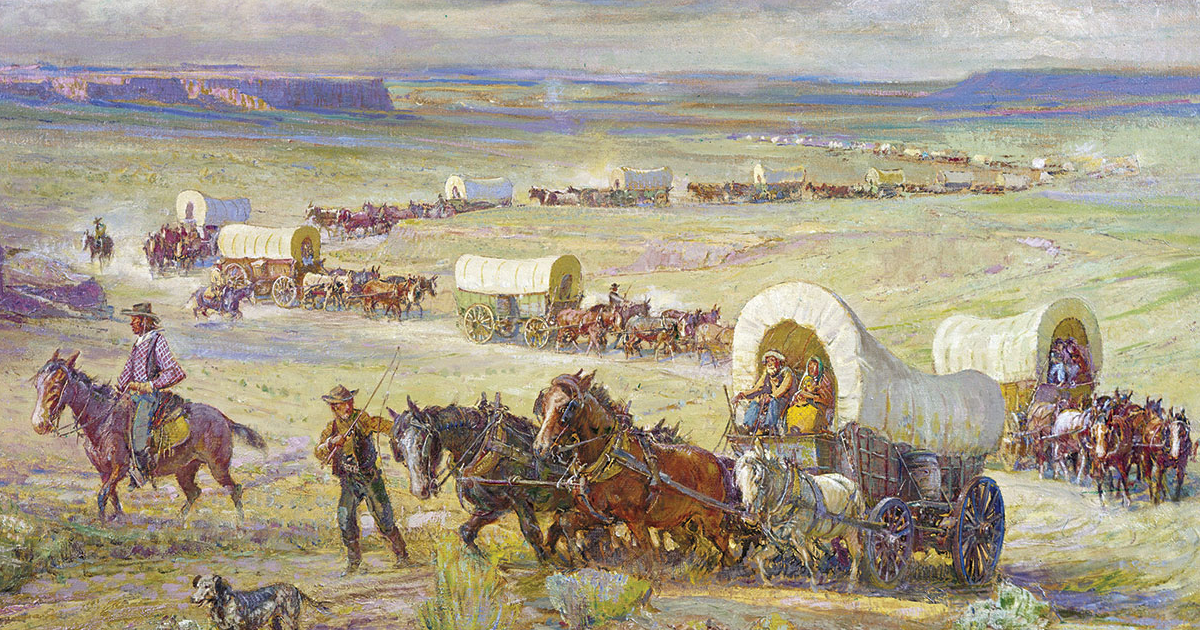
It is 1840 and your family is faced with a decision, your friends and neighbors are all headed west to settle in the new territory. You have heard stories of striking it rich in the "land of opportunity" out west but have also heard of tragedies and failures. What are you to do? Your task is to decide whether or not it will be beneficial to you and your family to pack up shop and head West.
Task

Task
You will work in groups of four to present a case for your family to stay or pack up and head out West. You will present your argument to the group to convince us of your decision based off of your research. To accomplish this task, you will need to understand what you'll need for the trip (supplies), how long and far you will travel (all the way to California?), and how to prepare for the obstacles you will encounter along the way (weather, Native Americans, etc.) Good luck! The group can also assign jobs to each group member.
Process
Process
To begin, your team will need to choose roles. Each role comes with it's own set of jobs, and you must all work together to create your argument.
Father- This person will decide which supplies are needed for the journey, how to store those supplies, and how much it will cost.
Mother- This person prepares for the obstacles that will be faced on the journey. Think about the weather, what people or animals you might encounter, and other potential obstacles. Leave food to the Oldest Sister, and transportation to the Uncle.
Uncle- This person maps out the journey. Decide how long you'll be traveling, how far you will go (final destination), and how you will get there (transportation).
Oldest Sister- This person decides what foods you will have for your meals, how often to eat, how to prepare the meals, and how to get more food while you are on the trails. Make sure Father is packing the supplies you might need in order to prepare these meals.
Once your roles are chosen, you will research on your own using the graphic organizers provided. Be sure to think about the essential question "Why should we travel West?" "How would this be helpful/or hurtful to our family?"
Step 1Research your individual information using the resources links and books listed below. Your title is linked to your recording sheet. |
Step 2As a group discuss your findings and decide if you are staying put or traveling West. Create a Pros and Cons list with information from each member of the group. |
Step 3As a group, create a presentation explaining your findings and your opinion. Include your Pros and Cons list. Possible ideas include a Powerpoint, brochure, skit, or original idea that is pre-approved. |
Step 4Present. Be sure to turn in all research and documents. Check the Evaluation to make sure you have all required information. Visit the Conclusion to see how you can take this project even farther! |
Online Resources

Traveling on the Oregon Trail (cover) | Benchmark Universe
A Trip on the Transcontinental Railroad (cover) | Benchmark Universe
Settling the West: 1862 to 1890 (cover) | Benchmark Universe
Western Legends (cover) | Benchmark Universe
All Resources - MackinVIA
The Oregon Trail Maps
Pioneer Life in America
Frontier House
Print Resources
Benchmark Advance: Developing a Nation
...If You Traveled West in a Covered Wagon by Ellen Levine
Watch the video below:
If You Traveled West in a Covered Wagon (youtube.com)
Evaluation
Evaluation
You are scored on each of the following sections.
Delegation of Responsibility
Exemplary 3 Each student in the group can clearly explain what information is needed by the group, what information s/he is responsible for locating, and when the information is needed.
Accomplished 2 Each student in the group can clearly explain what information s/he is responsible for locating.
Developing 1 Each student in the group can, with minimal prompting from peers, clearly explain what information s/he is responsible for locating.
Presentation
Exemplary 3 Each student presents at least 1 minute of information related to his/her portion of the project. The Presentation is presented by all members of the group equally.
Accomplished 2 Each student presents for at least one minute during the presentation; however, one or two students have more information to present than the other students.
Developing 1 3 of the 4 students presents for at least one minute during the presentation. The presentation does not show that all group members have researched and provided equal information for the project.
Plan for Organizing Information
Exemplary 3 Students have developed a clear plan for organizing the information as it is gathered and in the final research product. All students can independently explain the planned organization of the research findings.
Accomplished 2 Students have developed a clear plan for organizing the information in the final research product. All students can independently explain this plan.
Developing 1 Students have developed a clear plan for organizing the information as it is gathered. All students can independently explain most of this plan.
Quality of Sources
Exemplary 3 Researchers independently locate at least 2 reliable, interesting information source for EACH of their ideas or questions.
Accomplished 2 Researchers independently locate at least 1 reliable information source for EACH of their ideas or questions.
Developing 1 Researchers, with some adult help, locate at least 1 reliable information source for EACH of their ideas or questions.
Photo used under Creative Commons from State Records NSW
Conclusion
Conclusion

Wow! Congratulations on leading your family to success in the West! There are many reasons people stayed East, but the West definitely was an adventure! It was a lot of work expanding our country to where it is now. There was much lost on the way, but for some, huge payoffs! This definitely was an exciting time in our country's history! If you would like to learn more about the life of the pioneers or the Louisiana Purchase, which made this trip possible, check out the links below!
Credits
Resources
Traveling on the Oregon Trail (cover) | Benchmark Universe
A Trip on the Transcontinental Railroad (cover) | Benchmark Universe
Settling the West: 1862 to 1890 (cover) | Benchmark Universe
Western Legends (cover) | Benchmark Universe
All Resources - MackinVIA
The Oregon Trail Maps
Pioneer Life in America
Frontier House
Print Resources
Benchmark Advance: Developing a Nation
...If You Traveled West in a Covered Wagon by Ellen Levine
Watch the video below:
If You Traveled West in a Covered Wagon (youtube.com)
Teacher Page
Teacher Information
This lesson was developed as part of DoDEA approved standards for English language arts and Social Studies.
The purpose of this lesson is to give fourth graders an introduction into the Westward Expansion of our country. It includes concepts like the reasons why people made the journey, supplies needed, hardships faced, and the major effect on our country.
Learners
This lesson is designed to reach fourth grade DoDEA approved English language arts and Social Studies standards teaching about Westward Expansion. It also has students apply research, listening and speaking, and technology literacy standards The lesson can easily be extended to additional grades and subjects, by modifying how deeply the students go into the provided websites.
Students will need a basic understanding of website navigation and the use of presentation tools to effectively use this lesson.
Standards
Social Studies Standards Addressed:
4.3 The United States is one country defined by human geographic features and political systems. Regions can be described using information about geographic features, economics, industry, agriculture, and Native American cultures.
Northeast Region Northwest Region Mid-Atlantic Region Southwest Region Southeast Region West Region Midwest Region Students will gather, interpret, and use evidence from sources to describe regions of the United States. 33 | CCRS-H/SS | GRADES K-5 V2 JUNE 2022 Students will use geographic reasoning to locate and describe the major geographic features and physical settings that supported permanent settlement in regions. Students will gather, interpret, and use evidence to describe the regional Native American∗ cultures. Students will use an understanding of economics to identify the effects of available resources on the economy of regions.
English Language Arts Standards Addressed:
RI.4.5. Describe the overall structure (e.g., chronology, comparison, cause/effect, problem/solution) of events, ideas, concepts, or information in a text or part of a text. I can describe the organizational structure in informational or persuasive text (chronology, comparison, cause/effect, problem/solution).
RI.4.6. Compare and contrast a firsthand and secondhand account of the same event or topic; describe the differences in focus and the information provided. I can compare and contrast a first-hand and second-hand account of the same event or topic.
RI.4.7. Interpret information presented visually, orally, or quantitatively (e.g., in charts, graphs, diagrams, time lines, animations, or interactive elements on Web pages) and explain how the information contributes to an understanding of the text in which it appears.