Introduction
Now that we have investigated how scientists group organisms we are going to take a closer look at how different types of organisms in the animal kingdom are classified.
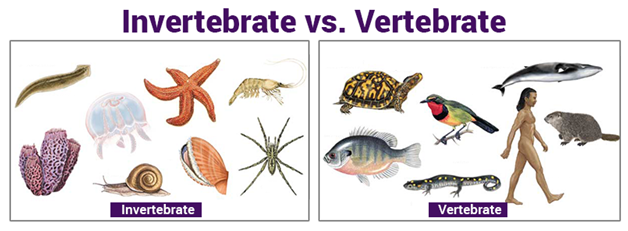
Animals are organised into two main groups - vertebrate and invertebrate. Of these, the invertebrates contain many more types of animals than the vertebrates. There are 950 000 different types of animals on Earth and of these, about 800 000 are arthropods!
Task
Your task is to research the differences between vertebrates and invertebrates to then help classify a number of unknown specimens as arthropods, molluscs, fish, birds, mammals, amphibians and reptiles.
As you research you will complete a graphic organiser to collect information on each group of animal. It is important that you take thorough notes because this will be the ONLY resource you are allowed to use as you begin to classify the 'unknown specimens' after the WebQuest.
Process
Below are a series of websites and videos you can use to begin your research on the classification of animals - invertebrates and vertebrates. You can use as many resources as you like, but your organiser must be complete!
Websites:
https://www.bbc.com/bitesize/articles/zp6g7p3
https://www.bbc.com/bitesize/articles/z8mbqhv
http://www.biology4kids.com/files/vert_main.html
https://biologywise.com/vertebrates-invertebrates
https://www.coolgalapagos.com/biology/classification-invertebrates.php
Interactive:
http://studyjams.scholastic.com/studyjams/jams/science/animals/vertebrates.htm
http://studyjams.scholastic.com/studyjams/jams/science/animals/invertebrates.htm
Videos:
Evaluation
Firstly, test what you have learnt - using your graphic organiser play "Who Wants to be an Animal Classification Millionaire?" on the link below:
https://www.quia.com/rr/11806.html?AP_rand=354398998
Finally - collect the 'bag' of unknown animals and using your graphic organiser to classify ALL the specimens. When you are finished check your answers with Ms Williams!
Conclusion