
Introduction
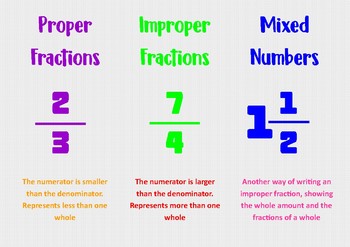
For today's lesson/activity we will be looking at the different types of fraction. They will be able to define fraction in there own terms after watch a youtube video on fractions. There are three (3) types of fraction which are proper fraction, improper fraction and mixed fraction. Each fraction can be different by their numerator and denominator. The number is the top number hence that the denominator is the bottom number. The proper fraction numerator is smaller than the denominator while the improper fraction numerator is larger than the denominator. Mixed fraction is consist of a whole number that stands alone with a proper fraction. Fractions can be added, subtracted, multiplied or even divided but before the process starts individuals should first differentiated between the different denominator after which the different steps of multiplication, addition, subtraction and division should follows.
Task
Students are expected to define what a fraction is in their own terms and to know what a fraction is consist of ( parts of a fraction). Students will then differentiate among the different types of fraction using words and illustrations. When students get the full understanding of each fraction they will then carry out the different mathematical operations, which are multiplication, addition, subtraction and division.
Process
Week 1 of types of fractions. Students should be able to first tell what is a fraction and then identify the different types of fractions. In adding proper fraction with the same denominator students would have to keep the denominator (let it remain as it is) and add the numerator. When writing the answer students will put the number that they get over the denominator that is already there and the same will go for subtraction. Students will subtract the numerator and write the answer over the common denominator. But as they climb up the ladder the process change. When adding and subtracting fractions with different denominator. First, students will have to find the least common multiple (LCM) of the denominator inorder to get both fraction having the same denominator. After finding the LCM they will then add or subtract the numerator and place it over the numerator in which they would find. Same goes for the other operations.
Evaluation
Student will be evaluate using the following:
Define what is a fraction in their own term. 5marks
Name the different parts of a fraction. 5marks
Differentiate among the different fractions. 5marks
Represent each fraction on the board using white board marker. 3marks
Carry out basic mathematics operations. 7marks
Conclusion
During this lesson/activity students were able to define what a fraction is and having a guided discussion with their teacher. Differentiate among the different fractions using relevant examples which they all mastered. After mastering the different types of fractions they were able to calculate fraction using the basic mathematics operations.
Credits
I would like to acknowledge the following sites:
1. Youtube
Teacher Page
As teachers you may want to place students in groups after the topic is been introduced. In there different groups they would get a type of fraction in which they would be allowed to present to the class. Ensure that the activities or delivery of content is teachers centered.