
Introduction
This WebQuest is geared toward College students interested in Network Security or individuals interested in gaining basic network knowledge or pursuing a Security+ certification.
With advances in Internet technology and the growing trend of connected devices, the importance of securing data is becoming more important. It is not only important on an individual scale to protect all of the information you have on a network but it is also increasingly important for companies and firms to protect their networks against various threats. Communicating with data over a network is an important part of any business and with the increasing demand for connecting devices through the Internet is leading to new vulnerabilities for companies to combat.

Task
The following information will provide you with some basic knowledge of network security. By reading and researching the information provided in this webquest you will have the knowledge necessary to answer the evaluation questions. You will also be able to do the following:
– Identify the basic components of the information security cycle
– Identify information security controls
– List common authentication methods
– Identify fundamental security practices
– Differentiate between Vulnerabilities, Attacks, and Intrusions
Process
There are three primary goals or functions involved in good information security practice:
- Prevention
- Detection
- Recovery
CIA Triad
- Confidentiality
- Integrity
- Availability

Vulnerability
A vulnerability is any condition that leaves a system open to an attack.
Vulnerability Examples:
- Improperly configured software or installed hardware or software
- Bugs in software or operation systems
- The misuse of software or communication protocols
- Poorly designed network
- Poor physical security
- Insecure passwords
- Design flows in software or operation systems
Attacks:
Attacks involve the unauthorized exploitation of application vulnerabilities on a computer system.
Attack Examples:
- Physical security attacks
- Network based attacks including wireless networks
- Software based attacks
- Social engineering
- Web application based attacks.
Intrusion
Involves attackers accessing a computer system without authorization.
Intrusion Examples:
- Physical intrusion
- Host-based intrusions (host-based system monitors as well as analyzes a system’s internals along with the network packets. This implies that host-based ID looks at your communication traffic and checks the integrity of the system files to keep an eye on suspicious processes.)
- Network based intrusions
Intrusion prevention
There are various types of intruders including:
- Casual intruders who are novice intruders who use sue various hacking tools and are often referred to as script kiddies (Fitzgerald & Dennis, 2012).
- Expert security intruders called hackers or crackers.
- Professional hackers attack corporate or government computer’s for espionage, fraud or other destructive reasons.
- Organization employees that access the network using their authorization to cause damage.
To prevent these types of intrusions it is important to stay proactive by testing systems for vulnerabilities and actively look to prevent unauthorized access to your network (Fitzgerald & Dennis, 2012). Examples of intrusion prevention include:
- Security policies
- Perimeter security and firewalls
- Packet level firewalls
- Application layer firewalls
- Network address translation (NAT) firewalls
- Physical security
- Server and client protection
- Encryption
- Single Key
- Public Key
- Authentication
- Passwords
- Access Cards
- Biometrics
- Fingerprint scanner
- Central Authentication
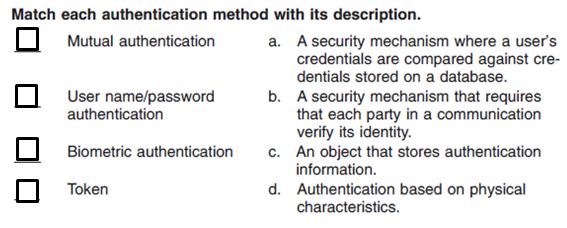
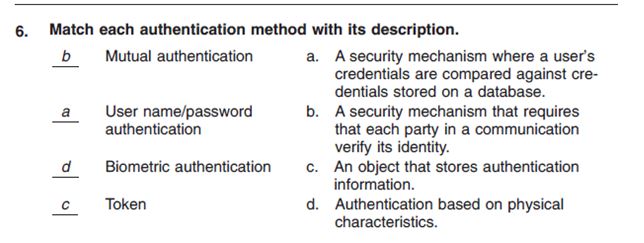
Authentication Methods:
- Something you know
- a password, phrase
- Something you have
- a token, access card, ID badge, data packets

- Something you are
- Biometrics, fingerprint, retinal scanner, hand geometry scanner or voice and facial recognition

Common Security Practices
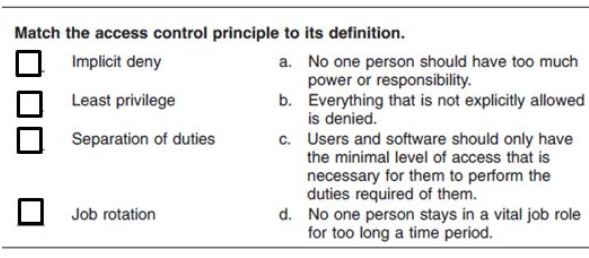
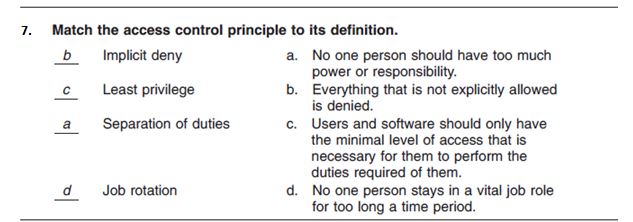
Implicit Deny
- Everything that is not explicitly allowed is denied.
Least Privilege
- Minimal level of access necessary to perform the duties of the individuals job.
Separation of Duties
- Reduced the amount of power one individual holds by separating their responsibilities.
Job Rotation
- Keep individuals rotated in positions within a firm to ensure that one individual does not hold too much knowledge.
Mandatory Vacation
- Vacations allow time to review employees activities.
Time of Day Restriction
- Restrict access for employees to the system during certain times of the day, and can be applied through group policies.
Privilege management
Evaluation
To be evaluated on this WebQuest successfully answer the following questions based on what you learned in the process section. The questions are from the Security + 301 study guide.
Questions:
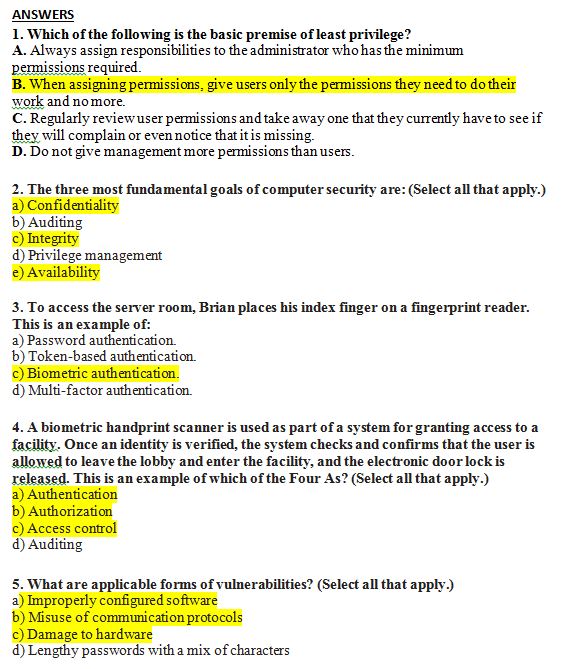
1. Which of the following is the basic premise of least privilege?
A. Always assign responsibilities to the administrator who has the minimum
permissions required.
B. When assigning permissions, give users only the permissions they need to do their
work and no more.
C. Regularly review user permissions and take away one that they currently have to see if
they will complain or even notice that it is missing.
D. Do not give management more permissions than users.
2. The three most fundamental goals of computer security are: (Select all that apply.)
a) Confidentiality
b) Auditing
c) Integrity
d) Privilege management
e) Availability
3. To access the server room, Brian places his index finger on a fingerprint reader.
This is an example of:
a) Password authentication.
b) Token-based authentication.
c) Biometric authentication.
d) Multi-factor authentication.
4. A biometric handprint scanner is used as part of a system for granting access to a
facility. Once an identity is verified, the system checks and confirms that the user is
allowed to leave the lobby and enter the facility, and the electronic door lock is
released. This is an example of which of the Four As? (Select all that apply.)
a) Authentication
b) Authorization
c) Access control
d) Auditing
5. What are applicable forms of vulnerabilities? (Select all that apply.)
a) Improperly configured software
b) Misuse of communication protocols
c) Damage to hardware
d) Lengthy passwords with a mix of characters
6. Matching
7. Matching
Conclusion
The importance of security data at home and the office is becoming increasing important with the advances in Internet communications. The WebQuest provided basic understanding of vulnerabilities, and intrusion protection as well as some common security practices used in the work place. This information will assist with understanding and combating basic network security threats and vulnerabilities.
Credits
References:
CompTIA . (2011). CompTIA security+ (Exam SY0-301). Element K. Corporation. Rochester, NY.
Fitzgerald, J., Dennis, A., Durcikova, A. (2012). Business data communications & networking. Hoboken, NJ: John Wiley & Sons, Inc.
Image References:
Armeda, D. (2010). The mission of security awareness. Retrieved from http://blog.sucuri.net/2010/06/
the-mission-of-security-awareness.html
Cyber. (n.d.) Viewing gallery for cyber security banner. Retrieved from http://galleryhip.com/cyber-
security-banner.html
Entrust. (2013). Are biometrics the answer. Retrieved from http://www.entrust.com/biometrics-
answer/
Lockheed Martin. (n.d.). Biometrics. Retrieved from http://www.lockheedmartin.com/us/what-we-
do/information-technology/biometrics.html
O’Brien, R. (2013). Passwords: no longer fit for purpose? Retrieved from http://www.theguardian.com/
media-network/media-network-blog/2013/oct/17/password-security-biometrics-apple-google
Teacher Page
Evaluation Answers
[img_assist|nid=17656|title=ANSWERS|desc=|link=none|align=left|width=549|height=640]
[img_assist|nid=17655|title=answer6|desc=|link=none|align=left|width=640|height=241]
[img_assist|nid=17657|title=answer7|desc=|link=none|align=left|width=640|height=224]