
Introduction
Welcome to the webquest on Solving Systems of Linear Inequalities! In this activity, you’ll explore how systems of inequalities can help you solve real-world problems with multiple constraints, like planning an event within a budget or managing limited resources.
Big Question
How can we use systems of linear inequalities to represent and solve real-world situations with specific limitations?
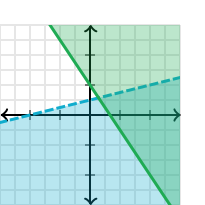
A.REI.12 Graph the solutions to a linear inequality in two variables as a half- plane (excluding the boundary in the case of a strict inequality), and graph the solution set to a system of linear inequalities in two variables as the intersection of the corresponding half-planes.
Task
By the end of this webquest, you’ll be able to:
- Graph systems of linear inequalities and identify their solution regions.
- Interpret these solution regions in the context of real-world problems.
- Apply what you learn to create and solve your own scenario involving constraints and solutions.
Process
Create a Google Doc to answer the following prompts.
Each prompt should be clearly labeled on your Doc.
For example:
Step 1:
Define these Key Concepts:
- Boundary Line:
- Shading:
- Intersection:
Reflection: Students will answer the reflection
Step 1: Understand Systems of Linear Inequalities
- Activity: Start by watching a brief introductory video (https://youtu.be/CA4S7S-3Lg4?si=4XPyaz-hSTQ3Q4fX) explaining the basics of linear inequalities and how we graph systems of inequalities.
- Define these Key Concepts in your notes:
- Boundary Line: Understand what a solid or dashed line means in an inequality.
- Shading: Learn how to shade regions to represent solutions to inequalities.
- Intersection: Recognize the solution region where shaded areas overlap in a system of inequalities.
- Reflection: What does the intersection of shaded regions represent in a system of inequalities?
Step 2: Graphing Practice
To share your graph to the Google Doc click on the share button on the top right corner, then copy the link of your graph and paste it to the Google Doc
- Activity: Use the graphing tool.

- Desmos https://www.desmos.com/calculator/sxrwtb5yiw to practice graphing the following systems of inequalities:
- System 1: y > 2x +1 and y ≤ −x + 4
- System 2: y < 12x + 3 and y ≥ −x − 2
- Instructions:
- Identify the boundary lines and shade the correct regions.
- Note where the shaded regions overlap and mark this area as the solution region.
- Question for Analysis: How does each inequality impact the final shaded solution region? What happens to the graph if you change an inequality from ≤ to < ?
Step 3: Real-World Application Scenarios
- Activity: Choose one of the following scenarios and create a system of inequalities to represent it. Then, graph your system and analyze the solution region using Desmos https://www.desmos.com/calculator/sxrwtb5yiw
- Scenario A: You are planning a fundraiser. You have a budget of $400 for supplies, where each item costs $20, and you also have a space limit that accommodates a maximum of 30 items. How would you use a system of inequalities to represent these constraints and determine feasible numbers of supplies within your budget?
- Scenario B: You are designing a community garden. You have a limit of 50 square feet and a budget of $500 for plants, with each plant costing $10 and taking up 2 square feet. What system of inequalities can represent your situation? How would you graph it?
- Instructions:
- Write the inequalities that represent the constraints in your scenario.
- Graph the system and shade the solution region that shows all feasible options
To share your graph to the Google Doc click on the share button on the top right corner, then copy the link of your graph and paste it to the Google Doc

Step 4: Create Your Own Scenario and System of Inequalities
- Activity: Now it’s your turn! Create a real-life situation involving two constraints that can be represented with a system of inequalities. Examples could include:
- A school club budget with limits on spending and attendance.
- A study schedule with time constraints on multiple subjects.
- Instructions:
- Write the inequalities for your scenario, then graph the system using a digital tool.
- Identify the solution region and explain what it represents in the context of your scenario.
Step 5: Reflection and Wrap-Up
- Reflection Questions:
- What does the solution region tell you about feasible options in your scenario?
- How could you use systems of inequalities in other real-life situations?

- Exit Ticket: Write a short paragraph explaining how systems of inequalities can be useful in making decisions with constraints.
Evaluation
Your work will be assessed based on:
- Accuracy: Correctly solving and graphing each system of inequalities.
- Interpretation: Effectively explaining the meaning of the solution region in each context.
- Application: Creating a realistic scenario and accurately representing it with a system of inequalities.
- Reflection: Thoughtfully considering how these skills apply to real-world decision-making.

Webquest Evaluation Rubric
| Criteria | 4 - Advanced | 3 - Proficient | 2 - Developing | 1 - Beginning |
|---|---|---|---|---|
| Accuracy | Graphs all systems of inequalities accurately, with correct boundary lines and shading. Clearly identifies and highlights the solution region. | Graphs most systems correctly with minor errors in boundary lines or shading. Accurately identifies solution regions. | Graphs show partial understanding, but contains multiple errors in lines, shading, or solution region identification. | Graphs do not accurately represent the inequalities or solution region. Needs support to complete graphing tasks. |
| Interpretation | Provides a clear, insightful explanation of the solution region in context for each scenario. | Provides a mostly clear explanation of the solution region in context, with minor inaccuracies. | Explanation of the solution region shows partial understanding or is unclear in context. | Explanation of the solution region is missing or does not reflect understanding. |
| Application | Creates a realistic, relevant scenario with a well-constructed system of inequalities and accurately graphs it. | Creates a relevant scenario with mostly accurate inequalities and graphs. Some minor mistakes in setup or graphing. | Scenario or system of inequalities lacks relevance or accuracy, or there are multiple graphing errors. | Scenario is unrealistic or incomplete, with little understanding of how to represent it with inequalities. |
| Reflection | Thoughtfully reflects on the application of systems of inequalities in real-life scenarios, showing insight and depth. | Reflects on real-life applications with some insight and relevant examples. | Reflection is brief or shows limited understanding of how systems of inequalities apply to real life. | Reflection is missing or unrelated to the topic. |
| Overall Effort | Demonstrates thorough understanding and attention to detail across all parts of the webquest. | Completes all parts of the webquest with good effort and understanding. | Completes some parts of the webquest, with partial understanding or effort. | Demonstrates minimal effort or understanding in completing the webquest. |
Score Interpretation
- 16-20 points (Advanced): Exceptional work with strong understanding and application of systems of inequalities. Consistently demonstrates accuracy and insight in all areas.
- 11-15 points (Proficient): Solid performance with a good grasp of key concepts and minor areas for improvement. Competently completes each part of the webquest.
- 6-10 points (Developing): Shows a basic understanding but needs improvement in accuracy, interpretation, or real-world application.
- 1-5 points (Beginning): Struggles with key concepts and completion; needs additional support to fully understand and complete the webquest.
Conclusion
Congratulations on completing the webquest! Systems of linear inequalities are a powerful tool for solving problems that involve multiple limitations or constraints. The next time you face a situation with constraints—like planning a budget or scheduling time—you can think about how these skills might help!
Credits
Desmos. (2024). Desmos Graphing Calculator. Desmos. https://www.desmos.com/calculator
Kahn Academy. (2011, March 8). Introduction to graphing systems of linear inequalities | Algebra II | Khan Academy. YouTube. https://youtu.be/CA4S7S-3Lg4?si=4XPyaz-hSTQ3Q4fX