
Introduction
Your help is needed desperately! Our meterologist at News 9 Weather Center won't be available next week! We need you and your classmates to fill in for the job. Its up to you to track and record the weather in time to broadcast live! Good luck and happy tracking!
Students will be able to understand that weather is a combination of sunlight, wind, snow, rain, and a temperature in a specific setting. Over time, people learn how to record weather and its patterns.
Task
Task
During this webquest you will:
- Collect data on the weather using a thermometer, barometer, and dew point.
- Observe the weather data using graphs, charts, and their observations journals.
- Present their findings to the class and explain the patterns they discovered in the weather.
Process
You are all now meterologists!
1. To lead in to this activity, students will answer a varitety of questions that will access their background knowledge on weather. They will record these answers in their weather journal.
- What do you think of when you hear the word "weather"?
- How does weather affect our daily lives? (Ex. what kinds of clothes do you wear, outdoor activities that you do, etc.)
- What kinds of things would you look for if you wanted to describe the weather of a particular day to someone else?
- What kinds of information are important to collect?
2. Your teacher will divide you into groups of three. Each group will be responsible for collecting data on a different instrument. These will consist of a thermometer, baromoter, and anemometer. Each group will fill out a sheet where they can record their information each day. In addition, students will fill out personal weather journals each day. This is a chance for them to describe everything they've observed. An example of what the weather log will look like is:
Weather Log
- Temperature: ________________ºC
(Use a commercial outdoor thermometer) - Sky conditions: ___________________
(Observe outside and use one of the standardized sky condition terms. For example, clear, partly cloudy, overcast with openings, overcast, etc.) - Wind: _______________
(calm, light, etc.) - Wind Direction: ________________
(N, NW, W, SW, etc.) - Wind Speed: ________________
(how many times the anemometer spun) - Precipitation Type: ____________
(at data collection time - rain, drizzle, snow, none, etc.) - Precipitation Amount : __________ mm
(in last 24 hours) - Air Pressure: ______________ units
(record your finding in the units marked on your class barometer)
*This log will be printed in a packet so that the students have enough for each day.
3. Once they students are assigned their tasks, I will have them research information about their instrument and what it does. This will also go on the worksheet where they record their group data.
4. Each day, groups will share their data with the class and the teacher will write it on a chart that will be displayed on the board. In addition to the information each group will collect, the class will discuss other elements. This information should also be recorded in their journals.
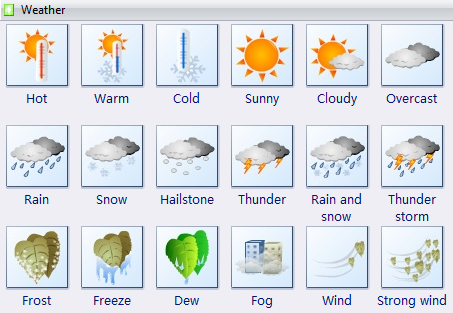
- Temperature (Use a commercial outdoor thermometer and record in degrees Celsius)
- Sky conditions (Observe outside and use one of the standardized sky condition terms. For example, clear, partly cloudy, overcast with openings, overcast, etc.)
- Wind (calm, light, etc.)
- Wind Direction (N, NW, W, SW, etc.)
- Wind Speed (how many times the anemometer spun)
- Precipitation Type (at data collection time - rain, drizzle, snow, none, etc.)
- Precipitation Amount (in last 24 hours. Record your findings in mm)
- Air Pressure (record your finding in the units marked on your class barometer)
5. At the end of the week, each group will be responsible for the section of information that includes their instrument, plus an additional section. They will then get together and prepare a script, with the help of the teacher. This script will be what they will present to the class as if they were meterologists. The teacher will be responsible for introducing them and explaining that they are filling in for the town meterologist because they couldn't be there. The teacher will film this and post it to their class website so that student can watch with their families at home.
HELPFUL WEBSITES:
http://www.weatherwizkids.com/weather-wind.htm
Evaluation
Lab Report : Weather Your Way
- Student Name: ________________________________________
| CATEGORY | 4 | 3 | 2 | 1 |
| Journal/Notebook | Clear, accurate, dated notes are taken regularly. | Dated, clear, accurate notes are taken occassionally. | Dated, notes are taken occassionally, but accuracy of notes might be questionable. | Notes rarely taken or of little use. |
| Scientific Concepts | Report illustrates an accurate and thorough understanding of scientific concepts underlying the lab. | Report illustrates an accurate understanding of most scientific concepts underlying the lab. | Report illustrates a limited understanding of scientific concepts underlying the lab. | Report illustrates inaccurate understanding of scientific concepts underlying the lab. |
| Directions | Directions are followed. | Most of the directions are followed. | Some directions are followed. | Almost none of the directions are followed. |
| Participation | Used time well in class and focused attention on the experiment. | Used time pretty well. Stayed focused on the experiment most of the time. | Did not appear very interested. Focus was lost on several occasions. | Participation was minimal OR student was hostile about participating. |
Conclusion
Thank you to all the students who helped fill in for our local meteorologist!
Without your help, the people of our town would have spent the week so frustrated because they wouldn't know what to expect! The weather really helps with a lot of our daily lives. It helps us decide what to wear, if we need to be extra careful while driving, and if there might be a delay somewhere.
I hope you got a lot out of this experience and maybe we'll have some future meteorlogists.
Credits
Thank you to the following:
http://www.ciese.org/curriculum/weatherproj2/en/guidelessons.shtml
http://rubistar.4teachers.org/index.php?ts=1416521354
http://www.weatherwizkids.com/weather-wind.htm
http://urbanext.illinois.edu/treehouse/seasons.cfm?Slide=1
http://www.almanac4kids.com/weather/index.php
About the author:
My name is Sara Sherman and I am a senior at Southern New Hampshire University. I am majoring in elementary education and special education. I can't wait to have a class of my own in the near future!
Teacher Page
This webquest was designed as a way to get students involved in the science behind the weather. They get to be actively involved in the process, instead of just watching it on television or reading about it in their textbook. Students are able to use weather instruments, fill out weather logs, make observations and predictions, and present their findings to the class in a fun way.
Learners:
- This activity is designed for second graders.
Standard
- ESS2.D Weather and Climate: Weather is the combination of sunlight, wind, snow or rain, and temperature in a particular region and time. People record weather patterns over time.
Process:
- This webquest requires a week to complete.
- At the start of the week, students will be assigned their groups and instruments. They will also fill out an introductory worksheet that accesses their background knowledge.
- Each following day, students will record their data on their worksheets and in their journals, while also sharing with the class.
- The week will conclude with the students reporting the weather to the class.
- Students will learn how to properly record data, journal correctly, and how to work well with a group.
Resources: