
Introduction
C3 plants are found in oxygen-present environments.
C4 plants are found in low-oxygen environments.
Task
Photosynthetic Mechanism of C3 Plants
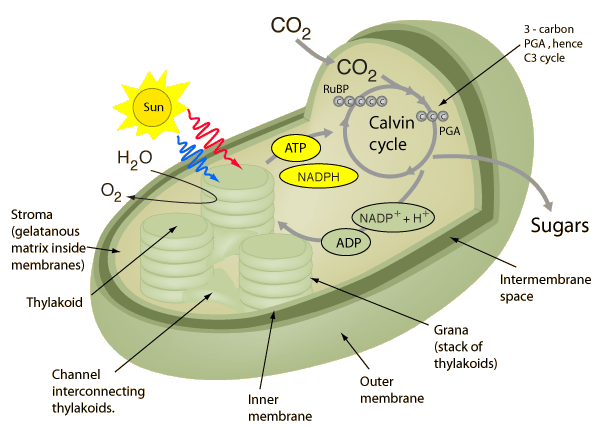
- They are called C3 plants because the CO2 is first incorporated into a 3-carbon compound.
- This type of photosynthesis (6CO2+ 6H2O + energy --> C6H12O6 + 6O2) occurs in C3 plants, the chloroplasts use solar energy to chemically convert carbon (inorganic) into carbohydrates (organic) such as starches or sugars. The byproducts of phtotsynthesis in C3 plants are oxygen, ATP, and heat.
- These plants undergo the Calvin Cycle as well. This process consists of three stages: CO2 fixation, Reduction, and Regeneration.
Photosynthetic Mechanism of C4 Plants
- They are called C4 plants because the CO2 is fist incorporated into a 4-carbon compound.
- The 4-carbon forms the compound oxaloatetic acid (C4). This is converted into malic acid which is transported into a bundle sheath cell (deep inside the leaf so that oxygen cannot diffuse easily to them).
- This feature keeps oxygen levels low.
Process
Labelled Diagram of the C3 & C4 Photosynthetic Pathway

Evaluation
10 Species of Plants That Undergo C3 Photosynthesis
- Rice
- Wheat
- Barley
- Rye
- Oat
- Soybeans
- Peanuts
- Cotton
- Sugar Beets
- Tobacco
10 Species of Plants That Undergo C4 Photosynthesis
- Corn
- Sugarcane
- Sorghum
- Millets
- Switchgrass
- Nutgrass
- Bermuda Grass
- Barnyard Grass
- Cogon
- Pigweed
Conclusion
- C3 plants are found in the presence of oyxgen.
- C4 plants are found in low-oxygen environments.
- These photosynthetic mechanisms are similar because they both are processes which need CO2 to occur. The diferences are that C3 Photosynthesis occurs in the presence of oxygen, when C4 Photosynthesis occurs in low-oxygen levels.