
Introduction
The following Performance-Based Task (PBT) was designed by the Secondary Language Arts (SLA) Office to help students become familiar with the tasks that they may be asked to complete on the upcoming Partnership for Assessment of Readiness of College and Careers (PARCC) Tests. This PBT should be completed in three parts, and each part should take approximately 30-45 minutes to complete. After you have completed each part, please make sure to both save your progress to your student account and print your work. In the end, you should submit all three parts stapled together to your teacher for grading and feedback.
Task
Part 1 Assignment:
You will closely analyze an anchor text (found on the next page under "Process") by reading and taking Cornell notes (including the notes, question, and summary sections) about it. After you have completed this portion of the assignment, you should use your understanding of the anchor text and your notes to answer the following five text-dependent questions. These questions should be answered on a separate sheet of paper, and should each be answered in several sentences each with specific evidence from the anchor text.
Text-dependent Questions:
1. When Spitzer states "Hubris is terminal,” he refers to hubris as something that is
a) natural
b) physically deadly
c) leads to an end
d) unavoidable
2. Explain how the author relates animal behavior to human behavior.
3. In the second to last paragraph, Bergstein maintains that corruption leads to “a stripping of power and a fall from grace” (3). Based on the article, what should leaders do to ensure that corruption does not lead to their downfall?
4. The author begins the last paragraph with the line, “Corruption is a byproduct of a person in power, either through money, by way of election, or by force, who is arrogant instead of grateful” (Bergstein 3). Cite two examples from the text that support the statement.
5. Part A: With which of the following statements would the author agree?
A. It is to be expected that successful people would practice animal-like behaviors.
B. The military produces more successful people than the private sector.
C. Corrupt behavior is necessary for society to function.
D. The “animal soul” and the “godly soul” have many similarities.
Part B: Which two of the following quotes best represent the answer to part A?
A. History is rife with leaders who have failed to recognize this and have allowed their corruption to spiral out of control.
B. The quest for success and ultimately power is a war, a fight for survival filled with adversity.
C. Power corrupts because people in positions of power are not often accountable for their actions, and therefore free to behave in excess.
D. Once power is realized, it leaves one feeling impervious.
E. Most people who get to positions of power are of this predisposition, with the animal soul occupying the dominant part of their constitution -- so much so that it is second nature to behave as such.
F. Those who recognize that their achievements are due to their own initiatives as well as the help and support of other people are the ones who don't partake in corruption.
Part 2 Assignment:
You will read and/or view a variety of texts and media (found on the next page under "Process") that all address the same theme as the anchor text. As you engage with these different texts, you should take notes that will assist you when completing Part 3 of this assignment. Your notes can be in any format that you choose, but should both demonstrate your understanding of the text and its main theme/ideas.
Part 3 Assignment:
Now that you have read a variety of texts that discuss the relationship between power and corruption, use what you have learned to support or refute the following statement in an argument essay:
"It is said that power corrupts, but actually it's more true that power attracts the corruptible." --David Brin
Your well-developed essay should have a clear claim and evidence from the anchor text and at least two additional sources (from those that you read/viewed during Part 2 of this assignment). In total, your response should be several paragraphs, and in writing it you should clearly indicate which sources you are using (by means of either direct quotes or paraphrases) and may refer to them as Anchor Text, Source A, Source B, and so on after initially introducing them. This essay should both focus on supporting or refuting the quote mentioned above and provide substantial support from the various texts provided for you in this assignment. You may use any of the notes you have previously taken to help you with this essay, and all parts of this assignment need to be submitted to your teacher for grading and feedback.
Process
Anchor Text: "Why Power Corrupts" by David Bergstein
Recent accusations against Chris Christie and members of his staff have many pondering an age-old question: Why does power corrupt? Last July, Eliot Spitzer appeared on "The Tonight Show" and was bluntly asked about his fall from grace by Jay Leno. "How can you be this stupid?" Leno inquired. Spitzer responded, "Hubris is terminal." Via the process of obtaining power, hubris is developed. And once power is realized, it leaves one feeling impervious.
This should not be a surprise. If there were no consequences to our actions, the majority of us would do whatever we wanted whenever we wanted, often in complete contradiction with acceptable social norms. Power corrupts because people in positions of power are not often accountable for their actions, and therefore free to behave in excess. This occurs at virtually every level where power is given to one person over another -- whether a head of state or virtually anywhere in the long chain of our legal system, starting with attorneys.
But what is more noteworthy is the way in which the trajectory required to obtain power affects our most primal instincts.
The spiritual aspects of many religions divide man into two parts: The physical (or animal soul), and the non-physical, typically considered the godly soul. The animal soul, which drives one's physical body or physical existence, is frequently at odds with the godly/altruistic soul -- often portrayed throughout popular culture as the devil on one shoulder and the angel on the other.
It's an unfortunate portrayal because the animal instinct is not necessarily evil, but merely focused solely on survival, independent of whether something is right or wrong or whom it may affect -- it is our unconscious response. A lion is not portrayed as evil when it kills another animal for food, or the dominant male takes the spoils of the hunt by ruthlessly applying its physical advantage.
But in our world we refer to these acts as corrupt or evil, and we associate negative connotations with such behavior -- because it is often ruthless. Man's survival, however, is far more complex than that of animals, and does require excess -- to plan for himself, his family, the future. The animal soul of man is driven by the same motivators found in the animal kingdom, but we inevitably consider it a dark side. Alternatively, the godly soul is without negative connotations because it does not require food, money or even others' appreciation. It need not accumulate anything. Those godly desires are considered pure.
This struggle between the animal and the godly souls is inherent in the path to power given that the ingredients for success require individual acts that most everyone would consider offensive. But these acts, though often ruthless, are necessary in order to succeed.
The quest for success and ultimately power is a war, a fight for survival filled with adversity, often spanning years. Those who do find success typically do so by virtue of the animal soul, if for no other reason than because it is absolutely necessary. Robert Greene's book, The 48 Laws of Power, is essentially a consolidation of the classic books on war such as Machiavelli's The Prince and Sun Tsu's The Art of War. It is also used as a textbook for businesses, and includes mantras such as: "Conceal your intentions," "Get others to do the work for you, but Always Take the credit," and "Pose as a Friend, Work as a Spy."
These understood and frequently applied rules for obtaining power necessitate that regardless of whether or not one begins down a path toward power with a certain amount of innocence, by repeating these acts they will -- if they are to truly succeed -- unleash their animal soul. Those acts required for obtaining power are, in and of themselves, the type of acts people would categorize as corrupt. Ultimately, for those who do find success and power, their animal soul has become so dominant over time that it becomes the norm.
And when one reaches the apex of their respective position -- be it the leader of a nation, the CEO of a business, or head of a religious body -- they have pronounced all the qualities of the animal soul, to the point that it is now completely unopposed by the godly soul. And in such positions of power, with nobody to resist them, they are now in a position which allows for essentially doing whatever, whenever, and without fear of consequence. The animal soul has essentially crushed out the godly soul through the trajectory toward success. That is why power corrupts -- because it is the same activity that got you to where you are, but now it is unopposed. And those who can do whatever they want nearly always do whatever they want.
Most people who get to positions of power are of this predisposition, with the animal soul occupying the dominant part of their constitution -- so much so that it is second nature to behave as such. There are exceptions, but the vast majority of powerful people falling into the animal category, the potential for corruption is ample. The difference between the minority and the majority can be attributed to one's perception.
When one attains success, especially true power, they mostly feel as if they have attained it themselves. Nevertheless, despite what people in power may believe, they did not get to where they are on their own. The truth is that power is given as much as it is taken. In almost all cases, if power is to continue, the people underneath you must have the willingness to allow you to remain in that position. Those who push too far and tip the scales often find that it leads to their demise. This happens with countless leaders.
Leaders do not exist on their own accord. They are part of the greater consciousness of human beings, and are ultimately in power because people want them there (or due to a fear of them in some cases). If we look back over history, virtually every leader with which corruption is associated came to power through the military ranks. The military profession is intrinsic to ruthless training, and soldiers therefore favor the animal instinct. Leaders who rise to power through the military system have been in control of the most powerful of channels, not to mention protected by that very body which is structured almost entirely on ruthlessness.
Today's private sector equivalent to that military mentality is the legal system, specifically attorneys. The legal profession is the most powerful body within our country, and like the military, oversight is an internal process -- ostensibly overseen by the very individuals responsible for interpreting legislation. While the legal profession is purportedly governed by and accountable to itself, the result is the ability to continually extend attorneys' unchecked reach over our lives -- both civilly and criminally. And as it would be unrealistic to expect one who rose to power through the military to remain humble, how can we expect our current crop of leaders, many of whom are attorneys, to be any different?
History is rife with leaders who have failed to recognize this and have allowed their corruption to spiral out of control. The result is always the same -- a stripping of power and a fall from grace. And whether it's Spitzer, Christie, or any of the myriad others, each inevitably forgot that they reached their apex because of the people. Those who recognize that their achievements are due to their own initiatives as well as the help and support of other people are the ones who don't partake in corruption.
Corruption is a byproduct of a person in power, either through money, by way of election, or by force, who is arrogant instead of grateful. In the words of Elliot Spitzer, "hubris is terminal.
Helpful Definitions:
-hubris - excessive pride (in a tragedy, it leads to a character’s downfall)
-impervious – untouchable
-trajectory -- path of actions
-altruistic -- working for the good of others
-inherent – essential
-apex -- highest point
-accord – merit
-intrinsic -- occurring naturally
-purportedly – supposedly
-rife -- full of
-byproduct – result
Source Citation: Bergstein, David. “Why Power Corrupts.” Huffington Post. 17 Jan. 2014. Updated 18 March 2014. Web. 7 July 2014.
Source A: "Does Power Corrupt? Absolutely Not" by Kate Pickert
Full-text article:
http://content.time.com/time/health/article/0,8599,1808140,00.html
Source B: "How Power Corrupts Leaders" by Ronald Riggio
Full-text article:
http://www.psychologytoday.com/blog/cutting-edge-leadership/200908/how-power-corrupts-leaders
Source C: "Viva la Vida" by Coldplay
Full song and lyrics:
https://www.youtube.com/watch?v=dvgZkm1xWPE
http://www.azlyrics.com/lyrics/coldplay/vivalavida.html
Source D: Select Scenes from the Lord of the Rings
Excerpt from the Fellowship of the Ring:
https://www.youtube.com/watch?v=Q3EBV43_kME
This first video explains the making of the rings given to the leaders of Middle-Earth and the one ring that was made with the power to rule all of the others. This ring falls into the possession of a humble Hobbit, Frodo, who must take the ring to Mount Doom to destroy it. He is considered right for this task as he is a character with pure intentions.
Excerpt from the Return of the King:
https://www.youtube.com/watch?v=c24-0Amwyik
The second video begins with Frodo at Mount Doom.
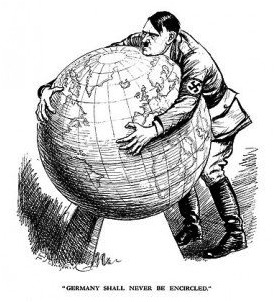
Source E: "Germany Shall Never Be Encircled" (Political Cartoon)
Evaluation
Below is the rubric for this assignment:
Total: _____/100 Name: _______________
Class Period: _____
Power and Corruption: Performance-Based Task
Scoring Rubric
Task 1: Cornell Notes and Text-Dependent Questions about the Anchor Text
- Cornell Notes Activity: _____/12
- Notes Section: _____/4
- Main Ideas/Questions Section: _____/4
- Summary Section: _____/4
- Text-Dependent Questions and Explanations: _____/18
- Question 1. _____/1 Explanation: _____/2
- Question and Explanation 2. _____/3
- Question and Explanation 3. _____/3
- Question and Explanation 4. _____/3
- Question 5A. _____/1 Explanation: _____/2
- Question 5B: _____/1 Explanation: _____/2
Task 2: Notes about Other Sources
- Note-Taking Activity: _____/20
- Source A: _____/4
- Source B: _____/4
- Source C: _____/4
- Source D: _____/4
- Source E: _____/4
Task 3: Argument Essay
- Total: _____/50
Conclusion
By completing this PBT, you have gone through a process that will help to introduce you to the types of tasks that you may be asked to complete on the PARCC Tests later this year. Hopefully it has helped you to see that several texts will be presented in various ways, and that you will need to synthesize the information from these texts in several short activiites and one longer written response.