
Introduction
QUESTION: DO YOU RECOGNIZE THE EARTH LIKE THIS?

No? Well...
HAVE YOU EVER HEARD OF PLATE TECTONICS?

Because of Plate Tectonics, we now have the Earth that we recognize today (the picture above). Keep reading to see what these plates do and the reason that they do it for.
- Pangea is a hypothetical supercontinent that included all current land masses, believed to have been in existence before the continents broke apart during the Triassic and Jurassic Periods.
- Plate tectonics is a theory explaining the structure of the earth's crust and many associated phenomena as resulting from the interaction of rigid lithospheric plates which move slowly over the underlying mantle.
- There are 9 major plates. The nine major plates are North American, Pacific, Eurasian, African, Indo-Australian, Australian, Indian, South American and Antarctic.
- There’s different types of plate boundaries. The three are convergent, divergent, and transform.
- Convergent – When two plates are colliding. i. Where oceanic crust meets ocean crust
ii. Where oceanic crust meets continental crust
The denser oceanic plate is subducted, often forming a mountain range on the continent. The Andes is an example of this type of collision.
iii. Where continental crust meets continental crust
Both continental crusts are too light to subduct so a continent-continent collision occurs, creating especially large mountain ranges. The most spectacular example of this is the Himalayas - Island arcs and oceanic trenches occur when both of the plates are made of oceanic crust. Zones of active seafloor spreading can also occur behind the island arc, known as back-arc basins. These are often associated with submarine volcanoes.
- Divergent – Where two plates are moving apart.
i. On land
Divergent boundaries within continents initially produce rifts, which produce rift valleys.ii. Under the sea
The most active divergent plate boundaries are between oceanic plates and are often called mid-oceanic ridges. -
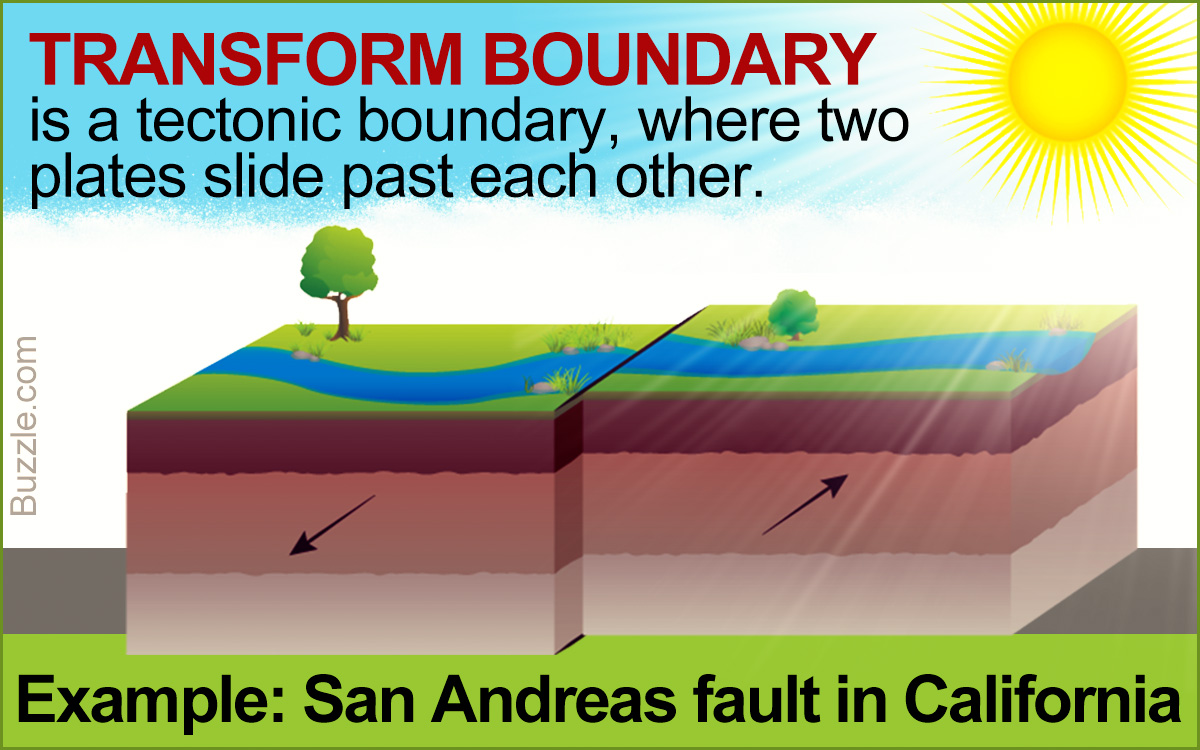
Transform – Where two plates slide passed each other. The relative motion of the plates is horizontal. They can occur underwater or on land, and crust is neither destroyed nor created. Because of friction, the plates cannot simply glide past each other. Rather, stress builds up in both plates and when it exceeds the threshold of the rocks, the energy is released – causing earthquakes.
AND ALL OF THIS CAUSES....
Mountains - Convergent Boundaries

Faults - Divergent Plate Boundaries

Tsunamis - Divergent Plate Boundaries

Volcanoes - Convergent Boundaries (subduction zones), Divergent Boundaries (Mid-Ocean Ridges, Continental Rifts)

Earthquakes - Convergent Plate Boundary (Subduction)

Task
By the end of this Webquest you will have learned the different type of plate boundaries and the different amount of plates effected by Plate tectonics.
Your Task is to actively write notes because there is a lot of information to learn!
I will provide youtube links to plate boundaries and all the plates effected by plate tectonics.
The links will provide you with a lot of information but it is up to you to do a deeper dive in the subject!
After watching the videos you will be tested with a game that will test what you learned.
You will also be given some question in the "Process" portion of the web quest that you will need to answer!
Did we take notes? Did we understand how plate tectonics works?
Make sure to click on the link below!
https://www.learner.org/interactives/dynamicearth/platesboundarieschallenge/
Process
Convergent Boundary:

Divergent Boundary:

Transform Boundary:
Questions:
1.) Which type of volcano would you most likely find at a convergent boundary?
2.) Which type of volcano would you most likely find at a divergent boundary?
3.) Where are transform boundaries found?
4.) How do convergent boundaries cause earthquakes?
5.) What happens at a divergent boundary?
6.) What geologic event is most likely to occur at transform boundaries?
7. In what year did the Mid- Atlantic ridge get mapped?
8. What are the pieces in the lithosphere called?
Answers:
1.) Composite volcanoes are common at convergent boundaries.
2.) Shield volcanoes often form along divergent plate boundaries.
3.) Many transform boundaries are found on the sea floor, where they connect segments of diverging mid- ocean ridges.
4.) Earthquake at convergent plate boundaries mark the motions of subjecting lithosphere as it plunges through the mantle.
5.) Divergent boundaries in the middle of the ocean contribute to seafloor spreading. As plates made of oceanic crust pull apart, a crack in the ocean floor appears.
6.) Faulting, earthquake, landslide, mass movement due to the effect of energy released by movement of plates.
7. 1950's
8. Plates
Evaluation
|
CATEGORIES |
4 |
3 |
2 |
1 |
|
ANSWERS TO THE QUESTIONS |
ALL QUESTIONS ARE ANSWERED CORRECTLY. |
THERE ARE 1 OR 2 QUESTIONS NOT ANSWERED AND/OR NOT CORRECT. |
THERE ARE 2 OR MORE OF THE QUESTIONS NOT ANSWERED AND/OR CORRECT. |
THERE ARE 3 OR MORE OF THE QUESTIONS NOT ANSWRED AND/OR CORRECT. |
|
USE OF RESOURCES |
THE RESOURCES PROVIDED WERE USED EFFICENTLY. |
THE RESOURCES PROVIDED WERE USED SIMI-EFFICENTLY. |
THE RESOURCES PROVIDED WERE USED ARE A BARE-MINIMUM.
|
THE RESOURCES ARE NOT USED. |
|
SPELLING AND PUNCTUATION |
NO SPELLING OR PUNCTUATION ERRORS. |
THERE IS 1-2 SPELLING AND/OR PUNCTUATION ERRORS. |
THERE ARE 2-3 SPELLING AND/OR PUNCTUATION ERRORS. |
THERE ARE MORE THAN 3 SPELLING AND/OR PUNCTUATION ERRORS. |
Conclusion
Understanding tectonic plates is very important for the earth and all of its inhabitants. To understand what causes the plates to move not
only gives us insight on how the earth has evolved geographically but allows insight as to how it will evolve in the future. We must ask
ourselves: "What are tectonic plates?", "What do they consist of?", "What causes them to take motion?", and "What are the affects these
plates have on the earth, on us?".
As the plates move and collide with one another they start a snowball reaction. Sometimes this reaction is so small and insignificant that it
goes completely unnoticed. Other times this reaction is so large that it creates geographical changes, such as a volcano formation.
Another large reaction is natural disasters such as earthquakes and tsunamis which can result in many deaths.
The type of reaction depends on where the plates are located and where the fault lines are located. There is no limitation as to where on
earth these tectonic plates exist- that sea, the mountains, in the city, your backyard. The location of these fault lines is a major source of
information for us and allows us to prepare for large reactions caused by the tectonic plate's motion. Unfortunately not every movement is
detected. Sometimes even the movements that will cause disasters go undetected and unnoticed. This only allows us to monitor and
prepare for a large scale reaction - sometimes that is all we can do: prepare for the worst and hope for the best.
Credits
INTRODUCTION:
- https://www.dictionary.com/browse/plate-tectonics#
- https://www.livescience.com/37706-what-is-plate-tectonics.html
- https://www.gns.cri.nz/Home/Learning/Science-Topics/Earthquakes/Earthquakes-at-a-Plate-Boundary/Tectonic-Plates-and-Plate-Boundaries
- https://www.yourdictionary.com/pangaea
Task:
Process: