
Introduction

Congratulations! 🎉
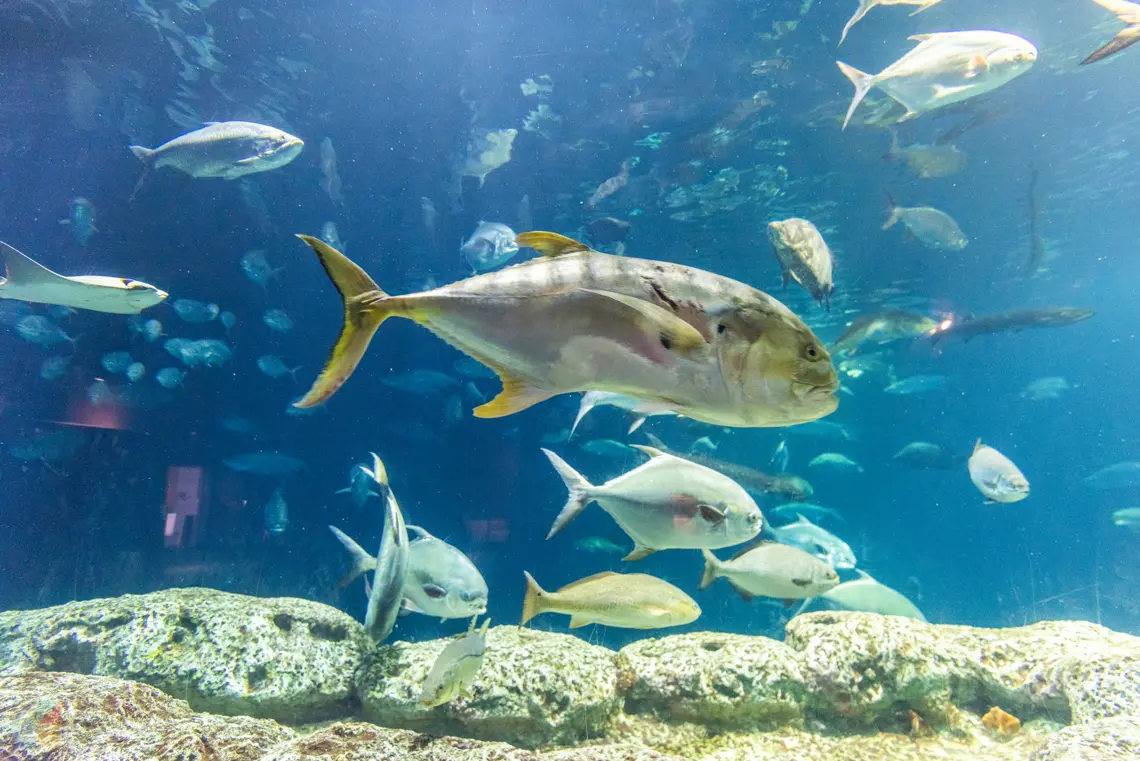
Your 7th grade class is planning a field trip to the South Carolina Aquarium in Charleston. The principal has approved the trip — but only if your class can prove the trip stays within budget.
You and your class are now the official Budget Planning Committee. Using proportional reasoning, unit rates, and real-world math skills, you must determine whether the trip is affordable and how much each student must pay.
Will the trip happen?! Check out what we might see! https://www.montereybayaquarium.org/animals/live-cams
Before you begin, review proportional reasoning concepts:
📘 Intro to Proportional Relationships? (Khan Academy)
https://www.khanacademy.org/math/cc-seventh-grade-math/cc-7th-ratio-proportion/cc-7th-proportional-rel/v/introduction-to-proportional-relationships
📺 Solving Proportions Video (Khan Academy)
📘 Unit Rates Explained (Math is Fun)
https://www.mathsisfun.com/definitions/unit-rate.html
Task
You must:
- Calculate transportation cost per student
- Calculate total ticket costs
- Calculate total lunch costs
- Determine total trip cost
- Determine how much each student must pay after the school contributes $500
- Decide whether the trip stays within a reasonable budget
Process
🔎 Step 1: Gather the Facts
-
85 students attending
-
6 teachers (free admission for teachers)
-
Charter bus cost: $1,680 total
-
Aquarium ticket cost: $14.50 per student
-
Lunch cost: $8.25 per student
-
School contributes: $500
🚌 Step 2: Transportation
-
Find the cost per student for the charter bus.
-
Show your unit rate calculation.
Helpful resource on dividing decimals:
📘 Dividing Decimals (Math is Fun)
https://www.mathsisfun.com/dividing-decimals.html
🎟️ Step 3: Admission
-
Calculate the total cost of student tickets.
-
Write a proportion showing the relationship between number of students and total ticket cost.
Need help writing proportions?
📘 Writing Proportions (CK-12)
https://flexbooks.ck12.org/cbook/ck-12-middle-school-math-concepts-grade-7/section/5.9/primary/lesson/proportions-msm7/
🍽️ Step 4: Lunch
-
Calculate total lunch cost.
-
Find the combined cost per student (tickets + lunch + bus).
💰Step 5: Total Trip Budget
-
Add all trip costs together.
-
Subtract the school’s $500 contribution.
-
Determine how much each student must pay.
❓Step 6: Challenge Extension
If only 70 students attend:
-
Recalculate the transportation cost per student.
-
Does the price increase or decrease?
-
Explain why proportional relationships change when quantities change.
Evaluation
Your project will be graded using the following rubric:
| Criteria | 4 – Advanced | 3 – Proficient | 2 – Developing | 1 – Beginning |
|---|---|---|---|---|
| Math Accuracy | All calculations correct | Minor errors | Multiple errors | Major misunderstandings |
| Use of Proportions | Correct and clearly shown | Mostly correct | Attempted | Not shown |
| Unit Rate | Clearly calculated and explained | Calculated correctly | Partially correct | Incorrect |
| Explanation | Strong reasoning & justification | Adequate explanation | Limited explanation | No explanation |
Conclusion
Great work, Budget Committee! 💼📊
You have used proportional reasoning to solve a real-world problem just like financial planners do every day.
Think about these reflection questions:
-
Why is proportional reasoning important in budgeting?
-
How did unit rates help simplify the problem?
-
Would increasing the number of students always decrease cost per student? Why or why not?
Math is powerful because it helps us make informed decisions in real life — even about something as exciting as a field trip!
Credits
This WebQuest was created for instructional purposes and aligns to:
South Carolina College- and Career-Ready Standard
7.PAFR.1.1 Apply proportional reasoning to solve problems in mathematical and real-world situations involving ratios and percentages.
Scenario Context
The field trip scenario is a fictionalized budgeting simulation created for classroom learning purposes. Ticket prices and costs may not reflect current real-world pricing and are used strictly for instructional design.