
Introduction
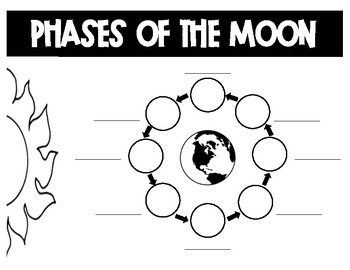
Moon Phase Graphic Organizer
_________________________________________________________________________________________________________
Moon Phase Video!
Source:
KidsEduc – Kids Educational Games. (2014). Lunar Cycle, Why The Moon Change Shapes, 8 Phases Of The Moon, Learning Videos For Children. YouTube. Retrieved March 30, 2022, from https://youtu.be/NCweccNOaqo.
___________________________________________________________________________________________________________
The Phases of the Moon
By Anne Buckle and Graham Jones
The Moon has eight phases in a lunar month: four primary and four intermediate phases.
How Do Moon Phases Work?
Half of the Moon’s surface is always illuminated by sunlight. As the Moon orbits Earth, it changes how much of the lit-up side we can see.
Moon Phases in Order
The eight Moon phases of a lunar month are divided into four primary and four intermediate (waxing and waning) Moon phases:
- New Moon
- Waxing Crescent Moon
- First Quarter Moon
- Waxing Gibbous Moon
- Full Moon
- Waning Gibbous Moon
- Third Quarter Moon
- Waning Crescent Moon
Primary Moon phases happen at a specific moment in time, while the time between these moments are the intermediate Moon phases. The lunar cycle lasts about 29.5 days, just under a calendar month.
New Moon
- Moon phase: primary
- Moonrise: around sunrise | Moonset: around sunset
- Illumination: 0%
- Position in space: the Moon is between the Sun and Earth
If the Moon’s path crosses the plane of Earth's orbit around the Sun (the ecliptic) while the Sun, Moon, and Earth are aligned at New Moon, a solar eclipse happens somewhere in the world.
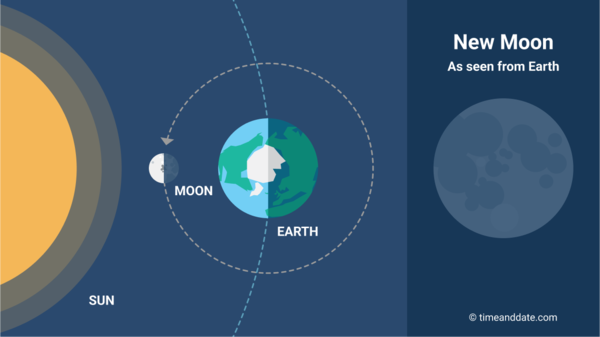
New Moon: The Moon is between the Sun and Earth. Only the dark unlit side of the Moon is facing toward us.
Waxing Crescent Moon
- Moon phase: intermediate
- Moonrise: morning | Moonset: afternoon
- Illumination: 0.1% to 49.9%
- Orientation: right half is lit in Northern Hemisphere,
left half is lit in Southern Hemisphere - Position in space: moving from New Moon to First Quarter Moon
The Crescent phases can be a good time to see Earthshine, when sunlight reflected from Earth gives the dark areas of the Moon a faint glow.
First Quarter Moon (Half Moon)
- Moon phase: primary
- Moonrise: around midday | Moonset: around midnight
- Illumination: 50% (How much you see the moon)
- Orientation: right half is lit in Northern Hemisphere,
left half is lit in Southern Hemisphere - Position in space: the Moon has gone one quarter of the way around Earth
Look for the First Quarter Moon in the blue afternoon sky.
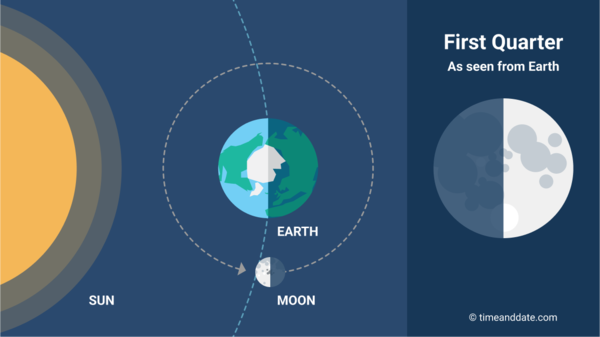
First Quarter Moon: The Moon is 90 degrees from the Sun, and exactly half of the Moon’s surface facing us is lit up.
Waxing Gibbous Moon
- Moon phase: intermediate
- Moonrise: afternoon | Moonset: early morning
- Illumination: 50.1% to 99.9%
- Orientation: right half is lit in Northern Hemisphere,
left half is lit in Southern Hemisphere - Position in space: moving from First Quarter to Full Mo
Full Moon
- Moon phase: primary
- Moonrise: around sunset | Moonset: around sunrise
- Illumination: 100%
- Position in space: the Moon and the Sun are on opposite sides of Earth
If the Moon’s path crosses the plane of Earth's orbit around the Sun (the ecliptic) while the Sun, Earth, and Moon are aligned at Full Moon, a lunar eclipse happens on the night side of Earth.
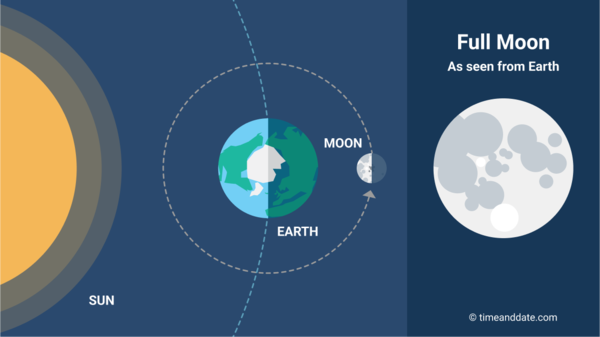
Full Moon: The Moon and the Sun are on opposite sides of Earth, and the side facing us is completely lit up.
Waning Gibbous Moon
- Moon phase: intermediate
- Moonrise: evening | Moonset: morning
- Illumination: 99.9% to 49.9%
- Orientation: left half is lit in Northern Hemisphere,
right half is lit in Southern Hemisphere - Position in space: moving from Full Moon to Third Quarter Moon
The Moon can still look quite full a few days after Full Moon in the Waning Gibbous phase.
Third Quarter Moon (Half Moon)
- Moon phase: primary
- Moonrise: around midnight | Moonset: around midday
- Illumination: 50%
- Orientation: left half is lit in Northern Hemisphere,
right half is lit in Southern Hemisphere - Position in space: the Moon has gone three quarters of the way on its orbit around Earth
The Third Quarter Moon begins the last quarter of the lunar cycle.
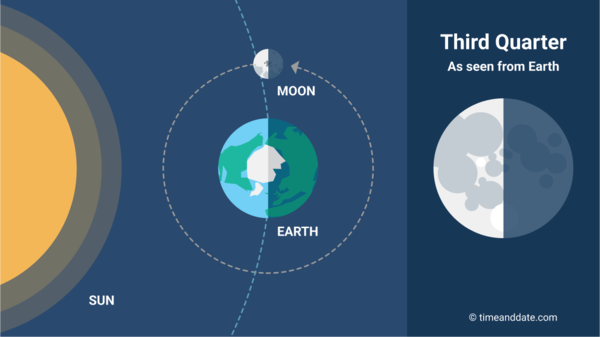
Third Quarter: The Moon has completed three quarters of its orbit around Earth, and exactly half of its surface facing us is lit up.
Waning Crescent Moon
- Moon phase: intermediate
- Moonrise: early morning | Moonset: afternoon
- Illumination: 49.9% to 0.1%
- Orientation: left half is lit in Northern Hemisphere,
right half is lit in Southern Hemisphere - Position in space: moving from Third Quarter to New Moon
The Crescent phases can be a good time to see Earthshine, when sunlight reflected from Earth gives the dark areas of the Moon a faint glow.
Source:
Buckle, A., & Jones, G. (n.d.). What are Moon Phases? Phases of the Moon. Retrieved March 30, 2022, from https://www.timeanddate.com/astronomy/moon/phases.html
_________________________________________________________________________________________________________
The Phases of the Moon for Kids
Read more at: https://www.ducksters.com/science/phases_of_the_moon.php
This text is Copyright © Ducksters. Do not use without permission.
The moon itself doesn't emit any light like the sun. What we see when we see the moon is sunlight reflected off the moon. The phase of the moon is how much of the moon appears to us on Earth to be lit up by the sun. Half of the moon is always lit up by the sun, except during an eclipse, but we only see a portion that's lit up. This is the phase of the moon. Around once per month, every 29.53 days to be exact, the phases of the moon make a complete cycle. As the moon circles the Earth, we can only see a portion of the lit up side. When we can see 100% of the lit up side, this is a full moon. When we can't see any of the lit up side, this is called a dark moon or new moon.
What are the different phases of the moon?
As the moon orbits or circles the Earth, the phase changes. We'll start with what is called the New Moon phase. This is where we can't see any of the lit up side of the moon. The moon is between us and the sun (see the picture). As the moon orbits the Earth we can see more and more of the lit up side until finally the moon is on the opposite side of the Earth from the sun and we get a full moon. As the moon continues to orbit the Earth we now see less and less of the lit up side.
Waxing or Waning?
As the New moon begins its orbit and we see more and more of the moon, this is called Waxing. After the moon gets to its Full phase, we start to see less and less of the moon. This is called Waning.
Source:
The phases of the moon for kids. Ducksters. (n.d.). Retrieved March 30, 2022, from https://www.ducksters.com/science/phases_of_the_moon.php
Task
Evaluation
1. Where is the moon located around the Earth during this phase? 
a. Between the sun and the Earth, causing the moon to not be visible due to a shadow
b. Farthest away from the sun with now shadow
c. Diagonal from the sun where only half of the moon can be seen
2. About how many days does it take the pattern of the phases of the moon to repeat?
a. about 8 days
b. about 60 days
c. about one month/31 days
3. What does it mean when a moon is waxing?
______________________________________________________________________________________________________
4. What does it mean when a moon is waning?
_______________________________________________________________________________________________________
5. What percentage will you be able to see of a first quarter moon?
a. 100%
b. 50%
c. 10%
d. 75%
6. The moon has sunlight just like the sun
a. True
b. False
7. We are able to see all sides of the moon
a. True
b. False
8. What phase of the moon is not visible at all?
a. full
b. new
c. first quarter
d. waxing gibbous
9.What is it called when less than half of the moon is let by the sun? _____________________________________________
10. Why are we able to see all of a full moon?
_________________________________________________________________________________________________________
__________________________________________________________________________________________________________
___________________________________________________________________________________________________________
Credits
Sources
Buckle, A., & Jones, G. (n.d.). What are Moon Phases? Phases of the Moon. Retrieved March 30, 2022, from https://www.timeanddate.com/astronomy/moon/phases.html
KidsEduc – Kids Educational Games. (2014). Lunar Cycle, Why The Moon Change Shapes, 8 Phases Of The Moon, Learning Videos For Children. YouTube. Retrieved March 30, 2022, from https://youtu.be/NCweccNOaqo.
The phases of the moon for kids. Ducksters. (n.d.). Retrieved March 30, 2022, from https://www.ducksters.com/science/phases_of_the_moon.php
Teacher Page
Louisiana Student Standard: 1-ESS1-1
Performance Expectation: Use observations of the sun, moon, and stars to describe patterns that can be predicted.
Disciplinary Core Ideas: Patterns of the motion of the sun, moon, and stars in the sky can be observed, described, and predicted.
Crosscutting Concepts: Patterns in the natural and human designed world can be observed, used to describe phenomena, and used as evidence.