
Introduction
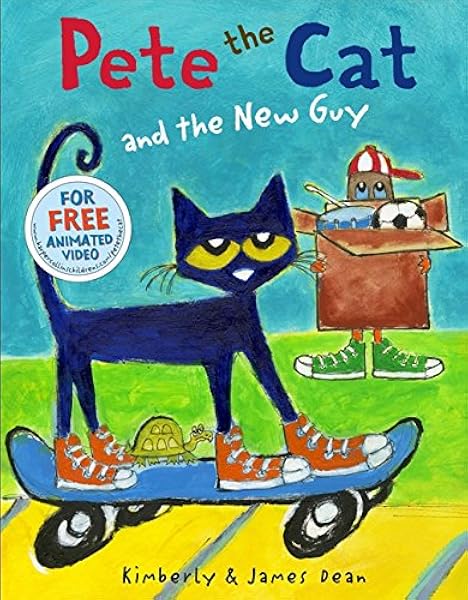
Have you ever met someone who is not just like you? Of course, you have and so has everyone else. Every single person in the world is different, we look, act, and think differently. Some of us can play the piano, some of us can play soccer, and others are really good at video games; this is because we all have different talents. Today, we will read a book about Pete the Cat and his new neighbor and how he learns not everyone can do everything that he could do. Pete the Cat and the New Guy by Kimberly and James Dean is about Pete the Cat and his amazing adventures. Come with Pete the Cat to meet the new guy and see where this new journey takes us. After reading the story we will be working on three different activities some that are worked on alone, and some you work on with a buddy! In the story make sure you keep an eye out for the main idea. The main idea is the entire point of the story, this is what the author wants you to learn from the story. Below is an image of the book that we will be using to complete these activities.
Task
The Task:
After reading the book, you will go through the book and talk about how you met someone new and what makes you different from that person. Talk about your differences but what still brings the two of you together. With this, you will each make lists of your favorite food, favorite movie, favorite song, and favorite activities. Then the two of you can show each other your lists and expand on it until you find something the two of you have in common.
- Make lists of your favorite things
-share lists
-expand on lists until you find common interests
-talk about how you both are different but can still share similar interests.
Process
Materials needed:
- Book "Pete the Cat and the New Guy" by Kimberly and James Dean
- Looseleaf paper
-Writing utensils
- A partner
-Crayons, markers, and colored pencils
-White paper
-Computer
-Internet access
Read the book before beginning any of these activities.
Activity #1: Setting, In the book we see that Pete the Cat is in his neighborhood. We all live in different neighborhoods, use the word "neighborhood" and make an acronym of different things you see in your neighborhood.
Step 1: Read the book
Step 2: Look at the neighborhood Pete is in, and relate it to yours. See similarities like neighbors, trees and etc.
Step 3: Grab some paper and other materials like markers and write "neighborhood" letter by letter going down the paper.
Step 4: Find things that start with the letters in your neighborhood and write them next to the letters that correspond with,
Step 5: Draw pictures that relate to the pictures.
Activity #2: main idea, In the book, we see that Pete the Cat meets a new neighbor and Pete finds out how this Platypus is different from him as a cat. He then realizes that he can not do all the same things, but they keep trying to find things that they both are able to do. Try a few things that someone in your family can do and you can't, and then vice versa.
Step 1: Read the book, and look for the main idea.
Step 2: Find a family member who is willing to participate.
Step 3: You both write a few things down each other are not able to do it.
Step 4: Realize it is okay to be able to different things, and then find something you are both able to do!
Activity #3: Vocabulary/Synonyms, in the book we see many new words, some such as juggling, feeling blue, and etc. I want you to find words five words that you are not super familiar with and look up synonyms to go with the word.
Step 1: Read the book, and find unfamiliar words.
Step 2: Write down unfamiliar words and using context clues to write down what you think they are.
Step 3: Go on the internet, or look through the dictionary and find the synonyms to the word you are not familiar with. Then use the word in a sentence.
Evaluation
| 5 points | 3 points | 1 point | |
| The student shows an understanding of the main idea. | The student uses the main idea correctly in the activity and identifies at least 2 or more differences. | The student uses the main idea correctly most of the time and has at least one difference in the activity. | The student attempts to understand the main idea and tries to do the activity. |
| The student accurately picks out vocabulary words and puts the words in a sentence correctly. | The student picks out at least five vocabulary words and uses them correctly in a sentence. | The student has at least three to four vocab words and tries to use them in a sentence correctly. | The student picks at least one vocab word and attempts to use it correctly in the sentence. |
| The student uses correct words and spelling in the "neighborhood" activity. | The student finds a word for every letter in the acronym and correctly spells the word. | The student finds a word for almost every letter in the acronym and correctly spells almost all the words. | The student finds a word for at least half of the letters in the acronym and correctly spells almost all the words. |
Conclusion
In conclusion, students should have a better understanding of the book and its main idea. Plus, the students will be able to identify differences in family, friends, and neighborhoods.
Ending questions to think about:
1. What made Pete the Cat and Gus the Platypus different?
2. What things make you different from the people around you?
3. What did you learn about being different from people around you?
Credits
Dean, Kimberly, and James Dean. Pete the Cat and the New Guy. Harper, an imprint of HarperCollins, 2014.
Teacher Page
Grade: 1st grade
Objective: Students will be able to find the main idea, settings, and use context clues to identify unknown words.
State Standards:
~1.RL.2.1 Ask and answer questions about the main idea and key details in a text.
~1.RL.2.3 Using key details, identify and describe the elements of plot, character, and setting.
~1.RV.2.1 Demonstrate understanding that context clues (e.g., words and sentence clues) and text features (e.g., glossaries, illustrations) may be used to help understand unknown words.
Main Idea: The main idea is that everyone you meet is different. They look, act, and think differently. Being different means that we all have different challenges and things that we are not able to do but that does not mean you should not be friends with someone just because everyone is different.