
Introduction
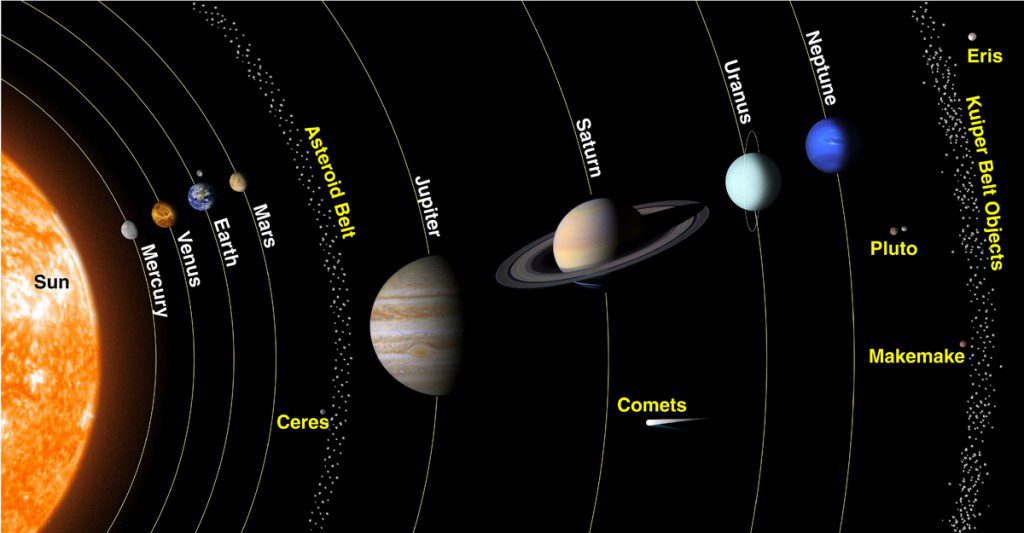
This Webquest Introduction: This lesson allows students to visualize the comparative sizes and distances of solar system bodies by making solar system objects to scale using common objects, walking off the distances between planets, and participating in a Web-based Sun/Earth scale model activity.
We have discovered several hidden planets in the solar system and there is no information behind them. I am asking for your help to identify them along with our current solar system. The best way to know about the solar system is to review what's out there in space and model the new planets in our solar system class project.
Task
Students will:
• Demonstrate the size of the sun and the bodies of the solar system on the ten-billionth scale.
• Construct and walk the distances between the bodies of the solar system on the ten-billionth scale.
• Compare the temperature, diameter, and distance to the sun with familiar things on Earth.
Process
You will sit in your seat and watch a video on the Solar System.
After the video you will fill in the Do Now.
You then will have the opportunity to share your answers with the class.
Then, you will be split into pairs
Each pair will receive a chrome book and a topic on the solar system.
You can use videos, images, audio, etc.
Once you gather all your information, you will share what you have found with the class.
You will go back to your seat and write down any further questions you might have.
You then will get a personal whiteboard, marker, and eraser.
You will then answer the questions to the Kahoot! on the board.
After, the Kahoot! you will go back to your original questions and see if you can answer them.
If you still need clarification, please circle the question and hand it to me, before leaving the class.
This is where the class will be split into pairs and given a topic to research. During this time you will use your resources to research and
discover more about the solar system. You then will demonstrate your new-found knowledge and share it with the class, using a video,
image, or audio. Be able to "teach" your peers.
Evaluation
This is how your work will be evaluated.
| Beginning 1 |
Developing 2 |
Qualified 3 |
Exemplary 4 |
Score |
|
|---|---|---|---|---|---|
| The Solar System | A general understanding of the solar system. No demonstration of the orbits of the planets. | Description of the planets orbit, with few errors in description. | Description of the planets orbit with the ability to add some outside information. | Description of the planets orbit, with a deeper understanding of the solar system. | |
Conclusion
How does the solar system orbit? And what have you learned about the Solar System?
Now we will be digging deeper into the Solar System and the impact it has on our daily lives.
Here are some questions that we can talk about.
What is the biggest thing you have ever touched?
If the Sun is so much bigger than the Moon, why does it appear the same size as the Moon when viewed through solar-viewing glasses?
What is an easy way to remember the planets?
Credits
asa.gov/sites/default/files/546148main_ESS8_ScaleModelsOfTheSolarSystem_C3_Final.pdf
Teacher Page
NATIONAL STANDARDS National Science Education Standards (NSTA) Earth and Space Science
Earth in the Solar System Common Core State Standards for Mathematics (NCTM) Ratios and Proportional Relationships
Understand ratio concepts and use ratio reasoning to solve problems ISTE NETS and Performance Indicators for Students (ISTE) Creativity and Innovation
Use models and simulations to explore complex systems and issues Research and Information Fluency
Process data and report results Technology Operations and Concepts • Understand and use technology systems