
Introduction
My name is Claudia, I will be your professor. In this course you will learn about literature.
Objective: Identify the elements of a story in order to create your own story.
A story is a narrative, typically presented in a sequential manner, that describes a series of events involving characters within a specific setting. At its core, a story often follows a plot structure, where events unfold, conflicts arise, and resolutions are reached. However, stories can vary widely in form and content, encompassing genres such as fiction, non-fiction, fantasy, mystery, romance, and more.
Fundamentally, a story serves to entertain, inform, or communicate ideas. It may evoke emotions, provoke thought, or convey moral lessons. Through the use of various literary elements such as characters, setting, plot, theme, point of view, and style, storytellers craft narratives that engage their audience and convey meaning.
Stories have been a fundamental part of human culture for millennia, passed down through oral tradition, written texts, visual media, and digital platforms. They serve as a means of sharing experiences, preserving cultural heritage, and exploring the complexities of the human condition. Whether told around a campfire, depicted on a movie screen, or written in a book, stories have the power to captivate, inspire, and connect people across time and space.
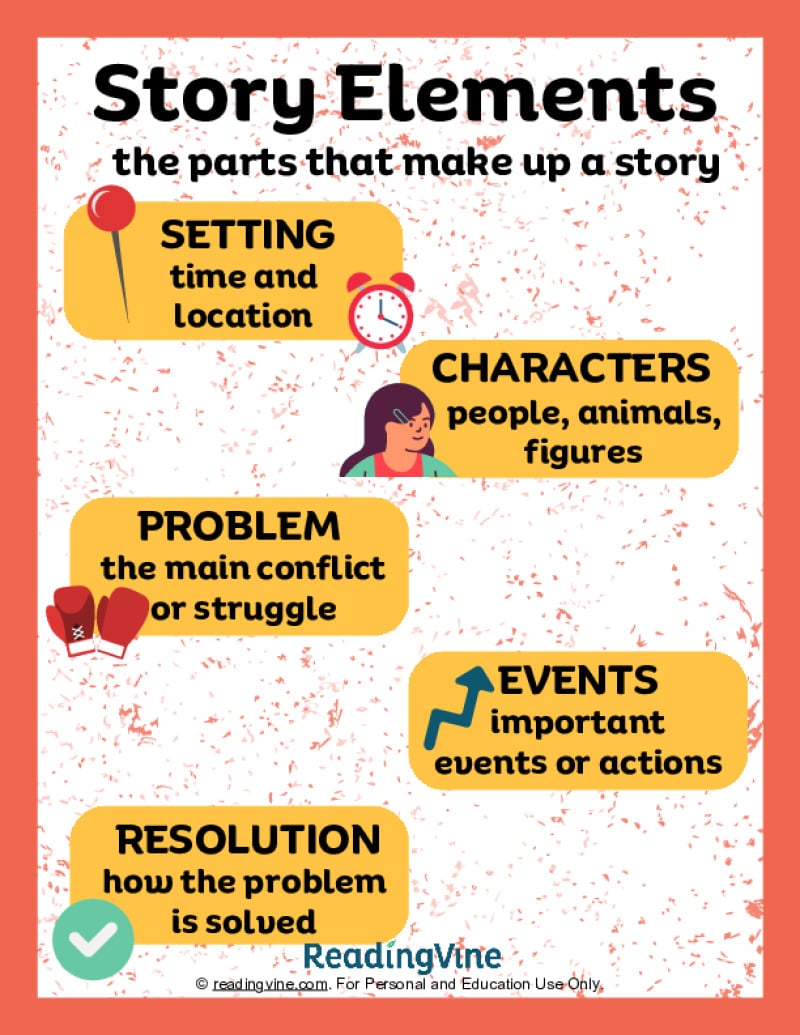
- Theme: The central idea or message of the story
- Characters: The people driving the story
- Point-of-View: Whose perspective the story follows
- Plot: The narrative structure of the story
- Conflict: Obstacles facing characters
- Setting: When and where the story takes place
- Style: The author's unique voice
Task
Activity 1: Click on the link and solve the questions.
https://wordwall.net/resource/1181439/fiction-story-elements
Activity: Watch the story: Four brothers and complete the chart with the elements of the story.
https://www.youtube.com/watch?v=mhvRk_46G_g
https://www.k12reader.com/worksheet/story-elements-form/view/
Process
Watch the video and take notes about the elements of the story
Evaluation
Evaluation: My own story
Indications
- Write your own story using
- Include the elements of a story.
- The topic is free.
Rubric for the evaluation.
|
|
CATEGORY |
4 |
3 |
2 |
1 |
|
Title |
Title is creative, sparks interest and is related to the story and topic. |
Title is related to the story and topic. |
Title is present, but does not appear to be related to the story and topic. |
No title. |
|
Spelling and Punctuation |
There are no spelling or punctuation errors in the final draft. Character and place names that the author invented are spelled consistently throughout. |
There is one spelling or punctuation error in the final draft. |
There are 2-3 spelling and punctuation errors in the final draft. |
The final draft has more than 3 spelling and punctuation errors. |
|
Setting |
Many vivid, descriptive words are used to tell when and where the story took place. |
Some vivid, descriptive words are used to tell the audience when and where the story took place. |
The reader can figure out when and where the story took place, but the author didn\'t supply much detail. |
The reader has trouble figuring out when and where the story took place. |
|
Problem/Conflict |
It is very easy for the reader to understand the problem the main characters face and why it is a problem. |
It is fairly easy for the reader to understand the problem the main characters face and why it is a problem. |
It is fairly easy for the reader to understand the problem the main characters face but it is not clear why it is a problem. |
It is not clear what problem the main characters face. |
|
Characters |
The main characters are named and clearly described in text as well as pictures. Most readers could describe the characters accurately. |
The main characters are named and described. Most readers would have some idea of what the characters looked like. |
The main characters are named. The reader knows very little about the characters. |
It is hard to tell who the main characters are. |
|
Focus on Assigned Topic |
The entire story is related to the assigned topic and allows the reader to understand much more about the topic. |
Most of the story is related to the assigned topic. The story wanders off at one point, but the reader can still learn something about the topic. |
Some of the story is related to the assigned topic, but a reader does not learn much about the topic. |
No attempt has been made to relate the story to the assigned topic. |
|
|
Conclusion
The elements of a story is to provide a framework for crafting narratives that engage, entertain, and provoke thought. By incorporating elements such as characters, setting, plot, theme, point of view, and style, storytellers aim to create rich, immersive experiences for their audience. These elements work together to establish the context, drive the plot forward, convey meaning, and evoke emotions. Ultimately, the objective is to construct a cohesive and compelling narrative that captures the reader's imagination, explores universal truths, and leaves a lasting impact. Whether through literature, film, or other forms of storytelling, mastering the elements of a story allows creators to connect with their audience on a profound and meaningful level.