
Introduction
This webquest will guide you through the process of answering the question "how can disease change the world?"
This unit will be almost entirely self-paced, requiring you to create a detailed calendar that maps out each section of this webquest and your "next steps."
For each step in the Process, you will be required to complete at least one Evaluation. (Process is where you will find your resources.) You and your group are responsible for the contents of this webquest; use your classmates, myself, and the internet as additional resources.
Ex.: Under Process, step 2 in Africa is to take the notes. Under Evaluation, step 2 is to take an assessment. You should use your notes to take this assessment.
Task
How can disease change the world?
In preparation for your final project, complete this webquest.
Process
Africa
1. Political Map of Africa - Individual: Label Morocco, Algeria, Libya, Egypt, Mali, Niger, Ghana, Chad, Sudan, South Sudan, Somalia, Kenya, Tanzania, and Western Sahara on your blank map. These are the modern North African countries. Using different colored pencils or markers and the internet as a resource, label and date the North African kingdoms of Ghana, Mali, Songhai, and the Swahili settlement.
2. Take Africa Notes - Individual: Complete the assignment "Africa Assessment" on Echo
3. The Africa Notes ^
The Gold Trade of Ancient and Medieval Africa
Page 232 in the textbook (Glencoe World History)
Societies and Empires in Africa 800-1500
Any other online resource you find.
Partner: Label your trade routes map "Global Trade Routes - 500 CE - 1500 CE." On your map, label a minimum of four trade routes that begin and/or end in Africa. Include the items, ideas, etc. being traded. This should be done on a different map than your political map; the same map should be used for all the regions trade routes.
4. Honors only: read the account of Ibn Battuta on page 235 of your textbook. - Individual: Honors only: Complete questions 1 and 2 (analyzing primary sources) and submit to Echo in "The Salt Mines - Analyzing Primary Sources"
Asia
1. Political Map of Asia, Pg. 248 in your textbook - Individual: Label Turkey, Israel, Saudi Arabia, Iraq, Iran, Pakistan, Afghanistan, India, China, Yemen, Oman, and the U.A.E. on your blank map. These are the modern Asia countries. Using different colored pencils or markers and the internet as a resource, label and date the following historical borders in Asia: the Tang Empire, the Song Empire, the Mongol Empire, the Ming Empire, Medieval Japan, the Delhi Sultanate and the Mughal Empire.
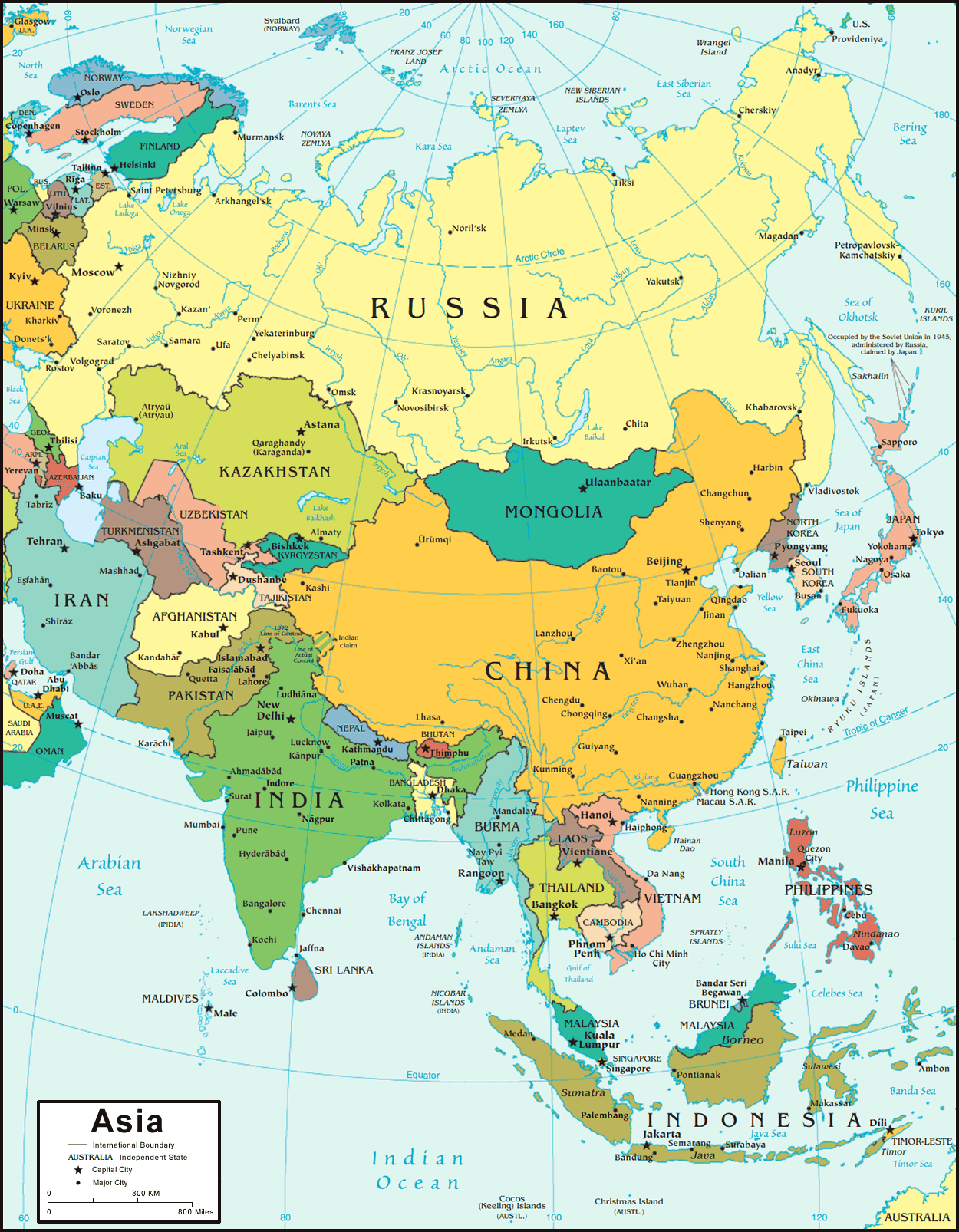
2. Silk Road Reading - Individual: In Echo, complete assigned reading and accompanying questions in the assignment titled "Silk Roads Reading and Questions."
3. Take Asia Notes - Individual: Complete the assignment "Asia Assessment" on Echo.
4. The Asia Notes ^
Medieval Trade Routes (see Africa)
Any other online resource you find
Partner: On your map, label the Silk Roads. Additionally, label a minimum of three trade routes that begin and/or end in Asia. Include the items, ideas, etc. being traded.
5. Crash Course Video: Zheng He only (No assignment at this time.)
Ottoman Empire
1. Political Map of North Africa, the Middle East, and Europe -
Page 459 in your textbook - Individual: Label Egypt, Libya, Turkey, Greece, Bulgaria, Bosnia Herzegovina, Syria, Israel, Saudi Arabia, Iraq, and Hungary. Also, label the Balkan region. Using a colored pencil or marker and the internet as a resource, label and date the historical Ottoman empire at the following dates: 1325 CE, 1451 CE, 1520 CE, 1900 CE.
2. Take The Ottoman Empires Notes - Individual: Complete the "Ottoman Empire Assessment" on Echo.
3. Ottoman Empire Notes ^
Economic and Social Change in the Balkans
Medieval Trade Routes (see Africa)
Any other online resource you find
Partner: On your map, label a minimum of three trade routes that begin and/or end in the Ottoman Empire. Include the items, ideas, etc. being traded. Make a special annotation of the Ottoman Empire's role in global trade.
4. Honors only: read about janissaries in the Ottoman Empire on pages 460 and 461 of your textbook. - Individual: Honors only: complete questions 1 and 2 (connecting to the past) and Submit to Echo in "Young People in the Ottoman Empire - Connecting to the Past".
5. Extra credit: read "The World of Suleyman" by National Geographic on pages 464 to 467 of your textbook. - Individual: Extra credit: Respond to questions 1, 2, and 3 in "interpreting the past" on page 467. Submit to the "World of Suleyman - Interpreting the Past" on Echo.
Europe
1. Political Map of Europe - Individual: Label the United Kingdom, Italy, Greece, Spain, France, Portugal, Germany, Greece, Bulgaria, Romania, Austria, Hungary, Vatican City, and Turkey (a tiny part of it is actually in Europe) on your blank map. These are the modern European countries.
2. Europe Notes - Individual: Complete the "Europe Assessment" on Echo.
3. Europe Notes ^
Medieval Trade Routes (see Africa)
Any other online resource you find
Individual: Follow the directions and submit the reading comprehension questions as directed in the Echo assignment "European Drive for Exploration."
4. Echo Assignment "The Drive for European Exploration" - Partner: On your map, label a minimum of four trade routes that begin and/or end in Europe.
5. Crash Course Video (from above)^: De Gama and Columbus -Partner: Complete the Echo assignment "Crash Course Video - Explorers."
The Early Americas
1. Political Map of North and South America - Individual: Label the the United States, Mexico, Brazil, French Guiana, Bolivia, Colombia, Venezuela, Chile, and Argentina on your blank map. These are the modern European countries. Using different colored pencils or markers and the internet as a resource, label and date the following early American societies: the Aztec, the Maya, and the Inca.
2. The Early Americas and Early Imperialism Notes - Individual: Complete "Americas Assessment" on Echo.
3. Exploration Routes (see below) - Partner: On your map, label and date the three voyages made by Christopher Columbus. Label and date the voyage made by Amerigo Vespucci. Both both explorers, note what country they represent. Make an annotation on your trade routes map, explaining why there are no trade routes running to the Americas at this time.

Evaluation
Africa
Asia
Ottoman Empire
Europe
The Americas
Conclusion
Once you have completed this webquest, double-check that you have completed all the Echo assignment associated with it. You have all of the information you need (and more) to excel at your final task, which is to answer the question "how can disease change the world?"
I believe in you! Go!