
Introduction
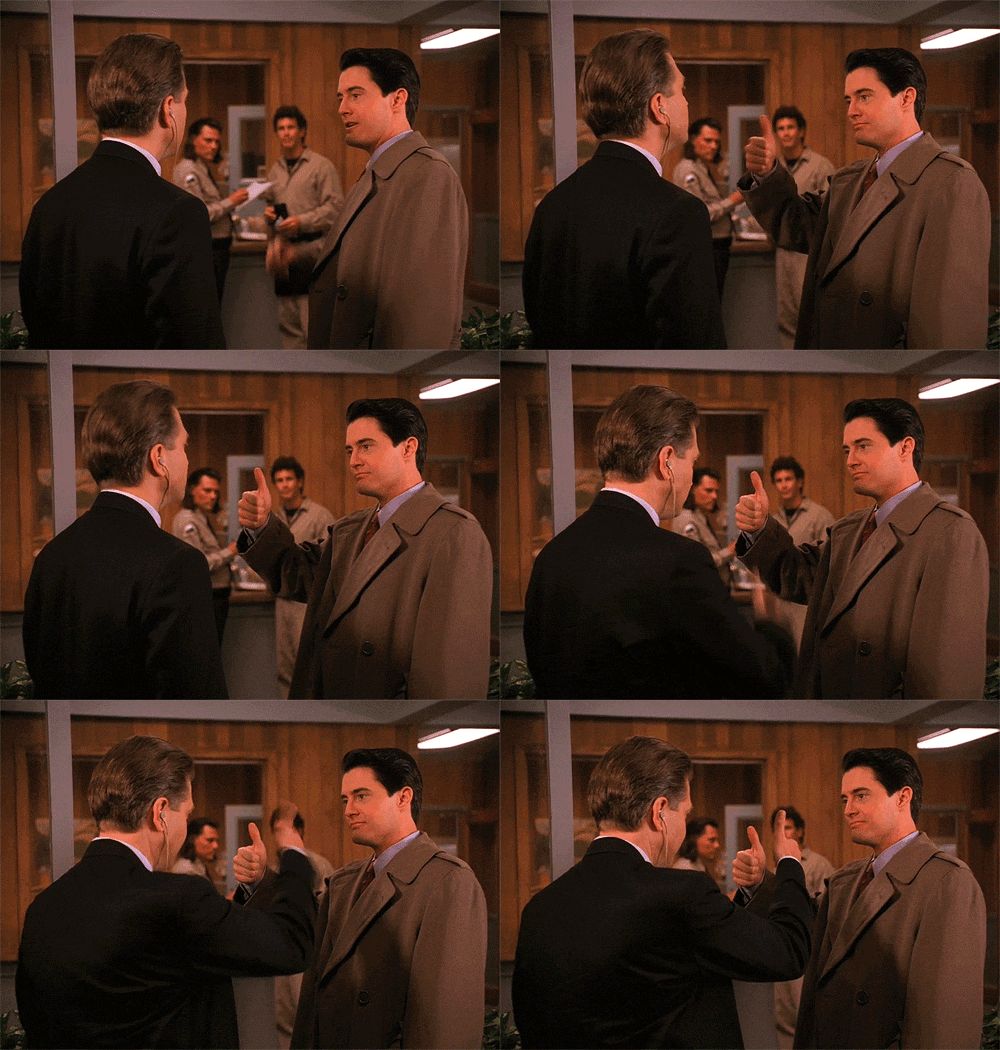
You look at your friends and say, "Hey! Follow me!" You swiftly turn around and walk towards the destination.
Do you turn around to see if they are indeed following you?
If you do turn around, why did you look?
And if not, why didn't you?
Orpheus and Eurydice is a famous Greek myth that has been turned into poems countless times for its tragic story. You will use this knowledge to understand the importance of keeping your ultimate goals in mind and continuing to look forward no matter what. This is a life skill that will help you much further than high school.

Task
You will learn about this Greek myth, analyze Orpheus's inner thoughts, and complete a presentation explaining your interpretation of the moral of the story.
Your presentation will include a :30 second clip of a song (the song must have no expletives and be school appropriate) and a one minute speech of you analyzing Orpheus's inner thoughts, what you think is the moral of the story, and why you think it's important.

Process
1. The first thing you must do is know the story of Orpheus and Eurydice.

You will read this lyric poem, written from Orpheus's point of view, that gives you the basis of the story. This is a general outline. On a blank piece of paper, you will identify the myth's dramatic structure. You will make and thoroughly fill out Freytag's pyramid. This is a review of what you already know about dramatic structure as well. I'll give you a hint: two of the five parts of the pyramid are called "exposition, rising action, etc."
Website: The Beat of Her Heart
2. Now to know more about Orpheus and Eurydice, you have to know the details of the story. Boethius was a Roman who wrote The Consolation of Philosophy and in it he included a poem about Orpheus and Eurydice from a third-person point of view. Keep in mind that Hades name is replaced with Tantalus, a Greek mythological figure whom lived in the deepest part of the Underworld. You will translate the poem into contemporary English. Do your best, it does not need to be perfect, but your paper should go line for line next to Boethius's poem.
For example, the first line of the poem reads, "Blest he whose feet have stood". Therefore, your first line of translation would be, "Blessed is he who stands."
You can find the poem here. Once at the website, CTRL F (Find) "Orpheus", then click on page 158 if it does not take you directly to the poem.
3. You have learned and should have an understanding of the myth of Orpheus and Eurydice now. Before we can analyze Orpheus we must have a background and understanding of his character. Don't fret! Go to this website to get a brief background of the main characters for this myth. You must define who Apollo is, what a Muse is, and lyre.
Click here for the website.
Use this website to get definitions. Make sure to use the right definition of Muse.

4. You thouroughly understand Orpheus as a character and his background. You are now going to work towards completing your presentation. Make an outline of what you think Orpheus's thoughts were as these events were happening to him. This only needs to be one paragraph long: 6 sentences. Use this website to be reminded of how to analyze a character: eHow, your best friend... sometimes.
5. Now it is time to think about what YOU think the moral of the story is. For examples of morals and a definition of moral, go here. There are lots of different stories that teach the same moral. Once you decide what the moral of the myth of Orpheus and Eurydice is, write about it on the same piece of paper as your analyzation of Orpheus.
6. This will probably be your favorite part! You will go to a website and pick/find your favorite song to use as part of your presentation. You will be using the first thirty seconds of this song before you start your speech in class. Make sure to find it on this website because it is allowed in school. REMINDER: It must be school appropriate.

7. Time to prepare for your speech! The thirty seconds from your selected song is not included as part of your time for your one minute speech. You are allowed a total of five (5) notecards to use for your speech and you can see the rubric to see how you will be scored. Everyone gets nervous and it is good to utilize that nervous energy positively to add to your speech. For those that cannot stand public speaking, it's okay. Take tips from this website: Overcoming Stage Fright
On your outline paper, write a final sentence or two about what the moral of the myth Orpheus and Eurydice means to you.
Evaluation
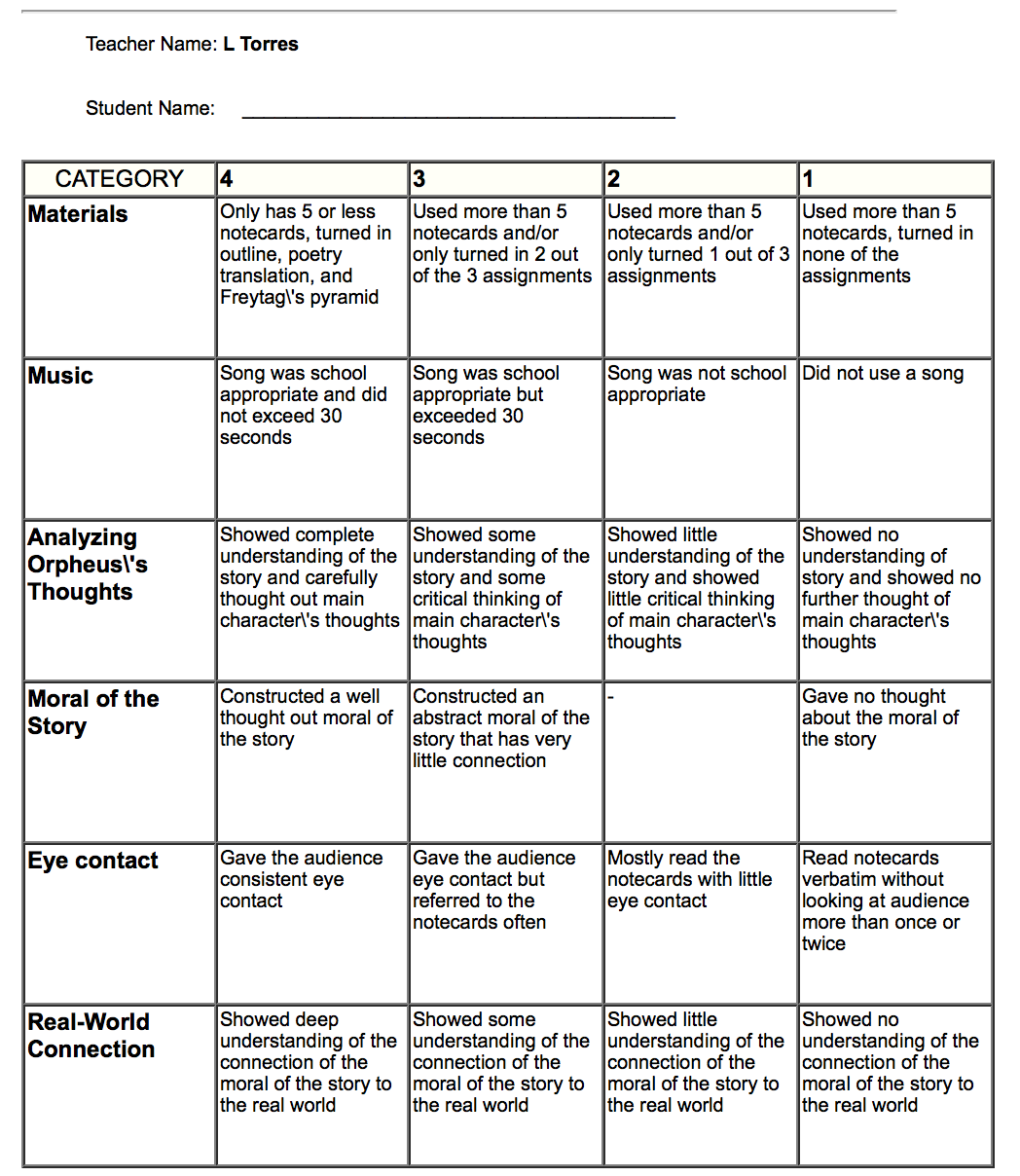
Below is the rubric that will show how you are graded. For some of the sections such as Moral of the Story, you can only receive a one if it's way off kilter, i.e. "The moral of the story is to not buy grapes on Tuesday."
Conclusion
This entire project centers around several real world problems.

The first is understanding and critical thinking of what the moral of the story is.
It is important to learn life lessons from stories in order to not repeat mistakes. The second real world problem is even after we've succeeded and achieved our goals, people tend to look back. Whether that be because of mistrust or being unsure, it is important that we do look forward.
Credits
Fair Use Notice: The material on this webquest is provided for educational and informational purposes. It may contain copyrighted material the use of which has not always been specifically authorized by the copyright owner. It is being made available in an effort to advance the understanding of scientific, environmental, economic, social justice and human rights issues etc. It is believed that this constitutes a 'fair use' of any such copyrighted material as provided for in section 107 of the US Copyright Law. In accordance with Title 17 U.S.C. Section 107, the material on this site is distributed without profit to those who have an interest in using the included information for research and educational purposes. If you wish to use copyrighted material from this site for purposes of your own that go beyond 'fair use', you must obtain permission from the copyright owner. The information on this webquest does not constitute legal or technical advice.
This may be used by others without permission given except if the user receives royalties through using the webquest.