
Introduction
Cellular respiration is the process by which the chemical energy of "food" molecules is released and partially captured in the form of ATP. Carbohydrates, fats, and proteins can all be used as fuels in cellular respiration, but glucose is most commonly used as an example to examine the reactions and pathways involved. Cells have many different tasks. For example, they divide, grow and keep the body temperature at 37°C. They need energy to complete these tasks.
Cells break down the food we eat into simpler molecules, like sugar, to get energy. In humans (and most other living beings), cells use oxygen to break down sugar (glucose). Oxygen is used, and carbon dioxide is produced as a waste product. Therefore, we need to bring oxygen into the body and remove carbon dioxide from the body.

Cellular respiration allows organisms to use (release) energy stored in the chemical bonds of glucose (C6H12O6). The energy in glucose is used to produce ATP. Cells use ATP to supply their energy needs. Cellular respiration is therefore a process in which the energy in glucose is transferred to ATP.

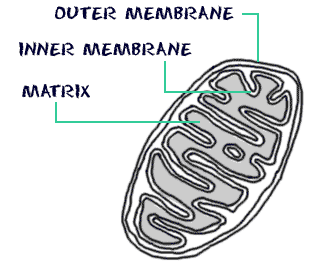
Mitochondria have two membranes .The outer membrane covers the organelle and contains it. The inner membrane folds over many times (cristae). That folding increases the surface area inside the organelle. Many of the chemical reactions happen on the inner membrane of the mitochondria. The increased surface area allows the small organelle to do as much work as possible. If you have more room to work, you can get more work done. Similar surface area strategies are used by microvilli in your intestinal cells. The fluid inside of the mitochondria is called the matrix.
The matrix is filled with water (H2O) and proteins (enzymes). Those proteins take food molecules and combine them with oxygen (O2). The mitochondria are the only place in the cell where oxygen can be combined with the food molecules. After the oxygen is added, the material can be digested. They are working organelles that keep the cell full of energy.
Task
You will work with a partner to draw a diagram that expresses the relationship between photosynthesis and cellular respiration. Your diagram will be graded on how clearly and accurately you display the steps, structures, and relationship of both processes.

Process
Your diagram should display the following terms and explanations:
(Use this as a checklist to ensure that you have included all the necessary information)
- Respiration Equation
- Respiration Equation in word form.
- Photosynthesis Equation
- Photosynthesis Equation in word form.
- Chloroplasts
- Chlorophyll
- Mitochondria
- Autotroph
- Heterotroph
- Stomata
- Roots
- Water
- Xylem
- Phloem
- Carbon Dioxide
- Glucose
- Sunlight
- Oxygen
- Energy
- Artwork, drawings, or pictures that depict what is happening in photosynthesis.
- Artwork, drawing, or pictures that depict what is happening in cellular respiration
- A written description of how photosynthesis and cellular respiration are related.
You must show a rough draft of your poster showing approximately what it will look like before building your poster.
Evaluation
|
PHOTOSYNTHESIS AND CELLULAR RESPIRATION POSTER PROJECT RUBRIC |
|
Category |
5 points |
4 points |
3 points |
2 points |
0 points |
Self- Assessment |
Teacher Assessment |
|
Rough Draft |
Rough Draft was turned in signed and approved by teacher. |
Rough Draft was not turned in. |
|
|
|||
|
`Use of Class Time ( X 3) |
Used class time well each class period. Focused on getting the project done. Never distracted others.
|
Used time well during each class period. Usually focused on getting the project done and never distracted others.
|
Used some of the time well during each class period. There was some focus on getting the project done but occasionally distracted others.
|
|
Did not use class time to focus on the project and often distracted others. |
|
|
|
Title |
Title is clearly visible from 3 ft away, and is appropriate for the topic. |
Title is appropriate for the topic, but is not clearly visible 3 ft away. |
Title is not appropriate for the topic, but is clearly visible from 3 ft away. |
Title is not appropriate for the topic, and is not clearly visible from 3 ft away. |
Title is missing. |
|
|
|
Terms to be included
(X 4) |
Poster includes all necessary terms. All items of importance on the poster are clearly labeled with labels that can be read from at least 3 ft. away. |
Poster is missing 1 or two terms. Almost all items of importance on the poster are clearly labeled with labels that can be read from at least 3 ft. away. |
Poster is missing 3 or more terms Many items of importance on the poster are clearly labeled with labels that can be read from at least 3 ft. away. |
Poster is missing 4 or more terms Most of the labels are too small to view, and are not clearly labeled. |
Poster is missing 5 or more terms. No important items were labeled. |
|
|
|
Explanations included
(X 4) |
Poster clearly explains the processes of photosynthesis and cellular respiration, and how they are related. |
Poster clearly explains the processes of photosynthesis and cellular respiration, but does not clearly explain how they are related. |
Poster clearly explains the processes of photosynthesis and cellular respiration, but does not include an explanation of how they are related. |
Poster attempts but does not clearly explain the process of photosynthesis and cellular respiration or how they are related. |
Poster is missing one or more explanations of the processes of photosynthesis and cellular respiration, and how they are related. |
|
|
|
Grammar |
No grammar or spelling errors. |
One grammatical or spelling error |
Two grammatical or spelling errors. |
Three or four spelling or grammatical errors |
Five or more grammatical or spelling errors. |
|
|
|
Pictures
(X 3) |
All pictures are related to the topic and make it easier to understand. All borrowed graphics have a source citation. |
All pictures are related to the topic and most make it easier to understand. Some borrowed graphics have a source citation. |
All pictures relate to the topic. One or two borrowed graphics have a source citation. |
Some of the pictures relate to the topic. One or two borrowed graphics have a source citation. |
Graphics do not relate to the topic. Only one or none of the borrowed graphics have a source citation. |
|
|
|
Neatness |
The poster is exceptional in terms of design, layout, and neatness. |
The poster is well done in terms of design, layout and neatness. |
The poster is mostly well done, but a little messy in certain areas. |
The poster is mostly messy, but well done in one or two areas. |
This poster is messy, and disorganized. |
|
|
|
Self Assessment |
Self Assessment was completed accurately. |
|
Self-assessment was completed, but the student did not correctly evaluate their performance. |
Self assessment was not completed. |
|
|
|
|
Total Points |
|
|
|
|
|
/100 |
/100 |
Conclusion
Photosynthesis and respiration are reactions that complement each other in the environment. They are in reality the same reactions but occurring in reverse. While in photosynthesis carbon dioxide and water yield glucose and oxygen, through the respiration process glucose and oxygen yield carbon dioxide and water.
They work well since living organisms supply plants with carbon dioxide which undergoes photosynthesis and produces glucose and these plants and bacteria give out oxygen which all living organisms need for respiration.
Comparison chart</> Embed this chart
Photosynthesis |
Respiration |
|
|---|---|---|
| Production of ATP | Yes | Yes; theoretical yield is 38 ATP molecules per glucose but actual yield is only about 30-32. |
| Reactants | 6CO2 and 12H2O and light energy | C6H12O6 and 6O2 |
| Requirement of sunlight | Can occur only in presence of sunlight | Sunlight not required; cellular respiration occurs at all times. |
| Equation | 6CO2 + 12H2O + light --> C6H12O6 + 6O2 + 6H20 | 6O2 + C6H12O6 --> 6CO2 +6H2O + ATP (energy) |
| Process | The production of organic carbon (glucose and starch) from inorganic carbon (carbon dioxide) with the use of ATP and NADPH produced in the light dependent reaction | Production of ATP via oxidation of organic sugar compounds. [1] glycolosis: breaking down of sugars; occurs in cytoplasm [2] Krebs Cycle: occurs in mitochondria; requires energy [3] Electron Transport Chain-- in mitochondria; converts O2 to water. |
| Fate of oxygen and carbon dioxide | Carbon dioxide is absorbed and oxygen is released. | Oxygen is absorbed and carbon dioxide is released. |
| Energy required or released? | Requires energy | Releases energy in a step wise manner as ATP molecules |
| Main function | Production of food. Energy Capture. | Breakdown of food. Energy release. |
| Chemical reaction | Carbon dioxide and water combine in presence of sunlight to produce glucose and oxygen. | Glucose is broken down into water and carbon dioxide (and energy). |
| Stages | 2 stages: The light dependent reaction, light independent reaction. (AKA light cycle & calvin cycle) | 4 stages: Glycolysis, Linking Reaction (pyruvate oxidation), Krebs cycle, Electron Transport Chain (oxidative phosphorylation). |
| What powers ATP synthase | H+ gradient across thylakoid membrane into stroma. High H+ concentration in the thylakoid lumen | H+ proton gradient across the inner mitochondria membrane into matrix. High H+ concentration in the intermembrane space. |
| Products | C6 H12 O6 (or G3P) and 6O2 and 6H20 | 6CO2 and 6H2O and energy(ATP) |
| What pumps protons across the membrane | Electron transport chain | Electron transport chain. Electrochemical gradient creates energy that the protons use to flow passively synthesizing ATP. |
| Occurs in which organelle? | Chloroplasts | Mitochondria Glycolysis (cytoplasm) |
| Final electron receptor | NADP+ (forms NADPH ) | O2 (Oxygen gas) |
| Occurs in which organisms? | Occurs in plants, protista (algae), and some bacteria. | Occurs in all living organisms (plants and animals). |
| Electron source | Oxidation H2O at PSII | Glucose, NADH + , FADH2 |
| Catalyst - A substance that increases the rate of a chemical reaction | Reaction takes places in presence of chlorophyll. | No catalyst is required for respiration reaction. |
| High electron potential energy | From light photons. | From breaking bonds |