
Introduction
Welcome, mathematician!
Have you ever looked at a wheel, a clock, or a coin and wondered about the mathematics hidden inside that perfect round shape? Circles are one of the most important shapes in geometry, and they show up everywhere in the real world.
In this WebQuest, you are going on a guided journey to discover the different parts of a circle, understand what they mean, and show what you have learned. By the end of this activity, you will be able to identify and describe every key part of a circle with confidence.
Learning objectives
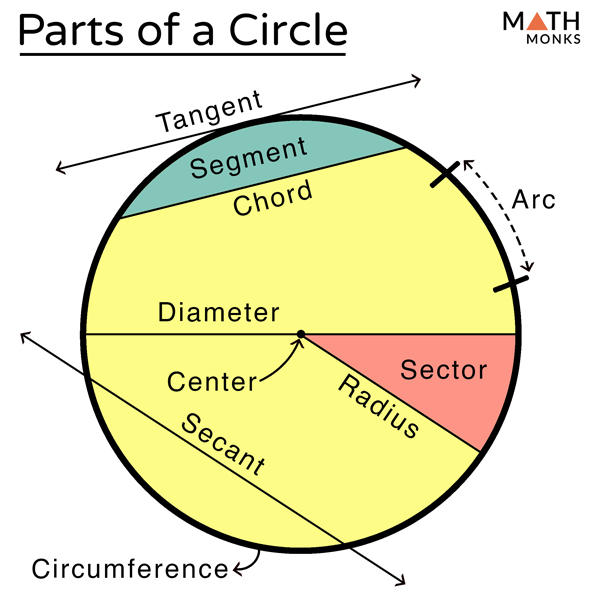
- Identify and name the parts of a circle: centre, radius, diameter, chord, arc, sector, segment, and circumference
- Describe the relationship between the radius and diameter
- Distinguish between an arc, a sector, and a segment
- Apply knowledge by labelling a diagram and completing a short activity
Task
Your mission is to become an expert on the parts of a circle. You will explore online resources, complete a labelling activity, and answer reflection questions to demonstrate your understanding.
By the end of this WebQuest you will submit:
- Labelled diagram: A fully labelled diagram of a circle with all 8 parts correctly identified
- Definition table: A table matching each part of the circle to its correct definition
- Reflection questions: Short written answers to 3 questions about what you learned
- Real-world connection: One example of a circle from everyday life with its parts identified
Process
How to complete this WebQuest
45–60 minutes
- Explore the parts (15 mins)
Visit the resources below and study each part of the circle. Take notes as you go. Pay special attention to the difference between a chord and a diameter, and between an arc, sector, and segment.
Geogebra: Interactive Circle Parts
- Learn the 8 key parts (10 mins)
Make sure you can define all of the following parts:
- Centre: The fixed middle point of the circle
- Radius: Distance from centre to any point on the circle
- Diameter: A chord passing through the centre; equals 2 × radius
- Chord: A line segment joining any two points on the circle
- Arc: A curved portion of the circumference
- Sector: A "pie slice" region between two radii and an arc
- Segment: The region between a chord and an arc
- Circumference: The total distance around the circle
- Label the diagram (10 mins)
Draw a circle in your workbook and label all 8 parts clearly. Use arrows and ensure each label is neat and correctly placed.
- Complete the definition table (5 mins)
In your workbook, create a two-column table with "Part" and "Definition". Fill in all 8 parts in your own words.
- Answer the reflection questions (10 mins)
Write a short answer to each of the following in your workbook:
- What is the relationship between the radius and the diameter of a circle?
- What is the difference between a sector and a segment?
- Find one real-life object that is circular. Name at least three parts of a circle you can identify on it.
Evaluation
How you will be assessed
Your work will be marked out of 20 points across four areas.
| Area | Excellent (5) | Good (4) | Developing (3) | Marks |
|---|---|---|---|---|
| Labelled diagram | All 8 parts correctly labelled and neatly drawn | 6–7 parts correctly labelled | 4–5 parts labelled with minor errors | /5 |
| Definition table | All definitions accurate and in own words | Most definitions correct with minor gaps | Some definitions correct but incomplete | /5 |
| Reflection questions | All 3 answers complete, clear, and accurate | 2 answers fully correct, 1 partially correct | Answers attempted but lack clarity or detail | /5 |
| Real-world connection | Clear example with 3+ parts correctly identified | Valid example with 2 parts identified | Example given but parts not clearly identified | /5 |
Conclusion
Well done!
You have completed the Parts of a Circle WebQuest. By working through this activity, you have explored one of the most important shapes in mathematics and discovered just how many parts make up what looks like a simple round line.
You can now identify the centre, radius, diameter, chord, arc, sector, segment, and circumference of any circle. These parts are the building blocks for more advanced topics in geometry, including calculating the area and circumference of circles, which you will explore next.
Look around you, circles are everywhere. Every wheel, every plate, every clock face contains all the parts you have just learned. You now have the language to describe them precisely.
Keep your labelled diagram and definition table. They will be useful study tools as you move forward in this topic. Great work today!
Credits
The following resources were used to develop this WebQuest:
- Khan Academy. (n.d.). Circles. https://www.khanacademy.org/math/geometry/hs-geo-circles
- Math Is Fun. (n.d.). Parts of a Circle. https://www.mathsisfun.com/geometry/circle.html
- Geogebra, (n.d.). Interactive Circle Parts https://www.geogebra.org/m/xB9ZaTrm