
Introduction
Subject: Social Studies
Topic: Types of Pollution
Subtopic: Keeping My Environment Clean
Focus Question: How can I keep my community clean?
❌ Photo unavailable
Welcome, environmental heroes!
Have you ever looked around your community and noticed litter on the ground, smoke in the air, or dirty water in drains and rivers?
These are all signs of pollution, and they affect the health of people, animals, and the environment.
Today, you will explore the different types of pollution and discover how your actions can help protect the world around you. By the end of this activity, you will understand how pollution affects your community and how you can make a difference.
Get ready to observe, think, and take action!
Task
In this WebQuest, you will:
- Define pollution and related terms.
- Identify different types of pollution (land, water, air, and noise).
- Classify examples of pollution correctly.
- Work collaboratively to explore solutions.
- Create a short written or visual response explaining how to keep your community clean.
Process
Follow each step carefully and in order:
Step 1: Watch and Observe
Begin by watching the digital story video below:
As you watch, pay close attention to:
- The different types of pollution shown.
- How pollution affects people, animals, and the environment
- Any solutions or actions suggested
While watching, write down at least two important points you notice.
Step 2: Read and Understand
Carefully read the information provided in the handout below:
Focus on understanding:
- What pollution is
- The meaning of key terms such as waste, reduce, reuse, and recycle
- The four main types of pollution:
- Land pollution
- Water pollution
- Air pollution
- Noise pollution
Take your time and ask your groupmate or partner for assistance if anything is unclear.
HANDOUT: Pollution & Environment
Focus Question: How can I keep my community clean?
What is the Environment?
The environment is everything around us – air, water, land, plants, animals, and people. It is where we live and depend on to survive.
What is Pollution?
Pollution is anything that harms the environment. It makes the air, water, or land dirty and unsafe for people, animals, and plants.
Key Words & Definitions
|
Word |
Definition |
|
Pollution |
Anything that makes the environment dirty or unsafe |
|
Waste |
Things we throw away |
|
Reuse |
Using something again instead of throwing it away |
|
Recycle |
Changing waste into something useful |
|
Reduce |
Using less so there is less waste |
|
Conservation |
Protecting nature and resources |
|
Sustain |
Keeping the environment healthy for the future |
|
Land Pollution |
Harmful things that make the land dirty |
|
Air Pollution |
Harmful smoke or gases in the air |
|
Water Pollution |
Harmful substances in rivers, lakes, or oceans |
|
Noise Pollution |
Harmful or loud sounds that disturb people or animals |
|
Type |
Examples |
|
Air Pollution |
Smoke from factories, car exhaust |
|
Water Pollution |
Trash in rivers, oil spills |
|
Land Pollution |
Litter, plastic bags, garbage heaps |
|
Noise Pollution |
Loud construction, traffic noise, blasting music |
Step 3: Identify and Classify
Look at the examples provided (images).
Your task is to:
- Identify what is happening in each example
- Decide which type of pollution it represents
- Explain your choice where possible
Think carefully: What clues helped you decide?
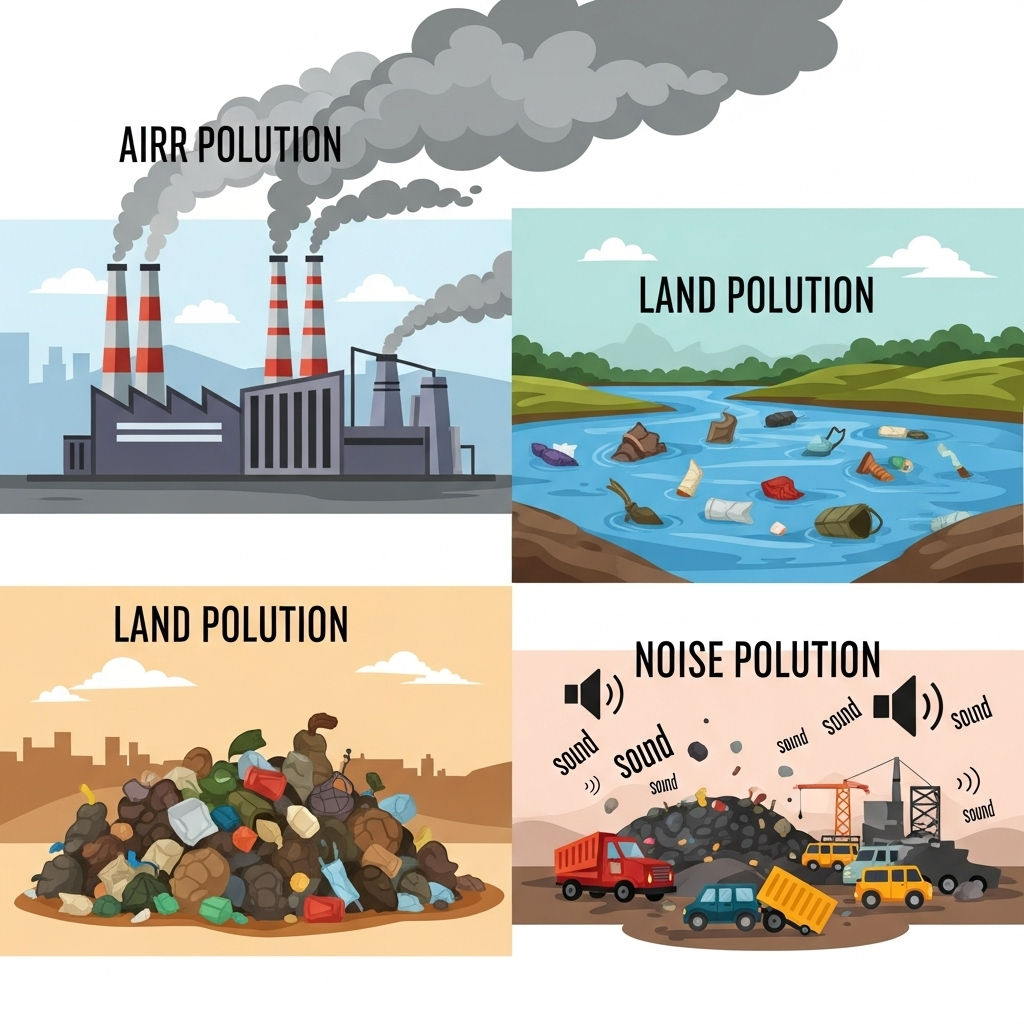
Step 4: Group Exploration Activity
Work with your group to explore one assigned type of pollution:
- Air Pollution
- Water Pollution
- Land Pollution
- Noise Pollution
With your group:
- Discuss what causes this type of pollution
- Identify at least two real-life examples
- Suggest at least one way to reduce or prevent it
Be prepared to share your ideas in class.
Step 5: Create and Apply Your Learning
Now it is your turn to apply what you have learned.
Choose ONE of the following:
Option A (Group Lavender):
Write a short paragraph (4–5 sentences) explaining:
- One type of pollution
- How it affects the environment
- One way to reduce it
Option B (Group Gardenia):
Use sentence starters to write 3 simple sentences about pollution.
Option C (Group Lilac):
Write a detailed paragraph (5–6 sentences) explaining:
- Two types of pollution
- Their effects
- Multiple solutions to reduce them
Step 6: Complete the Worksheet
Complete the worksheet below:
This activity will help you:
- Match types of pollution
- Answer questions about key concepts
- Demonstrate your understanding
Make sure your answers are clear and complete.
WORKSHEET
Name: ____________________ Date: _______________
Part 1: Match the type of pollution
Place the correct name for each type of pollution.
Word Bank: Air Pollution, Land Pollution, Noise Pollution, Water Pollution
- Smoke from factories → ______
- Trash in rivers → ______
- Loud traffic → ______
- Plastic bags on the ground → ______
Part 2: Short Answers
- Name one way you can reduce waste at school or home: ____________________________
- What does “reuse” mean? ________________
- Why is it important to keep our community clean? ____________________________
Part 3: Draw & Colour
- Draw one example of a polluted environment
|
DRAW HERE |
Resources
- Digital Story (Teacher-created)
- Handout: Pollution & Environment (Teacher Created)
Evaluation
| Criteria | Below Expectations (1) | Meets Expectations (3) | Exceeds Expectations (5) | Score |
|---|---|---|---|---|
| Understanding of Pollution | Shows little or no understanding of pollution and key terms | Shows basic understanding with some correct ideas |
Shows a clear and accurate understanding of pollution and key terms.
|
|
| Identification and Classification | Unable to correctly identify or classify pollution types | Correctly identifies some types with minor errors |
Accurately identifies and classifies all types of pollution.
|
|
| Application of Learning | Cannot apply knowledge to new situations | Applies knowledge with some support or minor errors |
Applies knowledge clearly and independently in new contexts
|
|
| Group Participation | Rarely participates or contributes | Participates with some effort |
Actively contributes ideas and works well with group members.
|
|
| Written or Visual Response | Response is incomplete or unclear | Response is mostly clear, with some correct ideas |
Response is clear, detailed, and well-explained
|
|
| Creativity and Effort | Shows little effort | Shows some effort |
Shows strong effort and creativity
|
|
| Grammar and Clarity | Many errors that affect understanding | Few errors |
Clear writing with no errors
|
Conclusion
🌍 Well done, environmental protectors!
Today, you explored the different types of pollution and learned how they affect your environment and community.
You discovered that pollution can harm living things, but you also learned that you have the power to make a difference.
By reducing waste, reusing materials, recycling, and making responsible choices, you can help keep your surroundings clean and safe.
Remember:
Every small action counts.
Every choice matters.
Let’s work together to protect our environment and build a cleaner, healthier future!
Credits
Educational content adapted from:
- Teacher-created materials
- Digital story on pollution
- Ministry of Education, Youth and Information (NSC Grade 4 Curriculum)
Teacher Page
Introduction
This WebQuest is designed to help Grade 4 students understand pollution and develop environmental awareness through interactive and student-centred learning.
Learning Objectives
Students will be able to:
- Define pollution and related terms
- Identify and classify types of pollution
- Suggest solutions to reduce pollution
- Apply knowledge through written and group activities
Time Required
Approximately 40 minutes
Materials
- Digital story
- Handout
- Worksheet
- Visual aids
Teaching Strategies
- Inquiry-based learning
- Cooperative group work
- Multimedia integration
- Guided questioning
Differentiation
- Below grade: guided sentences and support
- At grade: independent completion
- Above grade: extended responses and deeper explanations
Assessment
Students will be assessed based on:
- Participation
- Accuracy
- Understanding
- Application of knowledge
Key Skills
- Observation
- Classification
- Critical thinking
- Collaboration
- Problem solving
Key Vocabulary
- Pollution
- Waste
- Reduce
- Reuse
- Recycle
- Land pollution
- Water pollution
- Air pollution
- Noise pollution
ISTE Standards Connection
- Creative Communicator – students express ideas through sentences.
- Knowledge Constructor – students gather and apply information.
- Empowered Learner – students take responsibility for their learning.
Extension Activity
Students can create a poster or short presentation showing how to reduce pollution in their community.
References
Bradford, A. (2023). Pollution facts and types of pollution. https://www.livescience.com
Ministry of Education Jamaica. (2022). National standards grade 4 curriculum guide.
PixVerse AI Video Generator. (2026). Digital story on Pollution.
Smith, J. (2021). Understanding pollution in our communities.