
Introduction
Welcome little scientists! Today we will discover how solar system works and its planets. Your challenge is to draw a solar system and its planets around it!! Are you ready little Scientist?? Aye aye!!
Let's discuss first its definition and composition:
Solar system, assemblage consisting of the Sun—an average star in the Milky Way Galaxy—and those bodies orbiting around it: 8 (formerly 9) planets with more than 400 known planetary satellites (moons); many asteroids, some with their own satellites; comets and other icy bodies; and vast reaches of highly tenuous gas and dust known as the interplanetary medium. The solar system is part of the "observable universe," the region of space that humans can actually or theoretically observe with the aid of technology. Unlike the observable universe, the universe is possibly infinite (Britannica).
Located at the center of the solar system and influencing the motion of all the other bodies through its gravitational force is the Sun, which in itself contains more than 99 percent of the mass of the system. The planets, in order of their distance outward from the Sun, are Mercury, Venus, Earth, Mars, Jupiter, Saturn, Uranus, and Neptune. Four planets—Jupiter through Neptune—have ring systems, and all but Mercury and Venus have one or more moons. Pluto had been officially listed among the planets since it was discovered in 1930 orbiting beyond Neptune, but in 1992 an icy object was discovered still farther from the Sun than Pluto. Many other such discoveries followed, including an object named Eris that appears to be at least as large as Pluto. It became apparent that Pluto was simply one of the larger members of this new group of objects, collectively known as the Kuiper belt. Accordingly, in August 2006 the International Astronomical Union (IAU), the organization charged by the scientific community with classifying astronomical objects, voted to revoke Pluto’s planetary status and place it under a new classification called dwarf planet (Britannica).
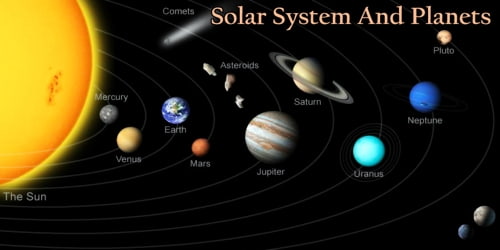
Link: Solar System And Planets - Assignment Point
Task
Objective:
To show understanding of the solar system through drawing.
Instructions:
-
Draw the Sun at the center of your paper.
-
Draw all eight planets in the correct order from the Sun:
Mercury, Venus, Earth, Mars, Jupiter, Saturn, Uranus, Neptune.
-
Make sure each planet is clearly labeled.
-
Use colors to show the differences between the planets.
-
Add at least one fun fact beside each planet.
Materials Needed:
-
Bond paper / drawing paper
-
Pencil
-
Crayons or colored pencils
Output:
-
Clean and colorful drawing
-
Correct order of planets
-
Proper labels
Process
Process: Drawing the Solar System Planets
-
Prepare your materials (drawing paper, pencil, eraser, and coloring materials).
-
Draw the Sun at the center or left side of the paper.
-
Sketch the orbits lightly around the Sun.
-
Draw the eight planets along the orbits in the correct order.
-
Make each planet a different size to show their differences.
-
Label each planet clearly.
-
Color the planets neatly and creatively.
-
Review your drawing to ensure accuracy and completeness.
Evaluation
Evaluation Criteria
|
Criteria |
Description |
Points |
|---|---|---|
|
Correct Order of Planets |
Planets are arranged correctly from the Sun |
10 |
|
Completeness |
All eight planets and the Sun are included |
10 |
|
Labeling |
Each planet is properly and clearly labeled |
10 |
|
Creativity & Neatness |
Use of colors, design, and cleanliness |
10 |
Total: 50 points
Conclusion
Conclusion
Through this drawing activity, students were able to identify the planets in the solar system and understand their correct order from the Sun. The task helped improve creativity, attention to detail, and knowledge of basic astronomy. By completing the drawing, students demonstrated their understanding of the solar system while expressing their learning through art.