
Introduction
Have you ever seen a puddle of water on the ground after a rainy day? Has it ever disappeared right in front of your eyes after the sun comes out? Or have you ever seen water drops form on the outside of a cold cup of juice? That is the water cycle at work: evaporation, condensation, precipitation and collection; moving water around earth over and over again.
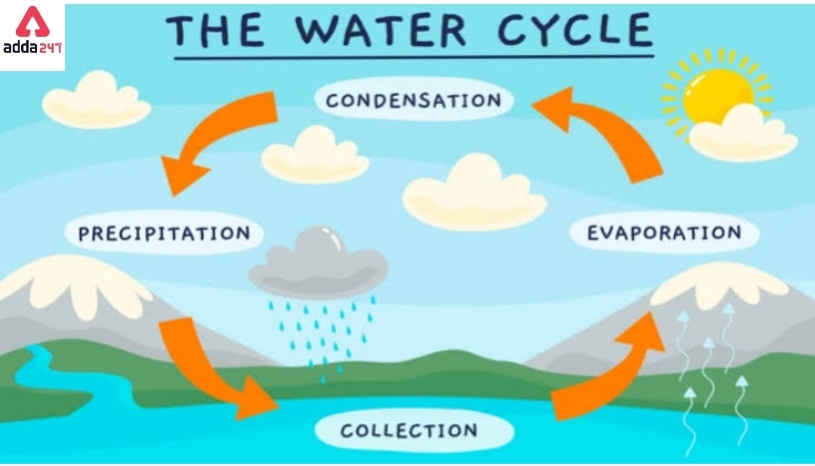
Are you ready to learn about each stage of this cycle and spot it in real life?
Task
In this WebQuest you will learn a lot about the magic found in transforming water between phases.
You will have two tasks to finish, they are your missions:
1) Scavenger Hunt!
Take pictures around school or at home that represent each stage.
❌ Photo unavailable
2) Draw a poster of the journey of a water drop:
Show the 4 stages with arrows and labels
Process
1) Scavenger Hunt!
Step 1: Stay safe.
Ask an adult before using a kettle, stove, or any potentially hot and dangerous device for your pictures
Step 2: Plan your pictures.
- Make a list of at least 1 photo per stage (evaporation, condensation, precipitation, and collection)
-
Decide where you’ll look: classroom, playground, kitchen, bathroom window, school yard, street after rain.
-
Mark each idea as Real (naturally happening) or Model (you set it up).
Step 3: Perfect your shot
Focus on the frame. Does the picture capture what I want to show?
Focus on the light: Is what I want to show visible enough?
Focus on clarity: Is the image clear?

2) Draw a poster of the journey of a water drop:
Step 1: Set up the page
-
Write the title
-
Draw a big circle. Put these labels in order around it: Evaporation → Condensation → Precipitation → Collection.
-
Draw arrows going clockwise so it makes a loop.
Step 2: Show and tell
-
Under each label, add one short sentence:
-
Evaporation: Water warms and turns into vapor.
-
Condensation: Vapor cools into tiny drops.
-
Precipitation: Drops fall as rain/snow/hail.
-
Collection: Water gathers in lakes, rivers, oceans, and soil.
-
-
Add pictures and write a caption under every picture.
Step 3: Double check & finish
-
Can you see all 4 stages in order? Do the arrows make a full loop? Is it clear? Is it colorful? Do I understand it?
❌ Photo unavailable
Evaluation
| Criterion | Excellent (5) | Good(4) | Okay(3) | Needs Work(2) | Points(1) |
|---|---|---|---|---|---|
| Understanding (concepts) | Explains all 4 stages correctly with examples | Minor mistake | Some confusion | Many errors | /5 |
| Poster Quality | Easy to read, arrows/labels clear, ≥5 images sized & captioned | Mostly clear | Crowded or missing parts | Hard to read | /5 |
| Weather Report | 60–90s, uses vocabulary, explains today’s weather link, clear voice | Minor timing/clarity issue | Misses a stage or tip | Unclear/too short/long | /5 |
| Writing (“Droppy”) | 120–150 words, all stages in order, neat grammar | Minor issues | Missing a stage or short | Hard to follow | /5 |
| Teamwork & Process | Roles used, on time, followed steps | Mostly on time | Needed reminders | Off-task | /5 |
| Credits & Consistency | All images/info credited; neat, same fonts | Minor errors | Several missing | No credits | /5 |
| Total | /30 |
Conclusion
You just showed how water moves from puddles to clouds to rain and back again. The water you drank today might be the same water a dinosaur once stepped in!
Try at home activity:
Tape a zip-lock bag with a little colored water to a sunny window. Watch evaporation and condensation over a day.
Credits
Information sources:
-
U.S. Geological Survey. (2025, April 2). Interactive water cycle diagram for kids (Beginner). U.S. Geological Survey. https://water.usgs.gov/edu/watercycle-kids-beg.html water.usgs.gov
-
U.S. Geological Survey. (n.d.). Water cycle. U.S. Geological Survey. https://www.usgs.gov/water-science-school/water-cycle (Retrieved September 29, 2025). USGS
-
NASA Climate Kids. (n.d.). What is the water cycle? NASA. https://climatekids.nasa.gov/water-cycle/ (Retrieved September 29, 2025). NASA Climate Kids
-
National Oceanic and Atmospheric Administration. (2023, March 24). The hydrologic cycle. NOAA JetStream. https://www.noaa.gov/jetstream/atmosphere/hydro NOAA
-
National Geographic Kids. (n.d.). The water cycle! National Geographic Kids. https://www.natgeokids.com/uk/discover/science/nature/water-cycle/ (Retrieved September 29, 2025). National Geographic
-
Met Office. (n.d.). The water cycle. Met Office Learning. https://weather.metoffice.gov.uk/learn-about/weather/how-weather-works/water-cycle (Retrieved September 29, 2025).
-
Peekaboo Kidz. (2015, March 11). The Water Cycle | The Dr. Binocs Show | Learn videos for Kids [Video]. YouTube. https://www.youtube.com/watch?v=ncORPosDrjI
WebQuest Website:
Create webquest: Create a WebQuest: Simple. quick. free. Create WebQuest | Create a WebQuest: Simple. Quick. Free. (n.d.) https://www.createwebquest.com/
Teacher Page
Target class: 6th Grade
Type of work: Individual
Time given to the student: 2-3 class sessions and 1 weekend at home
Materials needed: What they need for arts and crafts and a digital camera.