
Introduction
Imagine you are an ecologist (studies nature) working for a conservation organisation.
Recently, reef shark populations have dramatically declined in parts of the Great Barrier Reef.

Your team must explain to the public how this could affect the whole ecosystem.
To do this, you will investigate how energy flows through ecosystems via food chains and food webs, and what happens when key species are removed.
Task
Your group will research and create a digital infographic or concept map that explains:
- How energy flows through a food web in your chosen ecosystem.
- The roles of producers, consumers, and decomposers.
- The potential consequences if one species is removed.
You will present your infographic digitally (using Canva, Google Drawings, or PowerPoint) and upload it to our class space.
Process
1. Watch this short video on food chains and food webs:
2. Explore this interactive simulation: https://www.bbc.co.uk/games/interactive/gm2zlfh9hq?id=gm2zlfh9hq&exitGameUrl=https%3A%2F%2Fwww.bbc.co.uk%2Fbitesize%2Farticles%2Fz93vdxs&palette=colour-palette-7&language=en-GB&project=blocks-bitesize
3. Read this article: https://education.nationalgeographic.org/resource/food-chain/
- Write down the key points of the article
- Write down the definitions of these words: Omnivore, Herbivore, Carnivore
4. As a group, choose one ecosystem (coral reef, savanna, or rainforest).
5. Construct a food web diagram for that ecosystem.
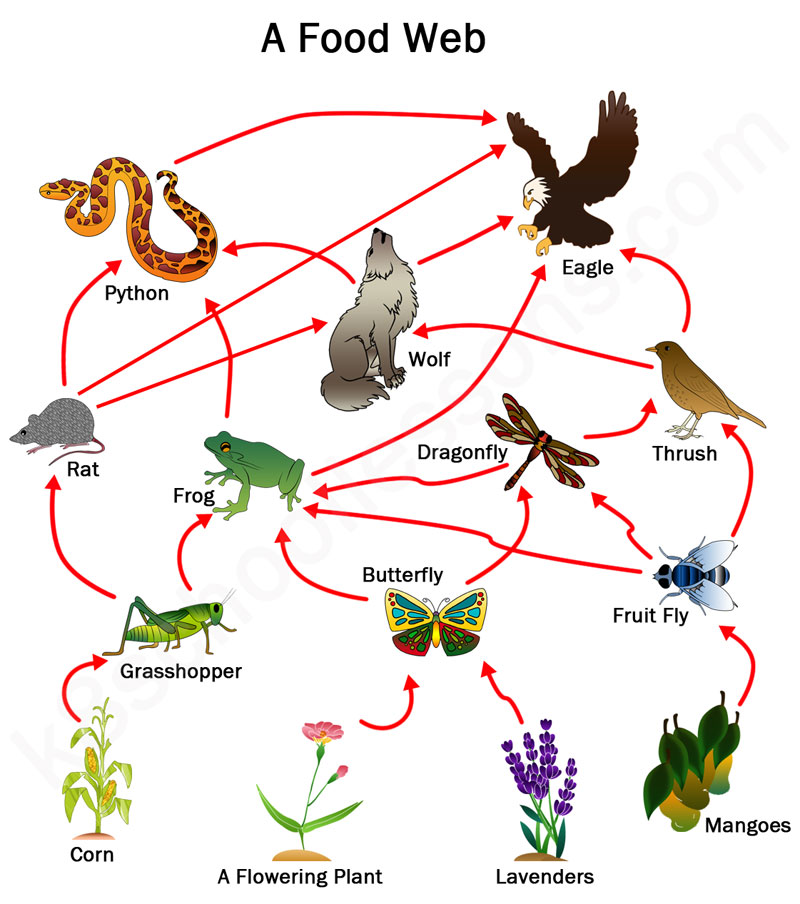
6. Use arrows to show energy flow and highlight the role of each organism.
i.e Primary consumer, secondary consumer, Apex Predator, Producer
7. Add a section predicting what would happen if one species is removed.
Evaluation
| Criteria | Excellent (18–20 pts) | Good (14–17 pts) | Fair (10–13 pts) | Needs Improvement (<10 pts) |
|---|---|---|---|---|
| Research (5 pts) | Used reliable scientific sources; information is accurate, detailed, and well-explained with strong examples. | Sources mostly reliable; explanations clear but missing some detail. | Limited sources used; explanations sometimes unclear or lack depth. | Weak research; information inaccurate or lacking; sources questionable. |
| Collaboration (5 pts) | Worked very effectively in the team; consistently shared ideas, listened actively, and supported others. | Mostly worked well with team; contributed regularly and listened to peers. | Sometimes worked with team; occasional contributions or listening. | Rarely contributed; limited teamwork or engagement. |
| Creativity & Problem-Solving (5 pts) | Infographic/concept map is highly original, engaging, and demonstrates creative problem-solving in showing ecosystem connections. | Work includes some original and creative elements; mostly engaging. | A few creative ideas, but largely ordinary or predictable. | Minimal creativity; rushed or incomplete work. |
| Presentation & Communication (5 pts) | Final product is clear, visually appealing, well-organized, and easy to understand; digital tools used effectively. | Mostly clear and organized; some visuals or digital tools used. | Somewhat clear, but lacks strong visuals or organization. | Hard to follow; weak use of visuals or digital tools. |
| Reflection (5 pts) | Thorough and thoughtful reflection; shows clear connections between learning, ecosystem concepts, and real-world issues. | Reflection is present, showing some connections to learning and ecosystems. | Reflection is brief, with limited evidence of connections or insight. | Little or no reflection; lacks evidence of learning. |
Conclusion
You have explored how living things are interconnected and why ecosystems depend on balanced relationships.
Ecosystems are dynamic and can be disrupted by human activity or natural changes.
The challenge is to apply this knowledge to real-world conservation issues, like the decline of reef sharks, and consider how we might prevent ecosystem collapse.
So ask yourself: What action could you take, even in small ways, to support healthy ecosystems?
Credits
Australia’s Wild Odyssey: Being at the top of the food chain [Video]. (n.d.). Bing Videos. https://www.bing.com/videos/riverview/relatedvideo?&q=Australia%27s+Wild+Odyssey%3a+Being+at+the+top+of+the+food+chain&&mid=D5C4E9EB8AD0AFAADAEDD5C4E9EB8AD0AFAADAED&&FORM=VRDGAR
BBC. (n.d.). Blocks Bitesize: ecosystem game [Interactive game]. BBC. https://www.bbc.co.uk/games/interactive/gm2zlfh9hq?id=gm2zlfh9hq&exitGameUrl=https%3A%2F%2Fwww.bbc.co.uk%2Fbitesize%2Farticles%2Fz93vdxs&palette=colour-palette-7&language=en-GB&project=blocks-bitesize
National Geographic Society. (n.d.). Food chain [Educational resource]. National Geographic Education. https://education.nationalgeographic.org/resource/food-chain/