
Introduction
Have you ever wondered why we usually do activities that give us rewards more often than those that punish us? How are animals trained to repeat behaviors and stop others?
Operant conditioning is just that - behavior is maintained and more likely to be repeated when it is followed by a reinforcement than when it is followed by a punishment.
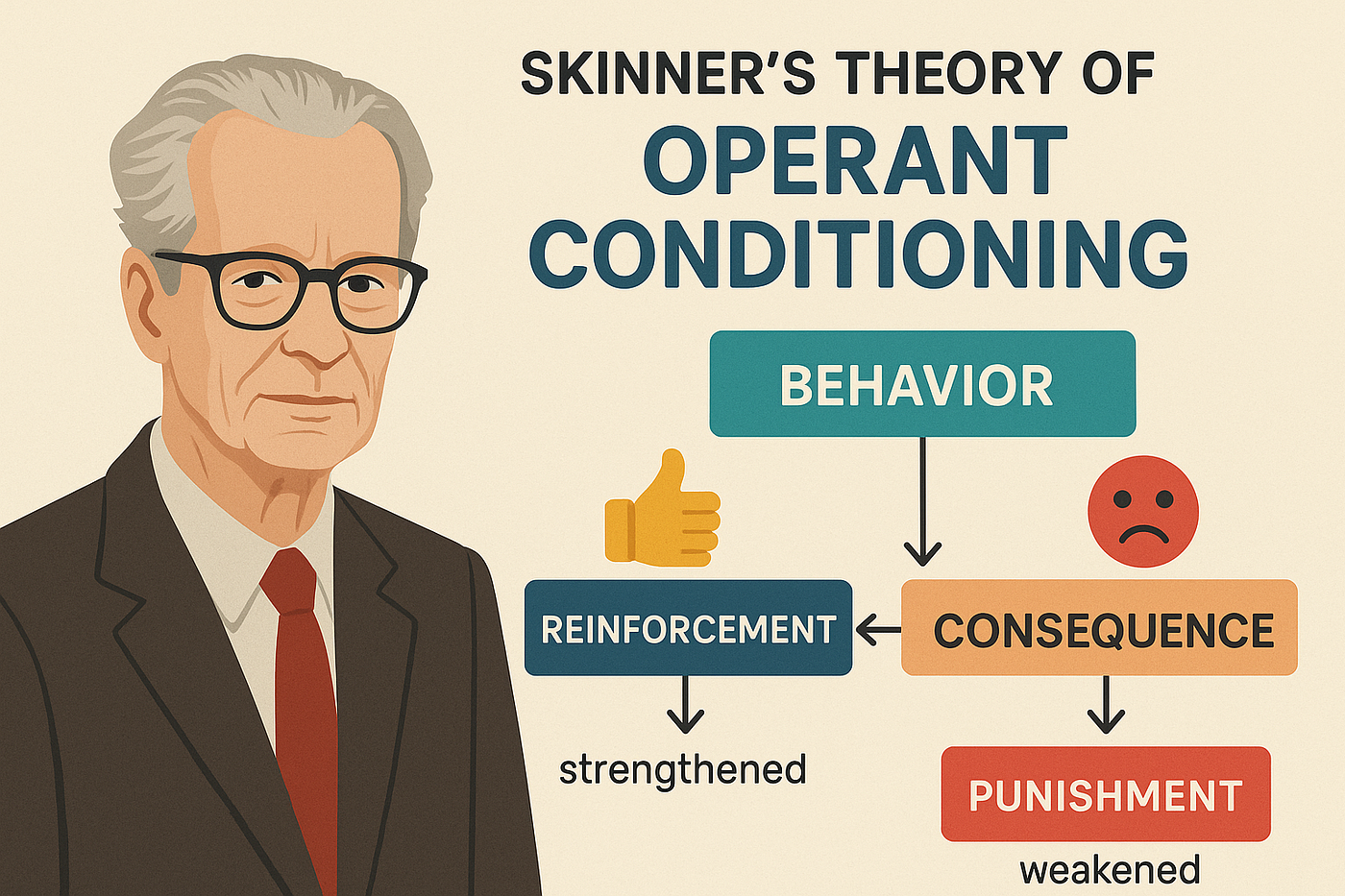
Everyday in our lives, we use operant conditioning without noticing; you study and receive a good grade, which motivates you to study again. Touching a hot stove and then burning yourself will teach you not to repeat that action.
In this activity, you will learn more about operant conditioning, how it was theorized and how its used, and you will get the opportunity to apply operant conditioning, just like a real psychologist in a psychology lab!
Task
Your task is to apply the principles of operant conditioning, not just on anyone, but on yourself to maintain a habit for around two weeks. Instead of just studying theories, you will get the opportunity to be both the researcher and the subject.
You will:
1- Choose a habit you want to start praciticing/ stop doing.
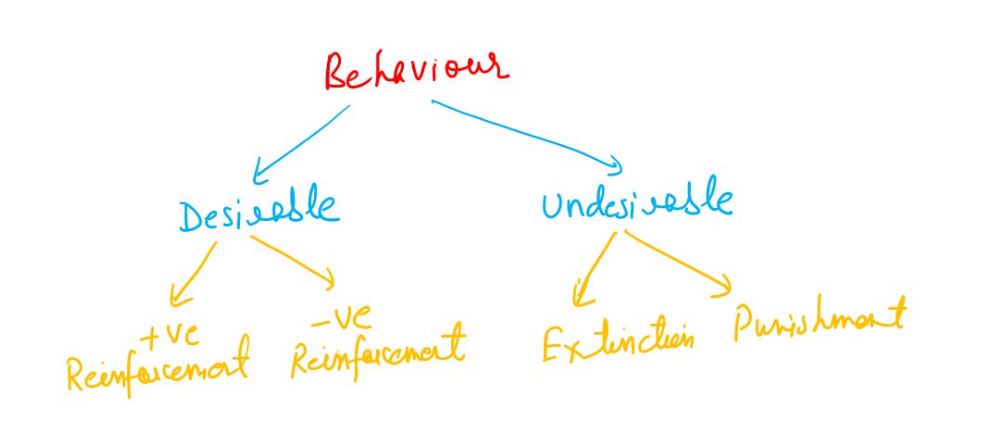
2- Choose a reinforcement/punishment that you will be using. You must work in pairs so that one ensures that the other receives the reinforcer/punisher.
3- Implement the plan over the course of two weeks.
4- Write a reflection paper on the methods that worked/didn't work and why do you think they did.
Process
1. Learn the Basics
Before you can apply operant conditioning, you need to understand what it is and how it works.
Schedules of reinforcement
Schedules of reinforcement are specific patterns or timings where rewards or punishments are received after the occurrence of a behavior. There are two main types of reinforcement schedules: partial/intermittent and continuous.
:max_bytes(150000):strip_icc()/what-is-a-schedule-of-reinforcement-2794864-01-574bc7e33aa74545a7fe934888339228.png)
Continuous is when everytime a behavior is performed, a reward or punishment is recieved. Every. Single. Time.
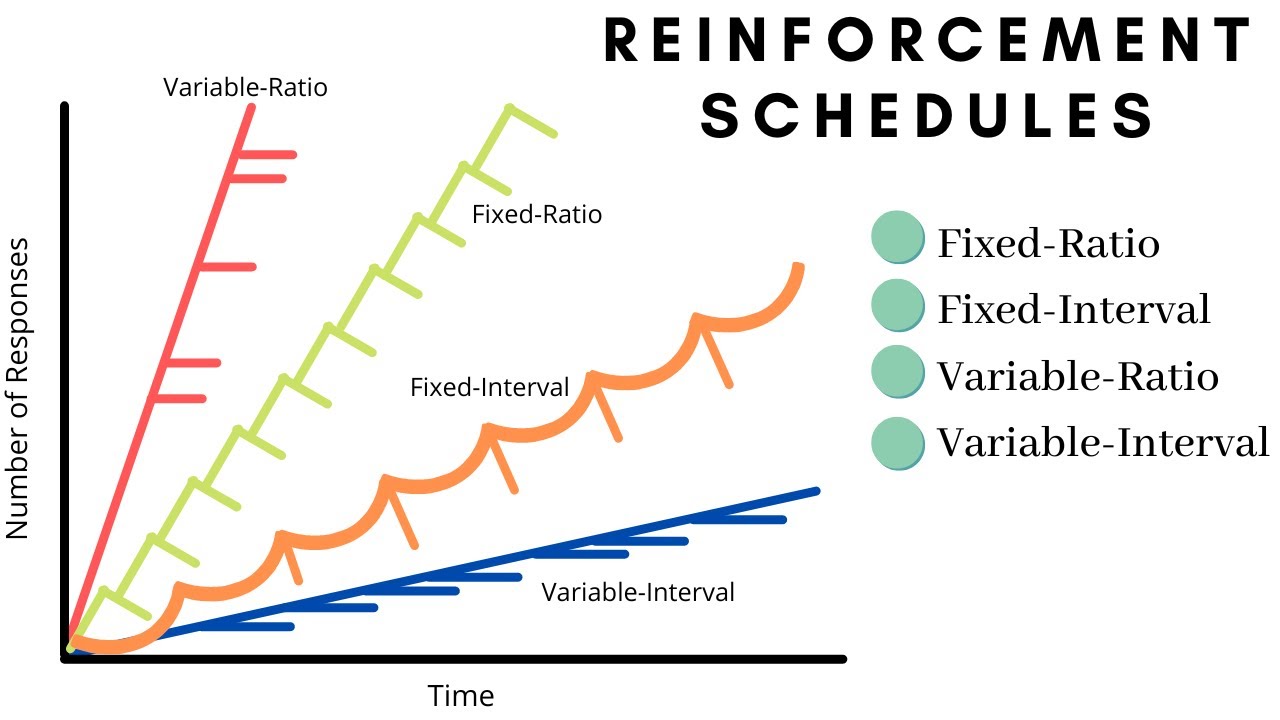
Partial is when the reinforcement is received only some of the time, not always. This variability in scheduling makes it resistant to extinction, and the schedules are divided into four main ones:
| Schedule | Definition | Example | Behavior Pattern |
|---|---|---|---|
| Fixed-Ratio (FR) | Reinforcement after a fixed number of responses | Paid after every 10 products | Rapid response, short pause after reinforcement |
| Variable-Ratio (VR) | Reinforcement after a variable number of responses | Winning on a slot machine | Very high and steady response rate |
| Fixed-Interval (FI) | Reinforcement after a fixed time period | Paycheck every 2 weeks | Response increases as time approaches |
| Variable-Interval (VI) | Reinforcement after varying time intervals | Checking email for a message | Steady, moderate response rate |
2. Behavior Modification Plan
A behavior modification plan is a step-by-step strategy that helps you change a specific behavior using the principles of operant conditioning — reinforcement, punishment, shaping, and reinforcement schedules. You choose a behavior you want to increase (like studying more, exercising, or being on time) or decrease (like procrastinating or biting your nails), and then plan how you’ll change it by controlling the consequences that follow it.
How to design a behavior modification plan?
1. Choose a target behavior: Think about one behavior in your life that you want to increase or decrease.
2. Record your baseline: Before you start changing the behavior, observe it for a few days and write down how often it happens.
3. Plan your reinforcement and punishment: Decide how you’ll reward yourself for doing the desired behavior (reinforcement) and how you’ll discourage the unwanted behavior (punishment).
4. Choose a Schedule of Reinforcement: Decide how often you will reward or punish the behavior. At first, you might reinforce it every time it happens (continuous reinforcement), and later, only sometimes (partial reinforcement) to make the habit stronger.
5. Use Shaping (Optional): If your goal feels too big, break it into smaller steps and reward progress along the way.
6. Track Your Progress: Keep a simple daily log where you keep track of the behavior, if the reinforcement was recieved, and how it felt.
Below are examples of behavior modification plans that you can take a look at for inspiration:
https://www.ncbi.nlm.nih.gov/books/NBK459285/
https://www.adinaaba.com/post/behavior-intervention-plan-examples
Evaluation
|
Criteria |
Excellent (4) | Good (3) | Satisfactory (2) | Needs Improvement (1) |
|---|---|---|---|---|
| Understanding of Operant Conditioning Concepts | Shows thorough and accurate understanding of reinforcement, punishment, shaping, and schedules. Explains them clearly and uses correct terminology. | Mostly accurate understanding with minor errors. Uses most terms correctly. | Shows basic understanding but with gaps or confusion in some key areas. | Shows little or incorrect understanding of core concepts. Terms are missing or misused. |
| Behavior Modification Plan Design | Plan is specific, realistic, creative, and clearly based on operant conditioning principles. Includes reinforcement, punishment, shaping, and schedule details. | Plan is mostly clear and realistic but may be missing one component or lack some detail. | Plan is basic, vague, or missing multiple components. | Plan is unclear, unrealistic, or not based on operant conditioning principles. |
| Implementation and Tracking | Daily log is detailed and complete. Shows consistent application of plan and thoughtful tracking of progress. | Daily log is complete but may have minor gaps or inconsistent tracking. | Log is partially complete with significant gaps in tracking or application. | No clear log or tracking provided. Plan not implemented. |
| Reflection and Analysis | Deep, honest reflection on what worked, what didn’t, and why. Connects results clearly to operant conditioning principles. | Reflection is clear and shows learning, though not deeply analytical. | Reflection is present but brief, general, or not well connected to psychology concepts. | Reflection is missing, incomplete, or does not connect to operant conditioning. |
| Presentation / Report Quality | Final product is well-organized, visually engaging, free of errors, and easy to follow. | Organized and clear with minor errors or areas for improvement. | Basic presentation with limited clarity, organization, or design. | Disorganized, unclear, or incomplete presentation/report. |
Total Points: 20
-
18–20 points: Outstanding – Excellent understanding and application
-
14–17 points: Proficient – Good understanding with minor gaps
-
10–13 points: Basic – Some understanding, but incomplete application
-
Below 10 points: Needs improvement – Major gaps in understanding or application
Conclusion
Not only did you learn what operant conditioning is, you also got a chance to apply it on your own life! This shows that psychology is not just theory, but rather tools that can be used in our daily lives to improve our behavior and achieve our goals.
Changing behavior is never about willpower alone; it’s about understanding how consequences guide our actions.
Great job in staying consistent and achieving what you set out to do!

Credits
Adina ABA Staff. (2025, March 20). Top behavior intervention plan examples. Adina ABA. Retrieved from https://www.adinaaba.com/post/behavior-intervention-plan-examples Adina ABA Therapy
Andover. (2025, March 14). The difference between classical and operant conditioning [Video]. YouTube. https://youtu.be/H6LEcM0E0io?si=-qm9WS1BASpFQeUu
Lim, A. G. Y. (2024, February 2). Schedules of reinforcement in psychology (Examples). Simply Psychology. https://www.simplypsychology.org/schedules-of-reinforcement.html
Scott, H. K., Jain, A., & Cogburn, M. (2023, July 10). Behavior modification. In StatPearls. StatPearls Publishing. Retrieved from https://www.ncbi.nlm.nih.gov/books/NBK459285/