Introduction
Name: Mariam Hamad
Grade: 9 - Middle School Level
Introduction
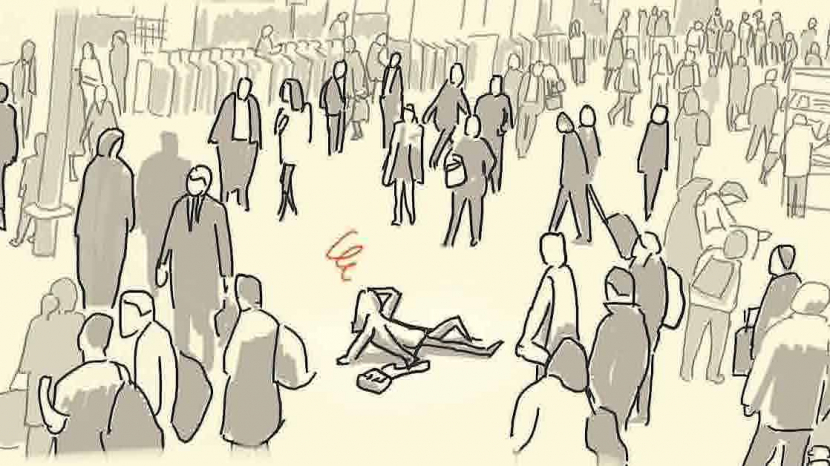
Let's set the scene. Imagine you are on your way to school when you suddenly see a person collapse to the ground. You look around you and there are a few people taking the same path as you are. What do you do when you see the person laying on the floor? Do you rush to help, or do you wait for someone else to take initiative before you?
This WebQuest will help you define the Bystander Effect, understand the origin of its name, explore the causes that push individuals to not intervene in the case of an emergency, and differentiate between situations where help is more likely to be given.
Towards the end, you will hopefully learn how to be an active bystander that assists others in the case of an emergency.
Task
By the end of this WebQuest, you will be able to:

- Define the Bystander Effect
- Explore the origin of the term
- Analyze the causes behind not taking action
- Identify situations where intervention is more likely to occur
- Learn how to become an active bystander
Process
Step 1: Understanding the Bystander Effect
- Watch the following video and take notes:
- Then, read the following article and take notes: https://practicalpie.com/the-bystander-effect-definition-examples/?utm_source=chatgpt.com
Step 2: Answering a few questions
1- Based on the article, what is the origin of the term the Bystander effect?
2- Based on personal experience, when have you observed this effect? Share the story with the class.
3- Do you think a person is more likely to help in the presence of others or when alone?
Step 3: Why would a person not take action?
- Find resources that list down possible reasons why a person would choose not to intervene during an emergency
- From this article, https://www.britannica.com/topic/bystander-effect/Diffusion-of-responsibility, explain what the diffusion of responsibility is and how it plays a part in not taking action.

- Discuss, from the same article linked above, the impact of social influence when deciding to help the person in public.
- Based on the information you have so far, do you think ambiguous and unclear situations affect the likelihood of a bystander intervening?
Step 4: Identify situations where someone is more likely to help
You will be divided into groups of 3, and each group will be assigned a scenario. Highlight the parts that you think pushed the bystanders to intervene.
After sharing the answers, read the following article and identify the steps that should be followed to practice becoming an active bystander in society.
https://equality.leeds.ac.uk/support-and-resources/becoming-an-active-bystander/#how%20to%20be
Step 5: Summarize in your own way!
After the lesson is finalized, choose your preferred method of summarizing what you have learned. This could be through:
- A short role-play
- A powerpoint presentation
- A short recorded video
or any other idea...
Once done, present your work to the class :)
Evaluation
You will be graded based on the below rubric.
| Criteria | Excellent (5 pts) | Good (4 pts) | Satisfactory (3 pts) | Needs Improvement (2 pts) | Unsatisfactory (1 pt) |
|---|---|---|---|---|---|
| Content Understanding | Student demonstrates a deep understanding of the definition of the Bystander Effect, as well as its causes, and solutions. | Student shows a good understanding of the key concepts. | Student shows a satisfactory understanding of the key concepts. | Student shows a basic understanding of the key concepts | Student shows no understanding of the key concepts. |
| Creativity | Presentation idea is highly creative and memorable. | Presentation is creative, but the idea could have been slightly more elaborate. | Presentation is slightly creative. | Presentation has little creativity and is routine-like. | Presentation lacks creativity and is very straightforward. |
| Clarity of ideas | Information is presented in a clear and organized manner. | Information is generally clear, but some parts may be confusing. | Information is slightly clear, but is jumbled and lacks order. | Information is unclear, but follows some sort of logical order. | Information is unclear and has no logical order. |
| Presentation skills | The student presents confidently, maintains good eye contact, and has good intonation. | The students presents well, with some eye contact and intonation. | Basic presentation skills are met. | Little presentation skills are met, and the student doesn't appear confident. | Poor presentation skills; no eye contact, or intonation. |
Grading: __/ 20
Comments: ____________________________________
❌ Photo unavailable
Conclusion
In conclusion, the Bystander effect is a psychological phenomenon where the presence of others discourages an individual from intervening in the case of an emergency, meaning that it's likely that most bystanders will choose not to help simply because they assume someone else will.
By learning about the Bystander Effect, we know understand the significance of interfering in critical situations. It is essential to apply the knowledge gained through this WebQuest to foster a society where compassion and support are the primary responses in the face of emergencies.
❌ Photo unavailable
Credits
American Psychological Association. (n.d.). Bystander intervention tip sheet. American Psychological Association. https://www.apa.org/pi/health-equity/bystander-intervention
Becoming an active bystander. Equality and Inclusion Unit. (2022, April 26). https://equality.leeds.ac.uk/support-and-resources/becoming-an-active-b…;
Blagg , R. D. (2025, January 10). Bystander effect. Encyclopædia Britannica. https://www.britannica.com/topic/bystander-effect
Practical Psychology. (2022, February 28). The bystander effect (definition + examples). https://practicalpie.com/the-bystander-effect-definition-examples/
Picture credits:
https://static.republika.co.id/uploads/member/images/news/1k2lquo5cm.jpg
https://vapromag.co.uk/wp-content/uploads/2012/02/120308Tasks.jpg
https://wp.technologyreview.com/wp-content/uploads/2020/11/funnel_web.jpg
https://t3.ftcdn.net/jpg/03/12/44/34/360_F_312443477_5lxDV8QHzXyOwMH4FxLmU4Y93h12NZEJ.jpg