
Introduction

Welcome to Your Solar System Adventure!
Prepare yourself and get into the explorer mode!
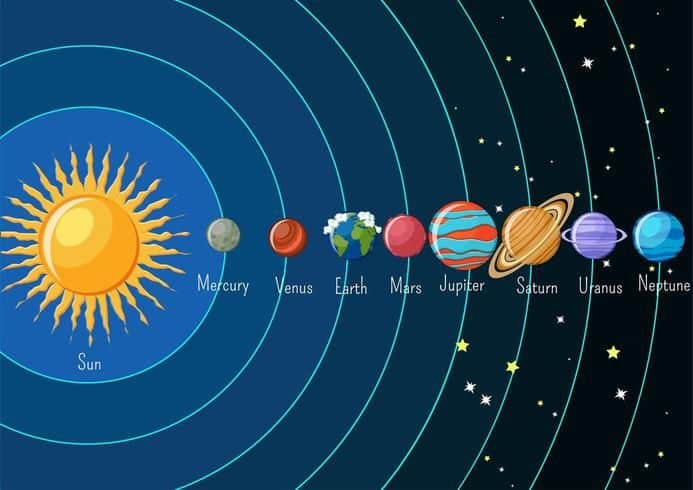
Today, we are embarking on a quest to discover our solar system. Envision flying through the planets, factoring in the moons, and getting the scoop of the Sun, which is a sizable star that makes the day shine!
We've all looked at the sky and wondered what is out there in space, we've looked at the sun and wondered how it spreads its light, we contemplated the stars and wondered how far they are.
-
Meet the Planets: We’ll stop by each planet, you'll learn what makes each planet special and unique, like Venus’s thick clouds or Mars’s tall mountains.
-
Uncover the mysteries of the sun: learn how the sun plays a central role in the solar system.
-
Report Your Discoveries: Once you finish your journey, you’ll put together everything you learned into a final report that shows all the amazing things you discovered.
As a unit, we’ll navigate through the cosmos as we try to learn the different features of our solar system, find out interesting details, and see how the sun directs all the planets.
Therefore, put on your space suit and let us go flying through the magnificent universe just outside our planet!
Task

My Solar System Adventure Report
Title Page
-
Title:
-
Name:
-
Date:
Introduction
-
Welcome Message: Briefly introduce the solar system and what the report will cover.
Planet Profiles
For each planet, include the following sections:
Planet Name
-
Fun Fact: One interesting fact about the planet.
-
Special Features: Describe unique characteristics (e.g., Venus’s thick clouds, Mars’s tall mountains).
Space Mysteries
-
Asteroid Belt: Explain what it is and why it's interesting.
-
Saturn’s Rings: Describe why Saturn has rings.
-
The Sun’s Energy: Explain the importance of the Sun and its energy.
Conclusion
-
Summary: Recap the adventure and highlight the most exciting discoveries.
-
Personal Reflection: Share what was enjoyed the most and any new things learned.
Final Report
-
All Discoveries: Compile all the sections into a final report showing the amazing things discovered during the adventure.
Process
Step1: Introduction:
Use the following website to find a simple definition of the "solar system":
solar system - Kids | Britannica Kids | Homework Help
Step 2: For the planet profiles:
Use this website to complete the profile of each planet, the link will lead you directly to the page needed, you must click on each planet to get the information needed:
https://spaceplace.nasa.gov/menu/solar-system/
Step 3: For space mysteries:
Asteroid Belt:
Watch this video and formulate a brief definition of the asteroid belt (origin, formation, location...)
Saturn Rings:
Use the following link to discover why Saturn has rings and formulate it in your own way:
Why does Saturn have rings? | NASA Space Place – NASA Science for Kids
The sun's energy:
Watch this video and deduce at least three benefits of the sun's energy:
Step 4: Conclusion:
Recap all the information gathered and share your thoughts regarding the solar system and its mysteries.
Good Luck on your adventure!
Evaluation
| Title | 2 |
| Introduction | 2 |
| Planet profile | 7 |
| Space mysteries | 3 |
| Conclusion | 2 |
| Grammar/spelling | 2 |
| Correct Format | 2 |
| Total | /20 |
Conclusion
Educational outcomes might differ from one student to another, but after completing this activity, students should gain a holistic knowledge of the solar system, its components, mysteries, and its center. This activity will implant in students a scientific curiosity towards the universe and will introduce them to certified scientific facts about space.

Credits
References:
Britannica Kids. (2019). solar system. Britannica Kids. https://kids.britannica.com/kids/article/solar-system/353789
NASA. (2015). Solar System | NASA Space Place – NASA Science for Kids. Nasa.gov. https://spaceplace.nasa.gov/menu/solar-system/
Kaushik, U. (2024). What is Asteroid Belt? Youtu.be.
Why does Saturn have rings? | NASA Space Place – NASA Science for Kids. (2017). Nasa.gov. https://spaceplace.nasa.gov/saturn-rings/en/
Nation, N. (2023, April 3). Solar Energy | How does the Sun help us | Energy of the Sun | Uses of Solar Energy for Kids. YouTube.

Green, J. (2023). https://cdn.illustratedteacup.com/wp-content/uploads/2023/09/Solar-System-Project-Ideas-for-Kids-that-are-Out-of-this-World.jpeg

Deak, M. (2024). Is the Milky Way Galaxy A Different Shape Than We Thought? https://www.google.com/url?sa=i&url=https%3A%2F%2Fwww.worldatlas.com%2Fspace%2Fis-the-milky-way-galaxy-a-different-shape-than-we-thought.html&psig=AOvVaw0gMOxeMQY4kM0Inks1dFXD&ust=1730067565394000&source=images&cd=vfe&opi=89978449&ved=0CBQQjRxqFwoTCNCGzI2KrYkDFQAAAAAdAAAAABAE
Milnes, A. (n.d.). Solar System Activities & Space Crafts. https://www.google.com/url?sa=i&url=https%3A%2F%2Fwww.pinterest.com%2Ftheinspirationedit%2Fsolar-system-activities-space-crafts%2F&psig=AOvVaw2sg_YsC94IBmn089C1PWDY&ust=1730067766578000&source=images&cd=vfe&opi=89978449&ved=0CBQQjRxqFwoTCOiBgfmKrYkDFQAAAAAdAAAAABAE