
Introduction
Have you ever wondered how the same water we drink, swim in, and see in the clouds has been on Earth for millions of years? Water is always on the move, traveling through rivers, oceans, clouds, and even through plants and animals—including you! This endless journey is called the water cycle, and it’s essential for life on Earth.
In this WebQuest, you’ll follow a tiny water drop through the different stages of the water cycle—evaporation, convection, precipitation, and collection/storage. Along the way, you’ll discover how the sun, clouds, oceans, and even plants all work together to keep water flowing. You’ll also explore how water helps plants grow, fills our rivers and lakes, and makes life possible for animals and people.
Are you ready to dive into the exciting world of the water cycle? Put on your explorer’s hat, because your mission is to learn all about water’s incredible journey and figure out how we can protect this precious resource!
Task
By the end of this WebQuest, you will complete two tasks:
1. Draw your own unique water cycle:
Create a creative labeled diagram of the water cycle with arrows showing the path of water.
2. Group Presentation:
In teams, each student acts out different parts of the water cycle, with each person playing the role of a water droplet in a specific stage of the cycle.
Process
Follow the following steps to complete your tasks:
I. Drawing a labeled diagram of the water cycle
Step 1: Gather Your Necessary Materials
- A blank sheet of paper or poster
- Colored pencils, crayons, or markers
- A ruler (optional, to draw neat arrows)
Step 2: Learn the Stages of the Water Cycle
Make sure you understand the whole cycle before proceeding, through the listed sources:
What is the Water Cycle?
The water cycle is the continuous movement or journey of water all around the Earth. It never stops and has no real beginning or end—it’s like a big circle! Water keeps changing forms as it travels between the sky, land, and oceans, making life on Earth possible.
Mention facts such as, Did You Know?
- The water cycle is also called the "hydrologic cycle."
- Earth has been recycling water for over 4 billion years!
- Do plants sweat? Well, sort of... People perspire (sweat), and plants transpire by releasing water from their leaves, helping them stay healthy and cool.
So, how does this incredible water cycle work? It can be broken down into four ordered main parts you should mention: Evaporation, Convection, Precipitation, and Collection/Storage.
1) Evaporation
Evaporation happens when the sun heats water from rivers, lakes, or oceans, turning it into vapor or steam. This water vapor rises into the atmosphere. Plants help too through transpiration, they release water vapor from their leaves, giving evaporation an extra boost!
2) Convection
Convection occurs when warm air near the Earth's surface rises, carrying water vapor with it. As the air rises, it cools, and the vapor condenses into water droplets, forming clouds.
You can observe condensation at home by pouring a cold drink on a hot day. Water droplets appear on the outside of the glass—not from inside but from the warm air turning into liquid when it touches the cold surface!
3) Precipitation
Precipitation happens when clouds become too heavy to hold the condensed water. The water falls back to Earth as rain, hail, sleet, or snow.
4) Collection/Storage
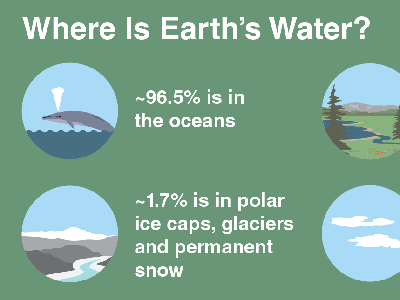
Some water completes the cycle quickly, while other water stays stored for long periods. Oceans are the largest storage, holding about 96% of Earth’s water (though it’s salty). Freshwater is stored in lakes, rivers, glaciers, snow caps, and even underground as groundwater—ensuring there’s water for plants, animals, and people to use.
This magical, never-ending journey of water is essential for life on Earth. Every drop has been part of this cycle for billions of years!
Animated video of the water cycle:
Step 3: Plan Your Diagram
- Draw a large sun in the sky to show the heat that drives the water cycle.
- Sketch an ocean, river, or lake on the ground where water starts.
- Add some clouds in the sky.
- Include arrows to show how water moves between stages (from ocean to sky, to clouds, back to Earth).
Step 4: Label the Stages
Use small, neat writing to label the stages:
- Evaporation
- Convection
- Precipitation
- Collection/Storage
Step 5: Add Color and Details
- Color the water blue, clouds white or gray, and the sun yellow.
- Make your diagram interesting with trees, mountains, animals, or people if you like.
Step 6: Check and Finalize Your Work
- Make sure to add your own twist of creativity and most importantly enjoy your work.
Sources:
Admin. (2024, June 24). Water cycle - process and its various stages. BYJUS. https://byjus.com/biology/water-cycle/
What is the Water Cycle for Kids?. Twinkl.com. (n.d.). https://www.twinkl.com/teaching-wiki/water-cycle-for-kids
II. Group Presentation
Step 1: Form Your Team
- I will assign teams of 4-5 students.
- Each student will play the role of a water droplet in one stage of the water cycle.
Step 2: Assign Roles and Stages based on the information from the source
As a team, decide who will act out each of these parts based on the what you learned:
- Evaporation: The droplet rises from oceans, lakes, or rivers and turns into water vapor.
- Convection: The droplet cools, turns into a cloud, and joins other droplets.
- Precipitation: The droplet falls to Earth as rain, snow, or hail.
- Collection/Storage: The droplet lands in oceans, rivers, or underground.
- Someone can act as the sun or plant with an important role.
Step 3: Plan Your Performance
- Brainstorm how each stage will look. Use creative movements, such as:
- Rising slowly like steam for evaporation.
- Floating gently as a cloud for condensation.
- Falling like rain for precipitation.
- Pooling together to form rivers or oceans for collection.
- Decide on actions for how the water droplets will move between stages. Use your arms, legs, or even sounds (like “swoosh” or “plop”)!
- Add a short line for each stage to explain what’s happening. Example: "I rise from the ocean and float into the sky! I’m evaporation!"
Step 4: Practice Your Performance
- Practice moving together as a team so the transitions between stages are smooth.
- Make sure each student knows their part and can explain their stage clearly.
- Time your presentation with maximum 10 minutes long.
Step 5: Get Creative!
- Use simple props or costumes if you want (e.g., a yellow scarf for the sun, blue for water droplets, plant costume for a plant).
- Add sound effects (like wind or splashing water) to make it more fun!
Step 6: Present to the Class
- During your presentation, each droplet will describe their stage and show how they move.
- Make sure everyone participates and works together as a team!
Source:
Slideshare. (2013, August 3). The water cycle for Elementary. SlideShare. https://www.slideshare.net/slideshow/the-water-cycle-for-elementary/249…
Evaluation
This assignment is worth a total of 100 points. It is divided in a grading criteria below:
1. Drawing of the water cycle (50 points)
| Criteria | Points | Description |
| Accuracy of Stages | 10 | All stages (evaporation, condensation, precipitation, and collection) are correctly included and labeled. |
| Use of Arrows to Show Water Movement | 10 | Arrows clearly and accurately show the flow of water between all stages. |
| Neatness and Organization | 5 | Diagram is neat, well-organized, and easy to understand. |
| Labels and Annotations | 10 | All parts are clearly labeled, with detailed and accurate annotations. |
| Creativity and Visual Appeal | 10 | Diagram is colorful, detailed, and engaging, with creative touches (e.g., sun, animals, plants). |
| Completion of Task | 5 | All required elements are included, and the diagram meets the assignment's expectations. |
| Total grade/50 |
2. Group Presentation (50 points)
| Criteria | Points | Description |
| Understanding of the Water Cycle | 10 | All stages are accurately represented, with clear and correct explanations. |
| Clarity and Presentation Skills | 5 | Presentation is clear, easy to follow, and well-rehearsed. |
| Use of Time | 5 | Presentation fits perfectly within the time limit. |
| Transitions Between Stages | 5 | Smooth, clear transitions between all stages of the cycle. |
| Organization | 5 | Everything fits well |
| Visual Design and Aesthetics | 10 | Slides are visually appealing, with appropriate use of images, graphics, and text. |
| Creativity and Engagement | 5 | Performance is highly creative with engaging movements, sounds, or props. |
| Teamwork and Participation | 5 | All group members actively participate and contribute equally. |
| Total grade/50 |
Conclusion
In conclusion, you have now explored a crucial part of our planet's biology: the water cycle! By completing your group presentations and creating your own diagrams, you've discovered how water moves through different stages, connecting everything from oceans to clouds to plants. You’ve learned that this process is not just fascinating; it's vital for all living things on Earth.
Through this WebQuest, you’ve gained insight into how the water cycle works, including evaporation, condensation, precipitation, and collection. You’ve seen how the sun powers this cycle, helping water to travel from the ground into the sky and back again. By acting out the water cycle and illustrating it, you’ve experienced firsthand how interconnected everything is in nature just like us.
Understanding the water cycle is essential for your future studies in science and biology. Water is a key resource that supports life, and by knowing how it travels and changes, you can appreciate its importance in ecosystems. As young explorers, you are now equipped with the knowledge to help protect our precious water resources, ensuring that future generations can also enjoy the wonders of our planet! Keep asking questions, exploring, and learning about the wonderful world around you.
Credits
References
Articles:
- Admin. (2024, June 24). Water cycle - process and its various stages. BYJUS. https://byjus.com/biology/water-cycle/
-
Slideshare. (2013, August 3). The water cycle for Elementary. SlideShare. https://www.slideshare.net/slideshow/the-water-cycle-for-elementary/249…
- What is the Water Cycle for Kids?. Twinkl.com. (n.d.). https://www.twinkl.com/teaching-wiki/water-cycle-for-kids
Video:
-
The Water Cycle | The Dr. Binocs Show | Learn Videos For Kids ( 2015, March 11) YouTube. (n.d.-b). YouTube. https://www.youtube.com/watch?v=9pqh6tlEOhs
Images:
- YouTube. (n.d.). YouTube. https://www.youtube.com/watch?v=9pqh6tlEOhs
-
The water cycle. Activity Village. (n.d.). https://www.activityvillage.co.uk/the-water-cycle
-
NASA salinity: Learn more (detail). (n.d.). https://salinity.oceansciences.org/learn-more.htm?id=87
-
The water cycle: Hands-on learning activities. The Mulberry Journal. (2022, April 29). https://themulberryjournal.com/writing-collective/the-water-cycle-activ…
- Water+Cycle+diagram images – browse 158 stock photos, vectors, and video. Adobe Stock. (n.d.). https://stock.adobe.com/lb/search?k=water%2Bcycle%2Bdiagram
WebQuest Website:
- Create webquest: Create a WebQuest: Simple. quick. free. Create WebQuest | Create a WebQuest: Simple. Quick. Free. (n.d.). https://www.createwebquest.com/