
Introduction
Through this WebQuest, students will explore how food is produced, the technologies that ensure its safety and quality, and the factors that shape consumer choices. By conducting interviews and research, they will investigate the stories behind everyday foods and identify ways to make food systems more sustainable and fair. In the process, they will connect ideas and recognize the bigger picture of how food reaches the consumer.
Task
In this WebQuest on food systems and the Farm to Fork Strategy, you will explore the intricate process of food from its production to its consumption. Your assignment includes examining different facets of the food system, including farming practices, technological innovations and consumer perspectives. By conducting interviews and collecting data, you'll gain insights into the operation of food systems, the challenges they encounter and the innovations shaping their future. You will come across STEM careers in the Food Industry. All this investigation will contribute to a deeper understanding of how to improve the sustainability, efficiency, and equity of food systems.
Process
Step 1: Background information
- Food systems encompass the entire range of activities involved in the production, processing, distribution, consumption and disposal of food. These systems include everything from agricultural practices and food manufacturing to retail and consumption, as well as waste management. A food system's sustainability and efficiency are crucial for ensuring food security, reducing environmental impact and promoting public health.
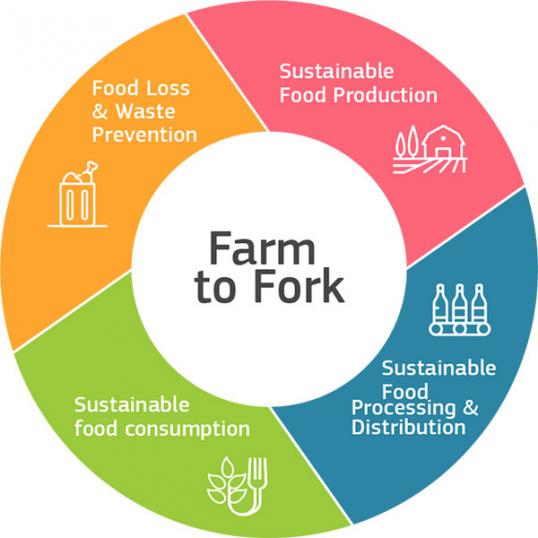
- The Farm to Fork Strategy is a central part of the European Green Deal, aiming to make food systems fair, healthy and environmentally friendly. It addresses the entire food supply chain from production and processing to distribution and consumption. The strategy emphasizes reducing the environmental and climate impact of food production, promoting sustainable practices and ensuring food security and nutrition.
[Photo source: https://food.ec.europa.eu/sites/default/files/styles/embed_medium/public/2020-05/food_farm2fork_ring.jpg?itok=_w2WoBoO ]
- The European Green Deal is the European Union's plan to make the EU's economy sustainable by turning climate and environmental challenges into opportunities. The deal aims for no net emissions of greenhouse gases by 2050, economic growth decoupled from resource use and no person or place left behind.
Useful links:
https://food.ec.europa.eu/horizontal-topics/farm-fork-strategy_en
https://commission.europa.eu/strategy-and-policy/priorities-2019-2024/european-green-deal_en
https://food.ec.europa.eu/system/files/2020-05/f2f_action-plan_2020_strategy-info_en.pdf
https://www.fao.org/sustainability/en/
Step 2: Team Formation and Role Assignment
Students will work in national teams to explore the farm-to-fork journey of the food system tby interviewing a farmer, a food industry expert and consumers. To choose a role and a group in their team, visit the following Google Doc https://docs.google.com/document/d/17qV8svzQjlqwJJMKKZWliWTnoi5iBd9Z2mU2fVD6ePo/edit?usp=sharing
Each team will assign the following roles:
- Question Developers who will
- collaborate to develop relevant questions for the interview with the farmer, the food industry expert and the consumers,
- ensure that questions are clear, focused and cover key topics related to the group's focus
- review the drafted questions of the group to ensure that they are comprehensive and relevant.
- Interviewer who will
- take the interviews and keep detailed notes,
- organize the collected data for analysis.
- Data analysts, who will
- analyze the interview data to identify key themes and insights,
- create visual representations of the data using graphs and charts,
- summarize findings in a clear and concise manner.
- Presenter, who will
- create a cohesive final presentation of the findings.
- answer any questions from the audience.
Step 2: Preparation for the interviews
‘Question Developers’ use the following padlet to collaboratively create and refine the interview questions, ensuring they cover different aspects of their assigned topic: https://padlet.com/meddiet4health/food-system-farm-to-fork-trip-51z7m0c0uiihdku6
Students carry out a visit where they will interview a farmer, a food producer or a consumer. Data analysts summarize the data clearly and concisely. Presenters will upload to the same padlet a summary of their findings.
"
Step 3: The Visit and Interviews
Teams carry out the visits. Interviewers conduct the interviews and data analysts summarize the data clearly and concisely. Presenters from all teams organize a common presentation for each country and upload to a Padlet https://padlet.com/meddiet4health/food-system-farm-to-fork-trip-51z7m0c0uiihdku6
Evaluation
- Webquest evaluation: https://docs.google.com/forms/d/e/1FAIpQLScocHJMMEN7sEduFYzT61qK7XdPxD4hmzmHCmfqTwCbiBabow/viewform?usp=sf_link
- Students’ evaluation will be based on the following rubric:
| Criteria | 5 - Excellent | 4 - Proficient | 3 - Satisfactory | 2 - Needs Improvement | 1 - Inadequate |
|---|---|---|---|---|---|
| Question Development | Questions are highly relevant, clear, focused, and cover all key topics comprehensively. | Questions are relevant and mostly clear; cover most key topics with minor gaps. | Questions cover some key topics but lack clarity or focus in parts. | Questions are unclear, unfocused, or miss several key topics. | Questions are irrelevant, unclear, or incomplete with little connection to the topic. |
| Interview Execution | Interviewer conducts thorough interviews, keeps detailed notes, and organizes data excellently. | Interviewer conducts interviews well with adequate notes and organized data. | Interviewer conducts basic interviews with limited notes and some data organization. | Interviewer struggles with interview or note-taking; data organization is poor. | Interviewer fails to conduct interviews or take useful notes; data is disorganized or missing. |
| Data Analysis | Analysis is insightful, identifies key themes clearly, and visual data representations are excellent and accurate. | Analysis identifies key themes with minor omissions; visuals are clear and mostly accurate. | Analysis is basic, identifying some themes; visuals are present but lack clarity or accuracy. | Analysis is incomplete or superficial; visuals are unclear or inaccurate. | No meaningful analysis; visuals are missing or incorrect. |
| Presentation Quality | Presentation is cohesive, engaging, and thoroughly explains findings; presenter answers questions confidently. | Presentation is clear and well-organized; answers questions with minor hesitation or gaps. | Presentation is understandable but lacks cohesion or depth; responses to questions are basic. | Presentation is disorganized or incomplete; presenter struggles to answer questions. | Presentation is unclear, incomplete, or missing; presenter cannot answer questions. |
| Collaboration and Teamwork | Team roles are clearly defined and executed; members collaborate effectively throughout the project. | Team roles are mostly clear; members collaborate well with minor coordination issues. | Team roles somewhat defined; collaboration is inconsistent or uneven. | Team roles unclear; collaboration is minimal or problematic. | No clear roles or collaboration; project work is disjointed or incomplete |
Conclusion
By completing this WebQuest students will have analyzed the whole food system from farm to fork and evaluate its impact on sustainability, health and the environment. They will investigate real-life practices by interviewing farmers, food experts and consumers, interpret the data collected and propose ways to reduce food waste and improve food safety. They will also collaborate, communicate and develop key skills to support responsible and sustainable food practices.
Credits
Teacher Page
This WebQuest was edited by a teacher of 2o Esperino EPAL Acharnon (Greece) as part of the activities of the "Mediterranean Diet for Overall Health" (MedDiet4Health) Erasmus+ project (Project number: 2023-2-EL01-KA210-VET-000183592).
In this WebQuest, students in Vocational Education analyze the farm-to-fork food system, evaluate its impact on sustainability, health and food security and investigate technological practices in food production. They develop research, data analysis, and problem-solving skills by conducting interviews and interpreting findings, gaining insight into STEM careers in the Food Industry. Students collaborate in teams, communicate findings clearly, and propose practical solutions for sustainable and safe food practices. They also reflect on personal and professional actions to support responsible, healthy, and environmentally friendly food systems.
This WebQuest reflects only the author’s views. The European Commission’s support for the production of this WebQuest does not constitute an endorsement of the contents which reflects the views only of the authors, and the Commission cannot be held responsible for any use which may be made of the information contained therein.