
Introduction

What is the present progressive tense?
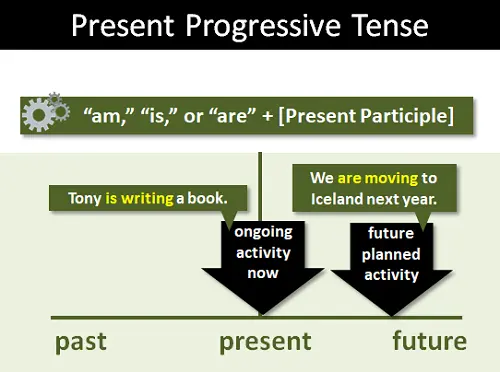
The present progressive tense is used for an ongoing action in the present. For example:
- John is baking a cake.
- They are painting the fence.
Even though it is a present tense, the present progressive tense can also be used to describe an activity that is going to happen in the future (especially for planned activities). For example:
- We are moving to New Zealand in the summer.
- The train is arriving in 2 minutes.
More Examples of the Present Progressive Tense
- Caroline is looking for the latest brochure.
- Dan and Billy are fishing off the pier.
- A lot of good arguments are spoiled by some fool who knows what he is talking about.(Playwright Miguel de Unamuno)
- Middle age is when you are sitting at home on a Saturday night and the telephone rings and you hope it isn't for you.
- (Poet Ogden Nas)
Forming the Present Progressive Tense
The present progressive tense is formed like this:
"am," "is," or "are"
+
[present participle ("verb-ing")]
Choose "am," "is," or "are" based on the following table:
| Subject | Verb "to be" | Present Participle |
|---|---|---|
| I | am | [verb] + "ing" |
| You | are | |
| He / She / It (or singular noun) | is | |
| We | are | |
| You | are | |
| They (or plural noun) | are |
For example:
- She is running.
- I am talking.
The Negative Form
If you need the negative version, you can use the following construction:
"am," "is," or "are"
+
"not"
+
[present participle]
- Caroline is not looking for the latest brochure.
- Dan and Billy are not fishing off the pier.
Remember that "is not" and "are not" are sometimes written as the contractions "isn't" and "aren't."
The Question Form
If you need to ask a question, you can use the following word order for a yes/no question:
"am," "is," or "are"
+
[subject]
+
[present participle]
- Is Caroline looking for the latest brochure?
- Are Dan and Billy fishing off the pier?
You can use the following word order for a question-word question:
[question word]
+
"am," "is," or "are"
+
[subject]
+
[present participle]
- Why is Caroline looking for the latest brochure?
- When are Dan and Billy fishing off the pier?
You can use the following word order for a choice question:
"am," "is," or "are"
+
[subject]
+
[present participle]
+
choice A
+
or
+
choice B
- Is Caroline looking for the latest brochure or her chair?
"am," "is," or "are"
+
[subject]
+
present participle A
+
or
+
present participle B
- Are Dan and Billy fishing or jumping off the pier?
Task

Task No. 1
Name: ID#:


I. Rewrite the following statements from simple tense to present progressive in affirmative, negative, and questions. 30 points.
Example:
They play soccer on Mondays:
Affirmative: They are playing soccer on Mondays.
Negative: They aren't playing soccer on Mondays.
Question: Are they playing soccer on Mondays?
1. She walks to school every day.
Affirmative:
Negative:
Question:
2. He eats breakfast at 7 o'clock.
Affirmative:
Negative:
Question:
3. They play soccer on Saturdays.
Affirmative:
Negative:
Question:
4, The sun rises in the east.
Affirmative:
Negative:
Question:
5. I work as a teacher.
Affirmative:
Negative:
Question:
6. Cats sleep a lot during the day.
Affirmative:
Negative:
Question:
7. The Earth orbits around the sun.
Affirmative:
Negative:
Question:
8. Birds chirp in the morning.
Affirmative:
Negative:
Question:
9.We study English every week.
Affirmative:
Negative:
Question
10. It rains a lot in the spring.
Affirmative:
Negative:
Question:
II: Fill in the blanks Quiz 1 – Use suitable present continuous tense forms. 14 points
-
Oh! ___________ you crying?
-
Hey, listen! A dog _____________
-
Where are ___________ now?
-
You __________ on my foot.
-
____________ raining outside now?
-
What are _____________ at?
-
Hurry up! We are __________ for you at the moment.
You looking is barking are standing Is it Why are
You going waiting

III. Conversation. Create a short conversation with a classmate. Use the present continuous or progressive as much as you can. Present it in our next synchronous session.16 points.
Process

The following steps are going to help you answer the task: the present progressive tense.
1. Watch the video about the present progressive
2. Read the material.
The Present Progressive Tense
Spelling Tip
Verbing (Present Participle)
- Add ing to most verbs. Ex. play > playing, cry > crying, bark > barking
- For verbs that end in e, remove the e and add ing. Ex: slide > sliding, ride > riding
- For verbs that end in ie, change the ie to y and add ing. Ex: die > dying, tie > tying
- For a verb whose last syllable is written with a consonant-vowel-consonant and is stressed, double the last letter before adding ing. Ex: beg > begging, begin > beginning. However: enter > entering (last syllable is not stressed)
The present progressive tense is often overused by non-native speakers of English. It should only be used in the following contexts: To describe an incomplete action which is in progress at the moment of speaking; usually with time expressions such as: now, at the moment, right now.
- (During a phone call or in an e-mail) We are discussing the project at the moment.
To describe a plan or arrangement in the near future; usually with time expressions such as: tonight, tomorrow, this week, this Monday.
- Jim's leaving for Brussels this evening.
To express actions that are repeated regularly; usually with a negative meaning and with the time expressions: always or forever.
- Her husband is always complaining about his health.
Note: A common mistake is using this form to describe what a company sells or produces. In general, a company sells something on a regular basis, so you need to use the present simple tense and not the present progressive.
- Incorrect: We are producing high-end plastic pipes.
- Correct: We produce high-end plastic pipes.
- Correct: That company is always selling some cheap gadget. (negative meaning)
The present progressive (continuous) is formed using am, is or are together with the ing (present participle) form of the verb.
| Subject | A form of be + Verbing (Present Participle) | Rest of Sentence |
| I | am taking | my final exam tomorrow |
| He / She / It | is sweeping | the floor at the moment |
| You / We / They | are giving | me a headache |
Contractions in the Present Progressive (Continuous)
In general we contract (or shorten) the subject (the person or thing doing the action), and form of be:
- I am > I'm - I'm going to the store in about ten minutes.
- He is > He's, She is > She's, It is > It's - It's raining cats and dogs.
- We are > We're, You are > You're, They are > They're – We're catching the 9:00 flight.
Save the long forms for when you want to create emphasis.
- You are not going out tonight!
When speaking, you should stress the not.
Negatives in the Present Progressive (Continuous)
Spelling Tip
When shortening a form of be and negative, just remove the o in not and add an apostrophe (') is not > isn't are not > aren'tThe negative in the present progressive tense is created using am not, is not or are not together with the ing form (present participle) of the verb.
| Subject | A form of be + Verbing | Rest of Sentence |
| I | am not working | on that project now |
| He / She / It | isn't sleeping | at the moment |
| You / We / They | aren't running | in the marathon tomorrow |
Note: In general, use these contractions in the negative: isn’t, aren’t. Am not cannot be shortened, but you can say I'm not. Save the long forms for when you want to create emphasis.
- I'm not listening to you.
- Roger isn't eating with us tonight.
- The Smiths aren't going to France this year. They're going to Thailand.
- He is not coming with me dressed like that!
Yes/No Questions in the Present Progressive (Continuous)
To ask a question that will be answered with either a yes or no, start with Am, Is or Are, then choose your subject (the person or thing doing the action), followed by the ing (present participle) form of the verb and then the rest of your question.
| A Form of be | Subject | Verbing | Rest of Sentence |
| Am | I | making | myself clear |
| Is | he / she / it | shaking | right now |
| Are | you / we / they | buying | steaks for dinner tomorrow |
- Am I talking too much?
- Is that your dog barking?
- Are you participating in the competition next week?
Wh-Questions in the Present Progressive
Wh- questions are questions that require more information in their answers. Typical wh- words are what, where, when, which, why, who, how, how many, how much. To create a wh-question, start with the wh-word, then add am, is or are, then the subject (a person or thing that is doing the action), followed by the ing ( present participle) form of the verb and only then add the rest of the sentence.
| Wh Word | A form of be | Subject | Verbing | Rest of Sentence |
| Who | am | I | meeting | with today |
| What | is | he / she / it | doing | right now |
| When | are | you / we / they | choosing | the colors for the room |
- Which route are you taking to the conference this week?
- Why is she bleeding?
- Who am I sending to the meeting?
3. Take the practice
Fill in the correct form of the Present Progressive as in the examples.
- The runners are approaching the finish line. (approach)
- Are you preparing the contract for the client? (prepare)
- Joyce isn't playing in today's tournament. (not play)
- The team members ______________ late to finish the bid. (stay)
- What _______Arnie ____________ over there? (do)
- _______ you __________ a big wedding? (plan)
- Tim is helping you put the lights up, ___________?
- The computers _____ finally ____________ like they're supposed to. (run)
- _________ Ann _________ in from New York tonight? (fly)
- The customers aren't getting the price quote this week, ____________?
- I________________ Peter for a drink later. (meet)
- How much money ________ they _________ in the company?(invest)
- He ___________ to you. (not lie) He ____________ the truth. (tell)
Answers:
- are staying
- is/doing
- Are/planning
- isn't he
- are/running
- Is/flying
- are they
- am meeting
- are/investing
- isn't lying/is telling
4.1 Take online practice.
https://agendaweb.org/verbs/present_continuous-exercises.html
https://www.really-learn-english.com/present-progressive-exercises.html
https://www.ego4u.com/en/cram-up/tests/present-progressive-1#google_vignette
5. Answer the task.
Evaluation

I. Present Progressive Sentence Evaluation Rubric
|
Criteria |
5 - Excellent |
4 - Good |
3 - Satisfactory |
2 - Needs Improvement |
1 - Poor |
|
Structure |
Perfect structure, no errors |
Minor errors, structure is mostly correct |
Noticeable errors, but understandable |
Frequent errors, hard to follow |
Incorrect structure, not understandable |
|
Verb Form |
Correct use of present participle (verb+ing) |
One minor error in verb form |
Some errors in the use of present participle |
Frequent errors, affecting comprehension |
Incorrect use, present participle not used |
|
Auxiliary Verb Usage |
Proper use of "am/is/are" as auxiliary verb |
One minor error in auxiliary verb usage |
Some errors in auxiliary verb usage |
Frequent errors in auxiliary verb usage |
Incorrect or missing auxiliary verb |
|
Subject-Verb Agreement |
Perfect agreement between subject and verb |
One minor error in subject-verb agreement |
Some errors in subject-verb agreement |
Frequent errors, affecting understanding |
Incorrect or no agreement between subject and verb |
|
Negation (for negative) |
Correct negation with "not" after auxiliary |
One minor error in negation structure |
Some errors in negation structure |
Frequent errors in forming negative sentences |
Incorrect or missing negation |
|
Question Formation (for questions) |
Correct question structure (Aux+Subj+Verb+ing) |
One minor error in question structure |
Some errors in question structure |
Frequent errors, hard to recognize as a question |
Incorrect question formation |
|
Overall Coherence |
sentence is clear and coherent |
Mostly clear, minor issues in coherence |
Understandable, but with noticeable coherence issues |
Hard to understand due to multiple issues |
Not coherent, meaning is lost |
|
Punctuation |
Correct punctuation used throughout |
Minor punctuation errors |
Noticeable punctuation errors |
Frequent punctuation errors |
Incorrect or missing punctuation |
II: Rubric for Evaluating Fill-in-the-Blank Using Present Progressive
|
Criteria |
Excellent (4) |
Good (3) |
Satisfactory (2) |
Needs Improvement (1) |
|
Correct Usage |
All blanks correctly filled with appropriate present progressive forms. |
Most blanks correctly filled, minor errors (1-2). |
Several blanks correctly filled, multiple errors (3-4). |
Many blanks incorrectly filled, frequent errors (5+). |
|
Subject-Verb Agreement |
Perfect subject-verb agreement in all sentences. |
Minor subject-verb agreement errors (1-2). |
Several subject-verb agreement errors (3-4). |
Frequent subject-verb agreement errors (5+). |
|
Contextual Accuracy |
The verbs used in the present progressive fit perfectly with the context. |
Most verbs fit the context, minor inconsistencies. |
Some verbs fit the context, noticeable inconsistencies. |
Verbs often do not fit the context, major inconsistencies. |
|
Spelling |
All words were spelled correctly. |
Few spelling errors (1-2). |
Some spelling errors (3–4). |
Frequent spelling errors (5+). |
|
Punctuation |
All punctuation was correctly used. |
There are few punctuation errors (1-2). |
Some punctuation errors (3–4). |
Frequent punctuation errors (5+). |
III: Present Progressive Conversation Rubric
|
Criteria |
5 - Excellent |
4 - Good |
3 - Satisfactory |
2 - Needs Improvement |
1 - Poor |
|
Grammar |
Uses present progressive tense accurately and consistently without errors. |
Uses present progressive tense accurately with minor errors. |
Uses present progressive tense but with noticeable errors. |
Uses present progressive tense incorrectly or inconsistently. |
Rarely or never uses the present progressive tense correctly. |
|
Fluency |
Speaks smoothly with no hesitation or pauses. |
Speaks smoothly with minimal hesitation or pauses. |
Speaks with some hesitation and pauses. |
Speaks with frequent hesitation and pauses. |
Speaks with constant hesitation and frequent long pauses. |
|
Vocabulary |
Uses a wide range of vocabulary appropriately. |
Uses a good range of vocabulary appropriately. |
Uses an adequate range of vocabulary. |
Uses a limited range of vocabulary. |
Uses very limited or inappropriate vocabulary. |
|
Comprehension |
Understands and responds appropriately to all questions and comments. |
Understands and responds appropriately to most questions and comments. |
Understands and responds to questions and comments with some difficulty. |
Has difficulty understanding and responding to questions and comments. |
Rarely or never understands or responds appropriately. |
|
Interaction |
Engages actively, asks relevant questions, and maintains the conversation naturally. |
Engages well, asks some relevant questions, and mostly maintains the conversation. |
Engages minimally, asks few questions, and struggles to maintain the conversation. |
Rarely engages, asks irrelevant questions, and has difficulty maintaining the conversation. |
Does not engage, ask questions, or maintain the conversation. |
Conclusion

In conclusion, mastering the present progressive tense is essential for expressing ongoing actions and events. We've explored how it differs from the simple present tense, which describes habitual actions or general truths, while the present progressive focuses on actions happening right now or around the current moment. To reinforce this understanding, let's engage in a few activities.
First, let's practice transitioning sentences from simple present to present progressive. For example, "She reads a book" becomes "She is reading a book." By doing this exercise, you'll become more comfortable identifying when to use each tense.
Next, we'll fill in the blanks to complete sentences in the present progressive. For example: "They __________ (to play) soccer in the park." The correct answer is "are playing." This activity will help solidify your grasp on forming the present progressive.
Finally, let's have a conversation using the present progressive. Pair up and discuss what you are doing today. For instance, "I am studying for my exams" or "We are planning a surprise party." Through dialogue, you'll gain practical experience and improve your fluency.
Credits


Websites
https://www.thoughtco.com/how-to-teach-present-continuous-1212112
https://m.busyteacher.org/13619-teaching-present-progressive-7-ideas.html
https://games4esl.com/what-are-you-doing-games/
https://rikeneville.com/teaching-the-present-progressive/
https://www.universalclass.com/articles/writing/how-to-teach-present-continuous-to-esl-learners.htm
https://www.grammar-monster.com/glossary/present_progressive_tense.htm
Quiz
Videos
Practices
https://agendaweb.org/verbs/present_continuous-exercises.html
https://www.ego4u.com/en/cram-up/tests/present-progressive-1#google_vignette
Teacher Page
The present progressive tense is a fundamental aspect of English grammar that allows students to express actions occurring now of speaking or around the current time. Understanding and using the present progressive is crucial for effective communication in everyday conversations, as it helps to convey immediacy and ongoing actions, which are common in both spoken and written language.
Additionally, learning the present progressive enables students to distinguish between different time frames, enhancing their overall grammatical competence. For example, knowing the difference between "She walks to school" (simple present) and "She is walking to school" (present progressive) provides a clearer understanding of time and context.
Moreover, mastering the present progressive prepares students for more complex grammatical structures and tenses they will encounter later in their language learning journey. It also helps in developing their listening and speaking skills, as they become better equipped to understand and participate in real-time conversations.
Incorporating the present progressive into lessons also allows teachers to introduce a variety of engaging activities, such as role-playing, storytelling, and interactive exercises, which can make learning more dynamic and enjoyable. Overall, teaching the present progressive is essential for building a solid foundation in English grammar and improving students' communicative abilities.