
Introduction
🚀 Explore the World of Fractions! 🧩
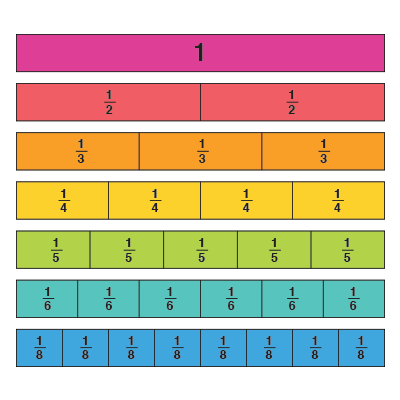
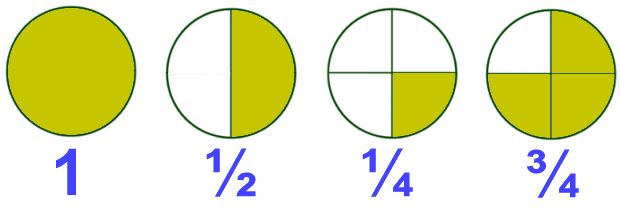
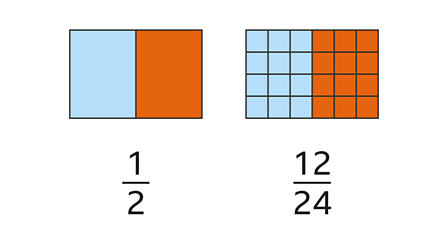
Welcome, math enthusiasts! 🌐✨ Get ready to embark on an exciting journey into the heart of fraction operations! This WebQuest
Portfolio Adventure is your ticket to mastering the intricate rules of adding, subtracting, and dividing fractions. Imagine this as your
personal exploration of the captivating world of mathematical operations, where every step leads you closer to becoming a fraction
master!
In this quest, you won't just crunch numbers; you'll dive deep into the why and how of fraction operations, backed by real-world
examples and hands-on problem-solving. It's not about memorizing; it's about understanding, applying, and showcasing your newfound
knowledge in a dazzling portfolio. So, gear up, mathematicians! The adventure awaits as you conquer the challenges, gather
mathematical treasures, and emerge as the triumphant hero of the Fraction Kingdom. Let the exploration begin! 🚀🔢 #MathMagicAwaits
Enter if you dare! 🕵️♂️🔍 If you dare here is a video telling you what a fraction is.
Task
By the completion of this web quest, your goal is to achieve a comprehensive mastery of the rules governing the addition, subtraction,
and division of fractions. The learning objectives encompass identifying different fraction operations, explaining their procedures and
applications, and demonstrating a cohesive understanding of how these operations interplay in mathematical contexts. You will display
your acquired knowledge through a well-structured portfolio. Using tools like notebooks or digital platforms, your task is to craft a
compelling portfolio that not only informs about the significance of fraction operations but also effectively communicates your grasp of
these rules through clear explanations, supported by well-documented examples and illustrations. This activity aims to refine your
mathematical communication skills, critical thinking, and the ability to articulate complex concepts in an accessible manner. Through this
showcase of knowledge and presentation skills, you will emerge as a proficient communicator, equipped to enlighten others about the
fundamental principles of fraction operations in the mathematical realm. Complete this live worksheet to test how much content you
remember on fractions before creating the portfolio. https://www.liveworksheets.com/w/en/math/429859
Process
Step 1: Familiarization and Preliminary Assessment
- Begin by reviewing the basics of fraction operations, including addition, subtraction, and division.
- Engage in a live worksheet session, answering questions related to fraction operations to assess your current understanding.
- Note down any challenges or areas where you feel less confident.
Step 2: Research and Content Gathering
- Utilize reliable mathematical resources, textbooks, or online platforms to reinforce your understanding of fraction operations.
- Create a comprehensive outline or checklist of the specific rules and procedures for adding, subtracting, and dividing fractions.
- Gather relevant examples and illustrations that illustrate each operation clearly.
Step 3: Portfolio Structure and Organization
- Plan the structure of your portfolio, dividing it into sections for addition, subtraction, and division of fractions.
- Clearly define the objectives for each section to guide your content creation process.
- Establish a logical flow within each section, ensuring a coherent progression of concepts.
Step 4: Content Creation
- For each section, present a concise explanation of the rules and procedures for the respective fraction operation.
- Include step-by-step examples that demonstrate the application of these rules.
- Integrate visuals such as diagrams or charts to enhance understanding.
Step 5: Application and Problem-Solving
- Dedicate a section to practical problem-solving using fraction operations.
- Provide a variety of problems that cover different scenarios and complexities.
- Demonstrate your problem-solving approach and ensure clarity in your solutions.
Step 6: Self-Assessment and Reflection
- Create a self-assessment section where you evaluate your understanding of fraction operations before and after the completion of the portfolio.
- Reflect on the challenges faced and the strategies employed to overcome them.
Step 7: Final Review and Submission
- Review your entire portfolio to ensure accuracy, clarity, and completeness.
Evaluation
Rubric for Fraction Operations Portfolio
Step 1: Familiarization and Preliminary Assessment
- Live Worksheet Engagement (5 points):
- Demonstrates active participation and engagement during the live worksheet session.
- Accurately answers questions related to fraction operations.
- Identifies and notes down areas of challenge or areas requiring more focus.
Step 2: Research and Content Gathering
- Utilization of Resources (15 points):
- Effectively uses mathematical resources, textbooks, or online platforms.
- Creates a comprehensive outline or checklist detailing rules for addition, subtraction, and division of fractions.
- Gathers relevant examples and illustrations to support each operation.
Step 3: Portfolio Structure and Organization
- Structural Planning (20 points):
- Develops a well-organized portfolio structure with distinct sections for each fraction operation.
- Clearly defines objectives for each section, providing guidance for content creation.
- Establishes a logical flow, ensuring a coherent progression of concepts throughout the portfolio.
Step 4: Content Creation
- Explanation and Visualization (20 points):
- Presents clear and concise explanations of rules and procedures for each fraction operation.
- Includes step-by-step examples demonstrating the application of rules.
- Integrates visuals such as diagrams or charts effectively to enhance understanding.
Step 5: Application and Problem-Solving
- Practical Problem-Solving (20 points):
- Dedicates a section to practical problem-solving using fraction operations.
- Provides a variety of problems covering different scenarios and complexities.
- Demonstrates a thorough problem-solving approach with clear and accurate solutions.
Step 6: Self-Assessment and Reflection
- Self-Reflection (10 points):
- Creates a self-assessment section evaluating understanding before and after completing the portfolio.
- Reflects on challenges faced during the process and strategies employed to overcome them.
Step 7: Final Review and Submission
- Portfolio Review (10 points):
- Conducts a comprehensive review of the entire portfolio for accuracy, clarity, and completeness.
- Ensures all components meet the specified criteria and guidelines.
Total Points: ___/100
| Criteria | Points |
|---|---|
| Step 1: Familiarization and Preliminary Assessment | |
| - Live Worksheet Engagement | 2 |
| - Accurate Answers to Fraction Operations Questions | 2 |
| - Identification of Areas of Challenge | 1 |
| Step 2: Research and Content Gathering | |
| - Effective Utilization of Resources | 8 |
| - Comprehensive Outline Checklist | 4 |
| - Relevant Examples and Illustrations | 3 |
| Step 3: Portfolio Structure and Organization | |
| - Well-Organized Portfolio Structure | 5 |
| - Clear Objectives for Each Section | 10 |
| - Logical Flow of Concepts | 5 |
| Step 4: Content Creation | |
| - Clear and Concise Explanations | 10 |
| - Step-by-Step Examples | 6 |
| - Effective Integration of Visuals | 4 |
| Step 5: Application and Problem-Solving | |
| - Dedicated Practical Problem-Solving Section | 10 |
| - Variety of Problems | 5 |
| - Thorough Problem-Solving Approach | 5 |
| Step 6: Self-Assessment and Reflection | |
| - Self-Assessment Section | 2 |
| - Reflection on Challenges and Strategies | 8 |
| Step 7: Final Review and Submission | |
| - Comprehensive Portfolio Review | 5 |
| - Adherence to Specified Criteria | 5 |
| Total Points | 100 |
Teacher's Comment:
Conclusion
Upon completing the assignment on fraction operations, individuals should have gained a proficient understanding of mathematical
concepts, including addition, subtraction, multiplication, and division of fractions. The experience of actively engaging in live sessions and
effectively utilizing resources, such as textbooks and online platforms, would have contributed to a comprehensive grasp of the subject.
Furthermore, the assignment focused on developing organizational and communication skills, encouraging participants to structure
information coherently within a well-defined portfolio. The emphasis on practical problem-solving aimed to demonstrate the application of
learned concepts to real-world scenarios. Through self-assessment and reflection, individuals were prompted to identify areas for
improvement and strategies for overcoming challenges, fostering a reflective and continuous improvement mindset. The final review of
the portfolio aimed to ensure accuracy, clarity, and completeness, emphasizing the importance of quality management in presenting
mathematical knowledge effectively. Overall, the assignment aimed to impart not only mathematical proficiency but also skills in resource
utilization, effective communication, and reflective practice.

Here is a link to a game practicing more on fractions. https://quizizz.com/join/quiz/6013b92aa75625001bd76bf6/start