
Introduction
Introduction to the vowel sounds
Welcome, students! Today we will delve into the fascinating world of vowel sounds. Vowels are the building blocks of spoken English, and understanding them is crucial for clear and effective communication. In this lesson, we will explore the different vowel sounds of English and give you many examples to help you become familiar with each sound.
Vowels are produced by the free flow of air through the vocal tract without any significant constriction. Unlike consonants, which involve some obstruction of airflow, vowels allow us to create the main sounds of English words and phrases. These sounds are formed by adjusting the position of the tongue, lips and jaw, resulting in a wide range of unique vowel sounds.
Let's start by looking at some common vowel sounds and their examples:
-
Short /æ/ sound:
-
Example words: cat, hat, bat.
-
Short /ɛ/ sound:
-
Example words: bed, pen, red.
-
Sound /ɪ/ short:
-
Example words: sit, hit, bit
-
Sound /ɒ/ short:
-
Examples of words: dog, hot, not
-
Sound /ʌ/ short:
-
Example words: cup, sun, fun
-
Sound /iː/ long:
-
Example words: see, tree, me
-
Sound /eɪ/ long:
-
Example words: day, say, way
-
Sound /ɑː/ long:
-
Examples of words: car, star, bar
-
Sound /ɔː/ long:
-
Examples of words: more, core, door
-
Long /uː/ sound:
-
Examples of words: blue, true, flu
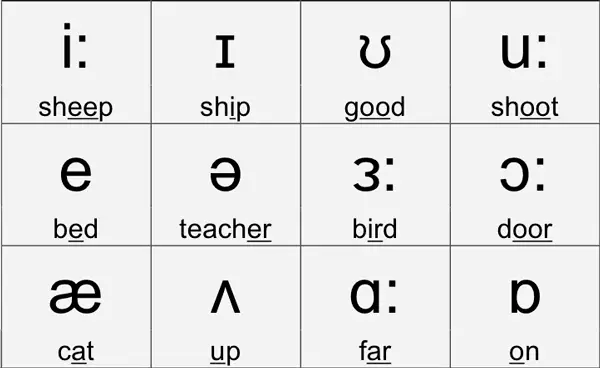
As you practice and master these vowel sounds, you will realize that they play an important role in pronunciation, accent, and comprehension of spoken English. Paying attention to vowel sounds will not only improve your communication skills, but will also help you improve your listening comprehension.
Remember, practice makes perfect! Let's begin this exciting journey to master the world of vowel sounds. Ready to embark on this adventure? Let's get started.
Task
-
Your task in this WebQuest is to identify and differentiate the different vowel sounds in English. You will investigate short and long vowel sounds, through interactive exercises and audio examples. At the end of this quest, you should be able to recognize and accurately reproduce the different vowel sounds.
Process
Step 1: Introduction to vowels whatch the provided content about the importance of vowels in English pronunciation and communication.
Step 2: Articulatory Features of Vowels Watch engaging videos and animations that demonstrate how vowel sounds are physically formed in the vocal tract. Pay attention to the role of the tongue height, tongue advancement, lip shape, and jaw position in shaping each vowel sound.
Step 3: Vowel Sound Exercises Complete interactive exercises and quizzes to test your knowledge of vowel sounds.
- https://wordwall.net/es/resource/58790832/finds-the-correct-vowel-sound
- https://agendaweb.org/phonetic.html
4. Step 4: Recording and analyzing vowel sounds
Record yourself pronouncing different vowel sounds and analyze your recordings to identify areas for improvement. Compare your production to the target sounds presented in the search.
https://docs.google.com/forms/d/16Nu36oGcTj6ZzFlsStFSRuBgB-yMqMyd4t2G_E-xsKw/edit
Evaluation
You will be evaluated based on your performance in the following areas:
|
EVALUATION |
POINTS |
|
|
25% |
|
25% |
|
20% |
|
30% |
|
100% |
Conclusion
Congratulations! You have successfully completed the Vowel Sounds WebQuest. You should now have a better understanding of the different English vowel sounds and their importance in communication. By mastering these sounds, you will improve your language skills and fluency. Keep practicing and incorporating these sounds into your speech to become a more confident English speaker.

Credits
This WebQuest has been created by Professor Yeisson Saenz in order to improve language learning and appreciation. The following resources have been used to develop this WebQuest:
Introduction to vowels Sounds
https://www.englishradar.com/english-pronunciation/english-vowel-sounds/
English vowel sounds "mouth position".
https://icspeech.com/vowel-sounds.html
English vowel sounds: pronunciation issues and student and teacher perceptions.
https://www.scielo.sa.cr/pdf/aie/v19n3/1409-4703-aie-19-03-33.pdf
I also want to share with you an application that will help you improve your knowledge of vowels and your pronunciation.
https://youtube.com/shorts/KYf5rC6UT1w?feature=share
https://play.google.com/store/apps/details?id=com.datawide.speakometer&hl=es_AR&pli=1
Remember, language learning is a continuous journey, and the more you practice, the more proficient you will become. Keep exploring and discovering new aspects of the English language - happy learning!