
Introduction
Welcome to the Solar System Webquest! The Solar System is a large and amazing place with a fascinating past and a lot of unsolved questions. Through an interactive learning experience where you explore the beauties of our planetary neighborhood, this webquest is intended to lead you.
You will learn about the distinctive qualities of each planet through this webquest, as well as the dwarf planets' traits, asteroids' and comets' properties, and the moons that circle them. The history of space exploration, including the difficulties and successes of sending spacecraft to investigate other planets, will also be covered.
You will learn more about the Solar System and its position in the cosmos as a result of completing the tasks in this webquest. As you look for and evaluate data from a variety of sources, you will also improve your research and critical thinking abilities. Prepare to take off on an amazing voyage around the Solar System as a result.
Lets watch this Youtube Video about the solar system:
_____________________________________________________________________________________________________________
Explanation of the Solar System.
"Consider a large neighborhood in space where the Sun, planets, moons, asteroids, and comets coexist with our planet Earth. The solar system is the name of this area. Similar to how our neighborhood includes homes and other structures, the solar system has many "homes" for the various celestial bodies. The Sun, which resembles a massive, blazing star, is located in the core of the solar system. All the planets receive heat and light from it, and it also maintains motion throughout our solar system. Since the Sun is so enormous, a million Earths would be needed to fill it.
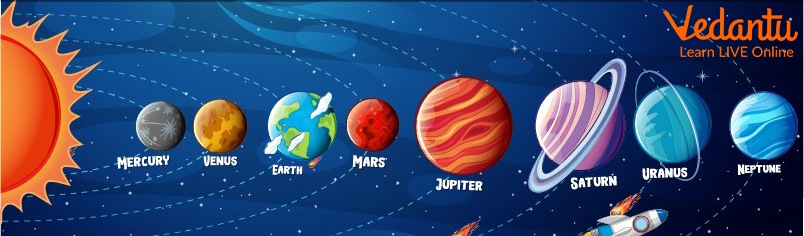
In the solar system, the planets are Earth's immediate neighbors. Mercury, Venus, Earth, Mars, Jupiter, Saturn, Uranus, and Neptune are the eight planets that make up our solar system. Every planet has distinctive qualities all its own. Others are enormous gas-filled spheres, while some are rocky like Earth. Some are surrounded by multiple moons, while others have rings. Around the Sun, these planets travel along routes known as orbits.
Moons are similar to companions that orbit the planets, so to speak. While other planets may have several moons, Earth only has one. Moons occur in a variety of sizes and forms, and they frequently include intriguing characteristics like ice, mountains, and valleys.
There are additional smaller asteroids and comets in the solar system. While comets are composed of ice, dust, and gas, asteroids are like boulders floating in space. On occasion, comets may be seen in the night sky as they round the Sun, leaving a lovely trail of light in their wake.
Astronauts and scientists have been studying the solar system for a long time. To understand more about these interesting places, they send spacecraft to visit the planets and moons, taking photographs and gathering data. Their discoveries encourage us to keep researching while also illuminating how our solar system functions. The Sun serves as the center of the solar system, while the planets, moons, asteroids, and comets are our heavenly neighbors. This wonderful location is full of treasures just waiting to be found."
Task
Task: Design Your Solar System Model
Grade Level: 5th Grade
Objective: To explore and demonstrate knowledge of the solar system by designing and constructing a model that accurately represents the relative size, position, and characteristics of the planets.
Instructions:
1. Research: To start, look at the planets in our solar system. Collect information on each planet's size, distance from the Sun, atmosphere, and any other distinctive qualities or traits using books, websites, and other trustworthy sources. Make a reference document for yourself by taking notes.
2. Plan your solar system model by making a sketch of it. Choose your materials, the size and placement of the planets, as well as any extra features (such the Kuiper Belt or the asteroid belt) that you wish to include.
3. Materials: Collect the tools and supplies you'll need to build your model. Styrofoam balls, paint, craft paper, toothpicks, and other art supplies are examples of typical supplies. Use whatever things you have on hand or can easily buy, and don't be afraid to get inventive.
4. Building: Start putting your solar system model, according to your design, together. Consider the different hues and patterns of each planet while painting the Styrofoam balls to represent them. Place the planets at their corresponding distances from the Sun using toothpicks or other supports. Make sure the planets' relative sizes are appropriately depicted.
5. Labels and Information: Include labels on your model that include the names of the planets as well as pertinent details like their sizes and distances from the Sun. Cutouts made from craft paper or tiny signage can be used for this.
6. Presentation: Once your model of the solar system is finished, put together a quick presentation to give to your students. Give an explanation of the main aspects of your model, the distinctive traits of each planet, and any noteworthy information you learned while conducting your study. Be ready to respond to inquiries from your peers.
7. Display: Put your model of the solar system on display in the classroom, or arrange a small exhibition for all the kids to participate in. Invite parents or students from other classrooms to the exhibit so they may learn about the solar system.
Remind students to work independently or in small groups based on the classroom's resources and preferences. Throughout the process, offer direction and encouragement so that kids may demonstrate their creativity and knowledge of the solar system.
Process
Procedure: Design Your Solar System Model
Grade Level: 5th Grade
Objective: To explore and demonstrate knowledge of the solar system by designing and constructing a model that accurately represents the relative size, position, and characteristics of the planets.
Materials:
- Reference materials (books, websites, etc.) for research
- Styrofoam balls in various sizes
- Paint and paintbrushes
- Craft paper
- Toothpicks
- Scissors
- Glue
- Markers or pens
- Optional: other craft supplies such as glitter, string, or construction paper for additional decorations
-
Research:
Access to solar system reference resources like books, websites, or prepared handouts should be made available to pupils.
Ask students to conduct study on each planet in the solar system, making note of its size, proximity to the Sun, atmosphere, and distinguishing characteristics.
Encourage pupils to compile a reference sheet or fact sheet for themselves out of their notes. -
Planning:
Ask pupils to create a design for their model of the solar system while taking the sizes and placements of the planets into account.
Give pupils the task of choosing the materials they'll need to build their models and any extras they wish to include, such the asteroid belt or the Kuiper Belt.
Ensure that the sizes and placements of the planets in the pupils' designs appropriately reflect the solar system as a whole. -
Construction:
Give the children the supplies they will need to build their model of the solar system.
Give pupils the task of painting the Styrofoam balls with the right hues and designs to symbolize each planet.
Help kids set the planets at the correct distances from the Sun by putting toothpicks or other supports to them.
Help pupils add any further details or embellishments they had planned to include, such as the asteroid belt or other astronomical objects, to their model. -
Labels and details:
Assign pupils the task of making labels for each planet that include the planet's name, size, and distance from the Sun.
Students can write the labels on craft paper or tiny placards, and you can provide them with guidance on where to place them on their model.
-
Presentation:
Give them the assignment of preparing a succinct presentation to deliver to their peers that will describe their model of the solar system and the major elements they included.
Encourage students to discuss any intriguing information they learned while conducting their study, as well as to explain the distinctive features of each planet.Remind students to give presentations they can confidently and clearly deliver.
Give students enough time to discuss their models with their peers and respond to their inquiries. -
Display:
Create a space in the classroom where students may show their models of the solar system.
Invite other students or parents to the display so they may learn about the solar system. You could also make a little show.
Encourage your pupils to provide intriguing facts and talk about their models with visitors, explaining their design decisions.
Evaluation
Assessment 1:
Your model and presentation will be assessed based on the following criteria:
- Accuracy: Are the relative sizes, positions, and characteristics of the planets represented accurately?
- Research: Did you gather and use reliable information about the planets in your model?
- Creativity: Did you demonstrate creativity in the design and construction of your solar system model?
- Presentation: Were you able to clearly explain your model and share interesting facts about the planets?
Assessment 2:
- Evaluate each student's model and presentation based on the accuracy of the relative sizes, positions, and characteristics of the planets.
- Assess students' research skills by reviewing the quality and reliability of the information they gathered.
- Consider students' creativity in the design and construction of their solar system models.
- Evaluate the clarity and effectiveness of each student's presentation, including their ability to explain their model and share interesting facts about the planets.
Conclusion
Congratulations to the fifth students who finished the solar system exploration assignment! You have been on a thrilling excursion across our cosmic neighborhood throughout this trip, exploring the beauties and secrets of the solar system. You have exhibited a stronger grasp of the planets, moons, and other celestial objects that make up our remarkable solar system by planning and building your solar system models, then presenting your results.
You performed research, polished your imagination, and improved your presentation abilities during this work. You painstakingly painted the planets, taking into account their distinctive hues and patterns, and set them in the proper positions with respect to the Sun. Your dedication to scientific inquiry was demonstrated by the care and accuracy with which you represented the planets' respective sizes and locations. Along with building your models of the solar system, you also educated your students by providing them with fascinating details and insights. You articulately outlined the special qualities of each planet and emphasized the wonders of our local universe. You encouraged a spirit of shared learning and discovery among your peers by participating in these sessions and actively taking part in the solar system exhibition.
You have gained knowledge about the solar system as well as useful abilities like planning, research, creativity, and public speaking with this assignment. You've shown that you can find information, evaluate and synthesize knowledge, and communicate your conclusions in an interesting and educational way. Keep in mind that there is still a lot to learn and explore about the solar system. Keep your interest alive and your gaze set upward as you progress in your study. Who knows, some of you could go on to become scientists, astronauts, or space explorers in the future, unlocking even more mysteries about our local universe.
Well done, 5th graders, on your exceptional efforts and accomplishments in exploring the solar system. You have taken one giant leap toward understanding the marvels of our universe. Keep reaching for the stars!

Credits
References
NASA. (2018, August 31). Solar System Exploration: NASA Science. Solar System Exploration: NASA Science. https://solarsystem.nasa.gov/
National Geographic. (2018). National Geographic Kids. National Geographic Kids. https://kids.nationalgeographic.com/
Teacher Page
Teacher's Page: Exploring the Solar System (Grade 5)
Welcome, teachers, to the "Exploring the Solar System" task designed for 5th-grade students. This engaging and hands-on activity will allow your students to deepen their understanding of the solar system while developing research, creativity, and presentation skills. Here's a guide to help you facilitate the task effectively:
Objective:
The objective of this task is for students to explore and demonstrate knowledge of the solar system by designing and constructing a model that accurately represents the relative size, position, and characteristics of the planets. Students will also prepare and deliver a presentation to share their findings with their classmates.
Materials:
- Reference materials (books, websites, etc.) about the solar system
- Styrofoam balls in various sizes
- Paint and paintbrushes
- Craft paper
- Toothpicks
- Scissors
- Glue
- Markers or pens
- Optional: other craft supplies such as glitter, string, or construction paper for additional decorations
Procedure:
1. Research:
- Introduce students to the concept of the solar system using age-appropriate language.
- Provide access to reference materials about the solar system, such as books, websites, or prepared handouts.
- Guide students to research each planet, taking notes on their size, distance from the Sun, atmosphere, and unique features.
- Encourage students to use their notes to create a reference guide or fact sheet for themselves.
2. Planning and Design:
- Instruct students to sketch a design for their solar system model, considering the relative sizes and positions of the planets.
- Encourage students to plan the materials they will use for constructing their models and any additional features they want to include.
- Remind students to ensure that the sizes and positions of the planets in their design accurately represent the real solar system.
3. Model Construction:
- Provide students with the necessary materials for constructing their solar system models.
- Assist students in painting the Styrofoam balls to represent each planet, using the appropriate colors and patterns.
- Guide students in attaching toothpicks or other supports to the planets and positioning them at their respective distances from the Sun.
- Support students in adding any additional features or decorations they planned for their models.
4. Labels and Information:
- Instruct students to create labels for each planet, including the name of the planet, its size, and its distance from the Sun.
- Provide craft paper or small signs for students to write the labels, and guide them in attaching the labels to the appropriate positions in their models.
5. Presentation:
- Explain to students the importance of effective presentations and public speaking skills.
- Instruct students to prepare a short presentation to share their solar system models and findings with their classmates.
- Encourage students to explain their models, highlighting key features and sharing interesting facts they discovered during their research.
- Provide opportunities for questions and encourage students to engage in discussions about their models and the solar system.
Assessment:
- Assess students' understanding of the solar system through observation of their models, attention to detail, and accuracy in representing the relative sizes and positions of the planets.
- Evaluate students' research skills by reviewing the quality and reliability of the information they gathered.
- Assess students' creativity in the design and construction of their solar system models.
- Evaluate students' presentation skills, including their ability to clearly explain their models and share interesting facts about the planets.
Conclusion:
The "Exploring the Solar System" task offers students an immersive and hands-on experience to deepen their understanding of our cosmic neighborhood. It promotes research skills, creativity, and presentation abilities, allowing students to become active participants in their learning journey. By guiding them through this task you are fostering a sense of curiosity and discovery, inspiring future scientists, astronauts, and space enthusiasts. Enjoy exploring the wonders of the solar system with your 5th-grade students!