
Introduction
V9 Australian Curriculum
In Year 6, learning in Mathematics builds on each student’s prior learning and experiences. Students engage in a range of approaches to learning and doing mathematics that develop their understanding of and fluency with of concepts, procedures and processes by making connections, reasoning, problem-solving and practice. Proficiency in mathematics enables students to respond to familiar and unfamiliar situations by employing mathematical strategies to make informed decisions and solve problems efficiently.
Students further develop proficiency and positive dispositions towards mathematics and its use as they:
- expand the repertoire of numbers they work with to include rational numbers and the use of integers in practical contexts such as locating points in the 4 quadrants of a Cartesian plane
Content Descriptor - Students learn to:
- recognise situations, including financial contexts, that use integers: locate and represent integers on a number line and as coordinates on the Cartesian plane. (AC9M6N01)
An Introduction to the Rule - What is an Integer?
An integer (pronounced IN-tuh-jer) is a whole number (not a fractional number) that can be positive, negative, or zero.
Operations of Integers are summarised below for you to understand:-

Watch the You tube clip provided to refresh your memory about Integers.
Here is some extra vocabulary which can help you understand the way in which positive and negative integers are used:-
|
(Positive) - (Negative) Up Down Increase Decrease Gain Lose Deposit Withdrawal Profit Loss Above Below |
Task
Lets Explore Integers
What are Integers and why are they important?
Positive and negative values are the building blocks of mathematics. On the number line they are represented as follows:-

Positive integers always have a greater value than negative integers.
Definition of Integers
Integers are the natural numbers, the negatives of these numbers, or zero. An integer is a complete entity. Integers are the numbers that can be positive, negative, or zero, numbers with no fractional part (no decimals).
Examples of integers are, 1, -2, 7, -8, 9, -12, etc.
For example, - 2 is an integer.
- 2 is read as ‘negative two’.
This can also be written as - 2 or (-2)
It is 2 less than 0.
0 - 2 = - 2
So natural numbers (which lie on the right side of zero) are positive, their counterparts (negative natural numbers) are negative.
These numbers have many uses in real life as well as in math class. You will better understand with the following examples:
Temperature
Temperature is a way integers are shown in real life because the temperature is always either over 0 or below zero. An example would be at night it could be -3 degrees and half way through the day it might be +24 degrees.
Sea Level
Sea level is a good example, because where ever you go, you're either above or below sea level. An example would be if you were traveling over a mountain, you might be +1574m above sea level, or if you're in a submarine you could be -7m below sea level.
Speed Limit
When you're driving you can go over or under the speed limit. If you go over, it's a negative, because if you speed you have to pay a fine, which means you'll have less money, which is a negative, but if you don't speed, you'll not lose money and that would be a positive.
Process
Addition and Subtraction with Positive and Negative Integers
Addition and Subtraction of positive and negative numbers can be illustrated on a number line using three simple rules:
- The first number tells you where to start.
- The first sign (the operation sign) indicates which way to go, + to the right, - to the left.
- If the second sign is positive (or blank) continue in the same direction, but if the second sign is negative then do the opposite.
- 10 - 9 - 8 - 7 - 6 - 5 - 4 - 3 - 2 - 1 0 1 2 3 4 5 6 7 8 9 10
Adding a Positive Number
3 + 2 = 5 Start at positive 3 and move to the right 2 places to finish at positive 5.
- 4 + 3 = - 1 Start at negative 4 and move to the right 3 places to finish at negative 1.
Adding a Negative Number
2 + - 4 = - 2 Start at positive 2, the + sign suggests go to the right, but the negative sign indicates do the opposite, left 4 places.
-3 + - 2 = - 5 Start at negative 3, the + sign suggests go to the right, but the negative sign indicates do the opposite, left 2 places.
Subtracting a Negative Number
Subtracting a number is the same as adding the opposite of the number.
Let's look at two examples:
− 5 −7 = − 5 + (−7)
10 − (−3) = 10 + 3
In both examples, we change subtraction to addition and changed the sign of the second number to the opposite sign.
Find out how this works by watching the video below:-
Various mini lessons to be completed by Students for discussion.
Order the integers 4,- 2,- 5, 0, 2,-1 from least to greatest.
Order the integers 3, 4,- 2,- 5,1,-7 from least to greatest.
Which of the following options is not true with respect to a given number line?

(a) B is greater than – 10
(b) A is greater than 0
(c) A is greater than B
(d) B is greater than 0
Answer: The first three options are correct but B lies on the left side of 0, so it is not greater than 0. So clearly option (D) is not true.
The six-day forecast for Antarctica lists the temperatures (in Celsius) as – 52°C, – 53°C, – 40°C, – 58°C, –70°C, – 79°C. Which choice shows the temperatures in order from the lowest to the highest?
(A) – 79°C, –70°C, – 52°C, – 53°C, – 40°C, – 58°C
(B) – 52°C, –53°C, – 58°C, –70°C, –79°C, – 40°C
(C) –79°C, –70°C, – 58°C, – 53°C, – 52°C, – 40°C
(D) – 40°C, – 52°C, – 53°C, – 58°C, –70°C, –79°C
Answer: On the number line, we see that the larger is the negative value the smaller is the number. Using this, we can say option (C) is correct.
Which of the following number lines represents - 1 - 4?
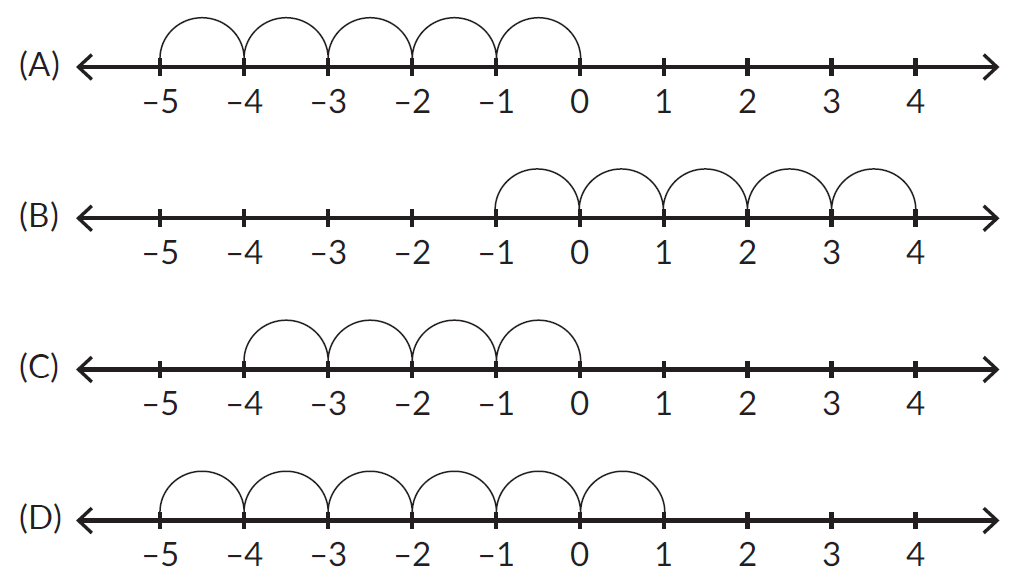
Answer: From the above illustrations, it is clear that option (A) is correct.
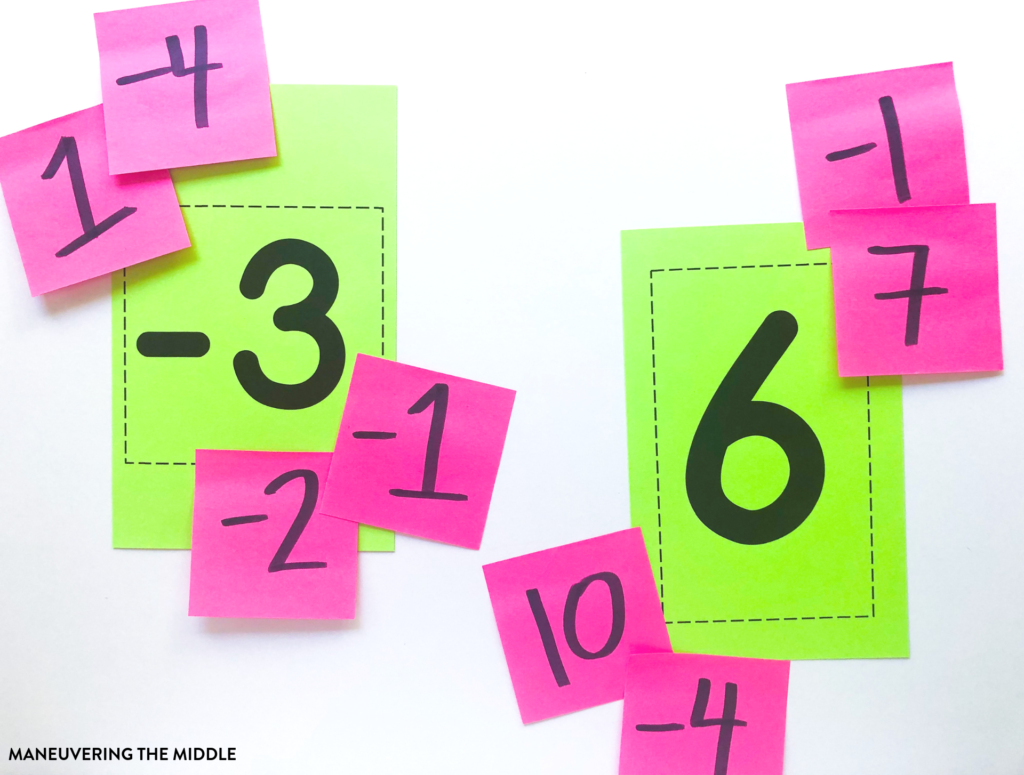
Give students a value they are trying to reach. Provide sticky notes or cards marked with a variety of integers. Students match integers to equal the given value. Similar to using counters, this allows for students to practice their fluency but also to be flexible problem solvers.
Evaluation
Integer Evaluation Rubric
It is very important to stop frequently during your lessons to check for understanding with your students. Use strategies throughout the day to make sure everyone is on track.
|
Integer Processes
|
||||
| Excellent
Has a superior understanding and can apply to new material. 4 points |
Proficient Has a solid understanding and can apply understanding sometimes to new material. 3 points |
Satisfactory
Has a basic, but still incomplete, understanding.
2 points |
Unsatisfactory
Has little or no understanding of material 1 point |
|
| Adding Integers Demonstrates and/or explains rules for adding positive and negative numbers |
Excellent
|
Proficient
|
Satisfactory
|
Unsatisfactory
|
| Subtracting Integers Demonstrates and/or explains rules for subtracting positive and negative numbers |
Excellent
|
Proficient
|
Satisfactory
|
Unsatisfactory
|
Conclusion
Conclusion
Math's is numbers and numbers are integers.
In these lessons we have learnt:-
- to understand the concept of addition and subtraction of integers.
- to understand the properties of the four fundamental operations applied to integers.
- to understand the rules necessary to solve problems with integers using addition and subtraction.
- to identify and solve problems using integer operations in everyday/real life situations.
Credits
Where credit is due -
I would like to give credit to the following Youtube channels, websites, articles and documents that have helped me develop my Webquest on Adding & Subtracting Positive and Negative Integers.
-
Adding and Subtracting Positive and Negative Numbers. (2017). Mathsisfun.com. https://www.mathsisfun.com/positive-negative-integers.html
-
Australian Curriculum, Assessment and Reporting Authority. (2022). Mathematics | V9 Australian Curriculum. V9.Australiancurriculum.edu.au. https://v9.australiancurriculum.edu.au/teacher-resources/understand-thi…
-
“How to Teach Integers.” Maneuvering the Middle, 8 Sept. 2019, www.maneuveringthemiddle.com/how-to-teach-integer-operations/.
-
Integers in real life. (2013, November 25). IPractice Math. https://blog.ipracticemath.com/2013/11/25/integers-in-real-life/
-
Subtracting a negative = adding a positive (video). (n.d.). Khan Academy. Retrieved May 9, 2023, from https://www.khanacademy.org/math/cc-seventh-grade-math/cc-7th-negative-…
-
WebQuests: Explanation. (2019). Thirteen.org. https://www.thirteen.org/edonline/concept2class/webquests/index.html
-
What is an integer youtube - Google Search. (n.d.). Www.google.com. Retrieved May 8, 2023, from https://www.google.com/search?q=What+is+an+integer+youtube&rlz=1C1VDKB_…
Teacher Page
Teacher Page
"A WebQuest" according to Bernie Dodge, the originator of the WebQuest concept, "is an inquiry-oriented activity in which most or all of the information used by learners is drawn from the Web. WebQuests are designed to use learners' time well, to focus on using information rather than on looking for it, and to support learners' thinking at the levels of analysis, synthesis, and evaluation."
The mini lessons and short classroom activities were developed as an introduction to adding and subtracting of integers. The lesson starts by reviewing the concept of an integer and then goes on to teaching positive and negative integers using the four operations. Each lesson targeting a specific operation. The mini lessons are designed for students to work on their own, in pairs and also as a class discussion on the whiteboard.
This content description (AC9M6N01) connects to the following general capabilities and cross-curriculum priorities.
- extending the number line in the negative direction to locate and represent integers, recognising the difference in location between (-22) and (+22) and their relationship to zero as -2 < 0 < 2.
- using horizontal and vertical number lines to represent and find solutions to everyday problems involving locating and ordering integers around zero, for example elevators, above and below sea level.
Sharon Smith
S302933