
Introduction
We are learning about the extension of settlement including the effects of contact (intended and unintended) between European settlers in Australia and Aboriginal and Torres Strait Islander people,and will show how our understanding by reporting on one of the important events that occurred involving indigenous Australian and European settlers during the colonisation of Australia.
The first European to set foot in Australia was Dutch navigator Willem Janszoon in 1606 — his was the first of 29 Dutch voyages to Australia in the 17th century (ABC, 2020). Englishman William Dampier also visited the coastline just north of what is now Broome, Western Australia in 1688 (NMA, 2020).
In 1770, Captain James Cook mapped some of the east coast of Australia, and attempted to claim what he called “terra incognitis Australis” or the “great unknown southern land,” for Great Britain (Mason, 2014, p. 46).
In 1787, the First Fleet of ships set sail from England, complete with eleven ships and 1480 people. They landed in what is now called Botany Bay, NSW on 26 January 1788, thus beginning the period of European settlement of Australia.
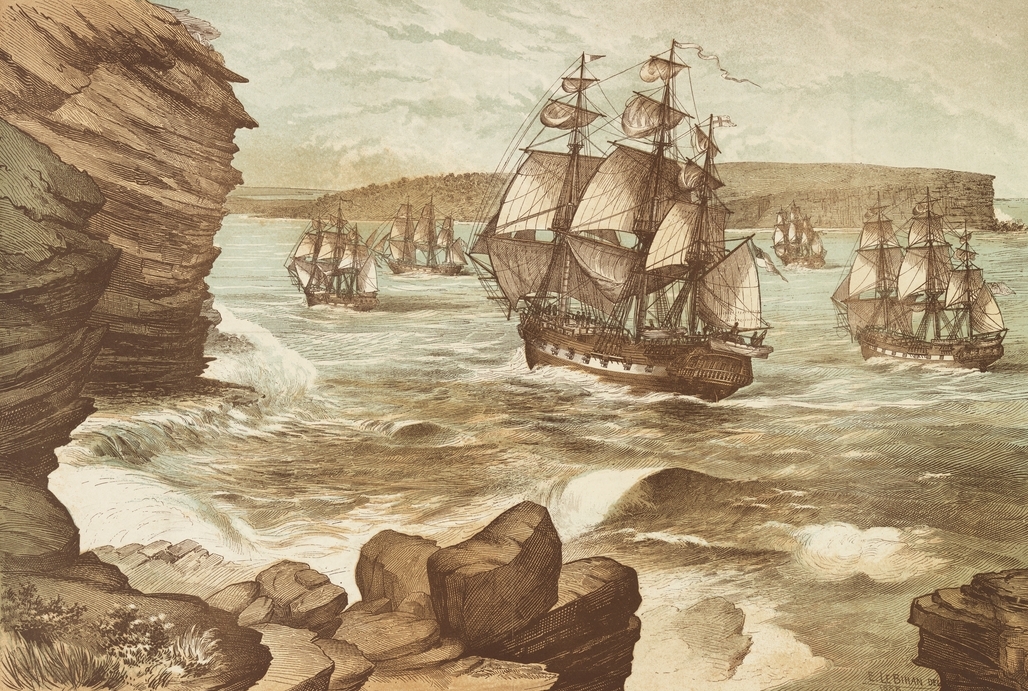
European settlement of Australia has had ongoing, catastrophic impacts for Aboriginal and Torres Strait Islander peoples (Atkinson et al, 2010).
Every part of Aboriginal and Torres Strait Islander's traditional lives were affected by the arrival of European colonists. Starting from the places where Europeans arrived, a pattern of confusion, conflict and dispossession was repeated across the entire country as Europeans pushed further into the continent.
The first deadly impact was exposure of Indigenous people to European diseases, such as smallpox and measles, to which Aboriginal and Torres Strait Islander people had no immunity. Indigenous peoples had never been exposed to such diseases, so they spread through Indigenous communities rapidly, with devastating consequences.
While some of the negative effects on the Indigenous population were unintentional, including the spread of diseases, much of the devastation heaped upon Australia's first peoples, including a number of horrific massacres, was carried out intentionally by settlers and colonial authorities alike. Likewise, though Indigenous Australians doubtless killed settlers and livestock like sheep, the consequences of contact between the two groups was vastly more destructive for Indigenous people than for colonists.
There were also many violent interactions between the settlers and Indigenous people, which led to many deaths, disproportionately on the side of Indigenous peoples.
The governor at the time, Arthur Phillip, had called for Europeans to live in harmony with Indigenous peoples and reduce conflict with Australia’s Indigenous peoples, but this did little to calm the violence of many Europeans (Franks, 2020). The spread of European occupation led to tension and conflict with the Aboriginal people as their food sources, sacred sites and traditional way of living were threatened and were forcibly taken away (Mason, 2014, pp. 55).
It is estimated in the first years of European settlement, the Aboriginal and Torres Strait Islander population of Australia was reduced by as much as 90%, due mainly to disease, European takeover of Indigenous lands and violent conflicts.
|
|
|
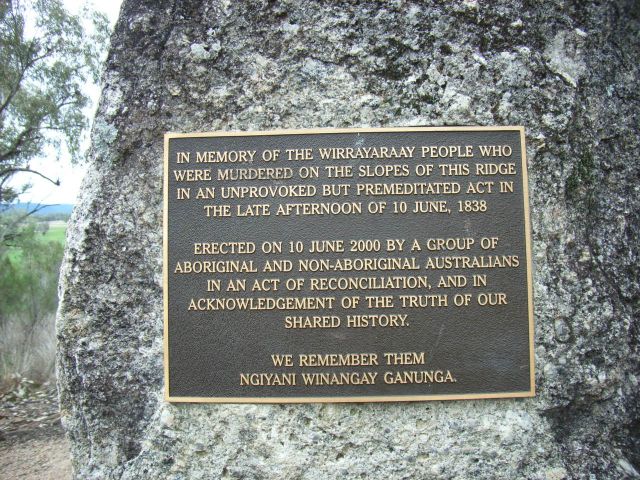
A plaque commemorating the Myall Creek massacre of 1838, an example of the violence that colonists inflicted on Australia's Indigenous peoples. Seven men were hanged at Sydney Gaol, the first British subjects to be executed for murdering Aboriginal people. “I now once more hoisted the English colours ... [and] took possession of the whole eastern coast by the name New South Wales.”*Proclamation made by Captain James Cook during his 1770 voyage along the eastern coastline of Australia (quoted in Mason, 2014, p. 46).Cook claimed the lands of Australia for the British Empire using the legal concept of "terra nullius", a Latin phrase meaning “land belonging to no one.” Although Cook had seen Indigenous people during his voyage, he had not spotted signs of what he referred to as “civilisation”. This was a British and European idea of how a "proper" society should look. The European concept of civilisation was rooted in the idea that ownership of land included cultivating land, farming animals and the construction of fences and permanent buildings. This idea of land ownership was not part of Aboriginal and Torres Strait Islander culture. In a way land does not belong to people but people belong to the land (Mason, 2014, p. 46). |
Task
Task
MEDIA ALERT!
Learning Goal: Your team of investigative journalists has been given the following assignment:
Report on one of the important events that occurred involving Indigenous Australians and European settlers, during the colonisation of Australia.
You will present your report in the form of a newspaper article.
You have a DEADLINE of 2 weeks to complete your News Report.
Process
Process
Step 1
Your News Director/Managing Editor (teacher) will ask you to team up with two other journalists. Your team will need to decide on who will be responsible for the following journalistic roles:
- Investigative Reporter: thoroughly researches the event and gathers information; analyses documents and primary sources and conducts interviews.
- Sub-Editor: takes the information from the reporter, puts it into a form which suits the needs of the chosen presentation (newspaper article, radio news podcast, television news story or short documentary), and concentrates on how the report can best be presented.
- Photojournalist: finds, takes and/or uses photographs or footage to tell the news.
All members of your team will be Specialist Writers and work together to contribute to the writing of your news report.
Your team may decide to be Advocacy Journalists and adopt a non-objective viewpoint, intentionally writing from the perspective of either the Europeans or Aborigines.
Step 2
The News Director/Managing Editor has outlined the following important events that occurred between Indigenous Australians and European settlers, during early colonisation.
Take a look at the Timeline of Aboriginal History. This will give you a brief overview of some of the events that occurred involving Indigenous Australians and Europeans.
Download, print and use the Research Scaffold sheet to help you answer the key questions needed to write your news report. This needs to be submitted to the News Director/Managing Editor at the end of Step 3.
Step 3
BREAKING NEWS!
Your team of journalists must decide on, and choose, one of these incidents to research, write about and present in the form of a NEWS REPORT (newspaper article).
- Use the provided links to help you gather your information.
- Look for other sources if you can!!!
- If you have a different incident that your team is interested in reporting on, please negotiate this with your News Director/Managing Editor.
The capture of Arabanoo
How the kidnapping of a First Nations man in 1788 may have led to a smallpox epidemic
The Black Wars
Black Wars – Australian History
The Black War: Tasmania still torn by its history
Van Diemen's Land Aborigines relocate to Flinders Island
Truganini – The Australian Women’s Register
The power of Truganini: reclaiming a hero's story
Tragic history of the First Tasmanians
Famous Australians - Truganini
First Australians clip: Her will to survive
Bennelong travels to Britain
Pemulwuy killed
Australia's oldest Murder Mystery
First Australians clip: Pemulwuy
Windradyne is captured
Windradyne: Indigenous Australian Warrior and Resistance Leader
The Myall Creek Massacre
Myall Creek Massacre – Convict Sydney
Myall Creek Massacre and Memorial Site
Jandamarra's War
Jandamarra: The outlaw who fought to save his country and people from colonisation
Jandamarra - A Legend of the Bunuba people
STOP PRESS!
Your team needs to submit your Research Scaffold sheet to the News Director/Managing Editor for FEEDBACK, before you go any further with the production of your News Report. Arrange a time to meet with the News Director/Managing Editor.
Step 4
Now that your Investigative Reporter has researched the facts, your Photojournalist has collected the necessary images for your report and your News Director/Managing Editor has given you FEEDBACK, it is time to work together as specialist writers to write your news story.
Remember that you need to write in a journalistic style, relevant to the type of news presentation your team will be producing. Your Sub-Editor's expertise, as well as your News Director's/Managing Editor's comments, will help with the wording and editing of your news report or script.
You may choose to report on the incident from one side's perspective (ie. the European settlers or the Aborigines).
This is known as Advocacy Journalism. If your team chooses to write like this, you need to give your news report more than just a slant - you need to intentionally have an opinion about the story you are writing.
Choosing to write your news report from a particular perspective will generate a deeper response in your finished article.
Step 5
Well done on your specialist writing!
Now it is time to produce your newspaper report.
NEWS FLASH! As well as investigative journalists, you must also be your own production team.
You will need to assume new roles for this part of your task. All members of your production team can assist with the technical aspects of formatting your report.
Writer: types up the article or script.
Creative Director/Director: makes the final creative decisions about what is included in the final newspaper page.
Paginator/News Reader: enters the text and images into the newspaper template
The link below will help you with the production of your final News Report:
Evaluation
Evaluation of your News Report.
Your news report will be assessed against the following Achievement Standards.
Conclusion
Conclusion
YOU MADE THE DEADLINE!
Before you submit your News Report to the News Director/Managing Editor, make sure you read through the following Success Criteria to ensure you have reached your Learning intention.
I know I am successful when:
- my team chooses a major incident that occurred, during the colonisation of Australia, involving Indigenous Australians and European settlers.
- my team members choose specific journalistic and production roles (and fulfil the responsibilities of these roles)
- my team uses the Research Scaffold to assist in the investigative research phase
- my team gathers the facts and necessary images and interviews to write our News Report
- my team gets feedback from the News Director/Managing Editor
- my team co-operatively writes our News Report from a particular perspective, in our own words
- my team decides on a format in which to share our News Report
- my team produces an authentic-looking newspaper article.
Please complete the Team Project Processing Form and fill in your reflection.
FINISHED BEFORE THE DEADLINE!
Credits
Credits
Resources:
NSW Adaption of the Australian Curriculum for History
Perkins, Rachel (Director/Writer/Producer). (2008) First Australians SBS Television Documentary: Australia
The Carousel Feedback Form and Team Project Processing Form were taken from the Kagan Cooperative Learning (by Dr Spencer & Miguel Kagan, Hawker Brownlow Education 2009) manual.
Images:
This Web Quest was adapted from Robyn McCarthy's original version