
Introduction
WELCOME YEAR 5 STUDENTS TO SHOW WEEK!!
In preparation for our trip to the Darwin Show on Friday, we are going to be investigating probability.
There will be many games to play that I am sure you will slay.
But first, let's learn to take a look at your chances.
Over the next four days, we will have four lessons to prepare you to think about your chances of winning prizes on Friday.
Lesson One: Understanding - Describing Probability and Chance
Lesson Two: Fluency - Finding Probability
Lesson Three: Problem Solving - Working through probability problems in a classroom setting
Lesson Four: Reasoning - Predicting which game has the highest chance of winning
Lesson Five: SHOW DAY - Final assessment
LET US GET STARTED!!
Task
Year 5 Students - Your final task will be to make a prediction about your chances of slaying the following three fair games; Laughing Clowns, Floating Ducks, and Bean Bag Toss. You will then get a chance to complete the games and record your results. The following lessons have been prepared in order to guide you toward your final challenge. By the completion of lesson four you will be able to successfully:
- Recognise how fractions are used in probability
- Use estimations and reasonableness to recognise outcomes
- Able to identify the language of probability
- Label a table accurately
Are you ready?
Process
Welcome to your lessons for the week,
Each of the following lessons will engage your prior knowledge from previous lessons and prepare you for applying probability and chance to real-life examples. You will be marked on your participation, effort, and knowledge. If you have any questions, please ask your teacher for help. Let's Go!!
LESSON 1
UNDERSTANDING - USING FRACTIONS TO REPRESENT PROBABILITY
Class Discussion - Coming up with questions such as "how likely is it for you to flip a coin and get heads or tails", the correct vocabulary will be encouraged as well as "there is a 1/2 chance of getting heads" to encourage the use of fractions so they understand this is what the lesson is about.
Task 1: Probability Line
We will be creating a probability line in our working books with 0 being impossible and 1 being certain. It will be broken up at the halfway point and then at the quarter points as well. Your probability line needs to include:
0 = 0% or impossible
1= 100% or certain
1/2 = 0.5 = 50% or likely
1/4 = 0.25 = 25% or not very likely, highly likely
Complete the below worksheet using your probability line
Get the resources you require from the maths cupboard.
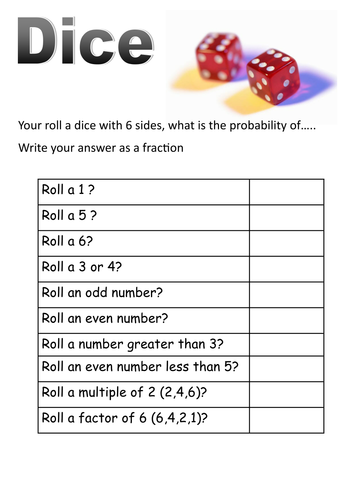
Class discussion - We will recap what has been learned in this lesson and go through the answers on the worksheet.
LESSON 2
FLUENCY - USING ESTIMATION REASONABLENESS TO ANSWER CALCULATIONS
Class discussion - What is probability? Probability is the number of ways an event can occur. For example; if a singular die is rolled then the probability of rolling a 2 is a 1/6 chance. Discuss other events using accurate vocabulary.
Task 2: Head and Tails
You are to create a table that includes your prediction, tally, and outcome. You will then predict how many heads you will get and how many tails you will get then flip a coin 50 times and write your outcome then advise whether your prediction was accurate.
Get the resources you require from the maths cupboard.
Extension Question:
Do you think you would get the same results if you did this again? Why?
Class discussion - How many people got heads and how many people got tails? Why do we think this occurred? Did anybody do anything differently?
Lesson 3
PROBLEM SOLVING - CREATING PROBABILITY PROBLEMS AND SOLVING THEM
Task 3: Creating a problem
Students may create a problem using a die, dice, coins, marbles, rock, paper, and scissors and then use a table to relay their results.
Get the resources you require from the maths cupboard.
You must begin by making a prediction on what will happen. Your predictions can be crafted from the following examples:
- How many times will _____ come up?
- Which _____ is least likely to come up?
- Would the same results occur if you did the same thing again? Why?
Once your experiment is completed you must write whether or not your prediction was accurate and what could have been done differently.
Class discussion - Discuss as a class each experiment, what was predicted and why.
Lesson 4
REASONING - MAKING PREDICTIONS AND INTERPRETING THE RESULTS OF CHANCE EXPERIMENTS
CONGRATULATIONS YEAR 5!! It is fair day and you have completed all the tasks that allow you to play the chance games at the fair and make your predictions about which one you will win.
Below is a table of the chance games that you must play and write predictions for. You will estimate which game has a higher chance of winning with 1 being the highest chance and 3 being the lowest chance. You will then play the games and write your findings and whether or not your predictions were accurate.
Sentence helper: I predict that _______ because ________
|
Game Name |
Prediction; why do you think this game has the highest chance of winning? |
|
Floating Ducks |
|
|
Laughing Clowns |
|
|
Bean bag toss |
|
You will get three chances to play each game and will need to fill out the below table to assist in writing your final findings.
|
Predictions (highest to lowest) |
Outcome 1 |
Outcome 2 |
Outcome 3 |
|
1 |
|
|
|
|
2 |
|
|
|
|
3 |
|
|
|
Evaluation
Teacher Marking Criteria
|
A |
B |
C |
D |
E |
|
Make informed predictions about the possible outcomes of the experiment. |
Makes accurate predictions about the possible outcomes of the experiment. |
Attempts to make predictions about the possible outcomes of the experiment. |
Makes uninformed predictions about the possible outcomes of the experiment. |
Does not make predictions about the possible outcomes of the experiment despite having assistance |
|
Uses a high level of mathematical vocabulary |
Uses moderate mathematical language |
Attempts to use mathematical language |
Attempts to use mathematical language with assistance |
Does not use mathematical language despite having assistance |
|
Accurately records and interprets the results in detail |
Accurately records and interprets the results |
Attempts to record and interprets the results with limited detail |
Attempts to record and interpret the results with assistance |
Does not attempt to record or interpret the results despite having assistance |
|
Actively participates in tasks |
All tasks were completed accurately and efficiently |
All tasks were completed accurately and to a satisfactory level |
Some tasks were completed to a sufficient level with assistance |
Some tasks were attempted unsuccessfully despite having assistance |
Teacher Page
Key Considerations (Proficiency Strands):
Understanding, Fluency, Problem-Solving, Reasoning
Further information regarding proficiency strands can be found by following the link.
Curriculum Strands:
List the possible outcomes of the chance experiments involving equally likely outcomes and compare to those which are not equally likely - AC9M5P01
Conduct repeated chance experiments including those with and without equally likely outcomes, observe and record the results; use frequency to compare outcomes and estimate their likelihoods - AC9M5P02
Further information regarding the Australian Curriculum can be found by following the link.