
Introduction
Writing and presenting: Prepared Speech
Writing a speech is only one component of effective public speaking - a speech still has to be presented. In this lesson, we will be focusing on delivering a speech.
My introduction video: https://www.youtube.com/watch?v=U9L8bSXKZTE
Here are some do's and don'ts on how to present your prepared speech perfectly described by Lisa's Study Guides:
Task
Writing and presenting a speech: Prepared Speech (10 Marks)
Before writing a speech, it's important to plan thoroughly and consider the key features.
Note: An interesting introduction and powerful conclusion can help you connect with your audience.
They introduce your message and leave your listener with a final thought by drawing attention to the importance of your main idea.
TAKE NOTE OF THE FOLLOWING when writing and presenting a speech:
- Enunciate clearly. Be enthusiastic and convincing, BUT be as natural as possible.
- Practice a good posture. Avoid moving around or fidgeting.
- Avoid mannerisms. Pause for the effect where appropriate.
- Make eye contact. Use cue cards, BUT DON’T READ. You may address the audience, but not too frequently.
- Prepare well: learn and practice your speech.
- Use short, simple sentences and language suited to the audience.
- OPTIONAL: INCLUDE AUDIO / VISUAL AIDS.
Make a Prepared speech
Choose one of the following topics on which to make an unprepared speech:
- We should wear normal clothes to school.
- You should be allowed to get a driver's license at 16.
- Mathematics and Science should be compulsory subjects.
- Art and Science should be more practical.
You will have 5-10 minutes to present.
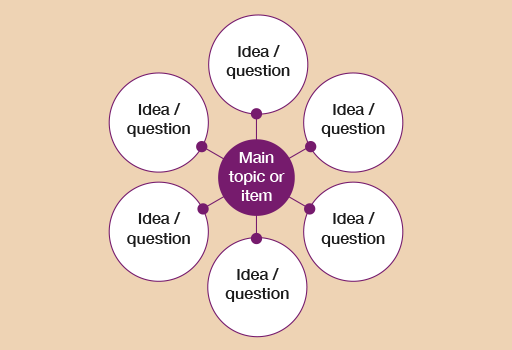
- Plan your speech using a spider diagram.

-
Write the first draft.
-
Revise, and edit the draft.
-
Write a final draft.
-
Proofread your final draft.
-
Present your speech!!!
Process
How to give a Prepared Speech.
STRUCTURE:
➢ Introduction must be short. Use a strong opening paragraph/sentence in which you state your point of view /refer to the topic. You may use a rhetorical question. Address the chairperson, e.g.” Dear Madam Chair, " and look at this person.
➢ Arguments/discussion: Make sure you have TWO to THREE arguments/points to support your point of view. Each argument should be strengthened by examples, references to statistics, or the opinion of a specialist in that field. Use connectors between arguments, e.g. Firstly, in addition to, finally, although, therefore, etc.
➢ Conclusion: Summary of arguments. Leave the audience something to ponder. Answer questions asked in the introduction. Make a last strong impact on the audience. NOTE: The sources you used must be stated at the bottom of your speech.
1. Grab a pen and a piece of paper.

If you have a few moments before your speech is expected to begin, grab a writing utensil and something to write on, whether it's a napkin, envelope, or the back of a receipt you have on hand, and jot it down.
2. Highlight a few interesting or significant points.
Keep in mind, that your unprepared speech doesn't have to be long. A little-known fact about effective speeches is that if you start with a good line and then end with a great punch, the speech will be perceived as a total success. So the beginning and end markers are critical. The middle portion of your speech should relate to the event you're attending or the class assignment, but if you have to choose one great moment, your ending line is particularly important. If you can walk away gracefully, your speech will be a hit, so keep your big zinger for last.
3. Try to memorize key points.
f you have time before your speech, create an outline of the major themes or points and commit it to memory with a memorization trick, like an acronym. Don't try to remember the entire speech in detail like this; just remember important points.
4. Hijack the topic.
There is an old trick that politicians use when they're being interviewed on TV, and once you realize this, you can use it yourself. They think of questions ahead of time (or topics to discuss), prepare some talking points, and talk about those, despite the topic or question they're given. This is a handy trick when you're facing a hard question or asked to discuss a topic with which you're unfamiliar.
5. Remember you're in charge of this time.
Your goal is to deliver a one-sided conversation, off the cuff, so you are in complete control. Relax and make it your own. If you want to make this a funny story about your pesky little brother who always bothers you during homework time, then do it. Everyone will applaud your effort.
6. Feel free to acknowledge that you have not prepared for a speech.
If you are speaking in front of friends or family, it may ease your nervousness to express your lack of preparation. This should not be an attempt to garner pity, but rather a way to put yourself and your audience at ease. Then, take a deep breath before you begin speaking. Zone out the audience or choose someone specific to focus on, whichever makes you more comfortable.
7. Begin with your introductory sentence, elaborate, then start working your way to your ending sentence.
Fill in the middle space with as many points as you can, elaborating on each one as you go. Just concentrate on the zinger you've reserved for the end.
8. As you deliver your speech, concentrate on diction and tone.
If you are thinking about this, you won't be thinking about the eyes watching you. Your mind can't think about too many things at once, so think about breathing, enunciating your words, and controlling your tone, and you'll maintain more control.
Here are a few tips on how to keep your audience hooked with your speech:
Evaluation
| Criteria |
Exceptional 10-8 |
Skillful 6-7 |
Moderate 4-5 |
Adequate 2-3 |
Elementary 1-0 |
|
Mark |
|---|---|---|---|---|---|---|---|
| Planning and organization of contents. |
Thoroughly planned Striking introduction Brilliant development of ideas and argument Original, creative, and mature insight Skillful ending. |
Very well planned. Very good and appropriate introduction. Very good, and sustained development of ideas and argument. Original, creative, and some insight Very good conclusion. |
Well planned. Good and appropriate introduction. Good, and sustained development of ideas and argument Creative, original, and some insight. Good conclusion. |
Satisfactory planning. Reasonably good introduction. Good development of argument. Fairly original, but not always creative and insight sometimes lacking. Reasonably good ending, but sometimes lacks cohesion. |
Adequate planning. Introduction adequate. Weak development of ideas and arguments has problems with cohesion. originality, but not always creative and lacks insight. Hardly considered a conclusion, and lacks cohesion. |
||
| Tone, speaking, and presentation skills. |
Natural delivery, fluent and skilled, appropriate tone and register. Audible articulation. Eye contact, facial expression, gestures, and body language are outstanding. The reaction is overwhelmingly positive. Confident delivery with little use of notes. |
Good presenter, fluent presentation appropriate style and register. Largely audible articulation. Eye contact, facial expressions, gestures, and body language are largely functional and convincing. Audience interest sustained. Notes used effectively. |
Reasonably fluent presenter, but sometimes shows hesitation, style and register mostly appropriate. Reasonably clear articulation and audibility Eye contact, facial expressions, gestures, and body language are reasonably convincing. Most members of the audience follow with interest. Some dependency on notes but still good contact with the audience. |
Sometimes fluent, but the presentation lacks appropriate style and register. Inadequate audibility and articulation Infrequent eye contact, facial expressions, gestures, and body language are not always convincing. Mixed reactions from the audience. The use of notes often detracts from the presentation. |
Hesitant, lacks expression Lacks fluency, mostly inappropriate style, and register.
Articulation is not clear and hardly audible Almost no eye contact / facial expressions/body language. Lack of audience interest shown. Dependent on notes. |
||
| Critical awareness of language usage. |
Thorough, mature vocabulary and creative language use. Outstanding language manipulation to evoke audience response. Exceptional awareness and sensitivity to respectful language use on sensitive issues. |
Good vocabulary and creative language use.
Good language manipulation to evoke audience response.
Good awareness of language, especially on sensitive issues. |
Reasonably mature vocabulary and creative language use.
Reasonable language manipulation to evoke audience response.
Reasonable awareness of language, especially on sensitive issues. |
Inadequate vocabulary and language use.
Some language manipulation to evoke an audience response.
Moderate awareness of language, especially on sensitive issues. |
Very limited vocabulary and language use. Struggles to manipulate language to evoke audience response.
Seldom aware of language, especially on sensitive issues. |
||
| /10 |
Conclusion
This lesson plan uses several poignant activities that will help students understand the important concepts behind delivering a speech using appropriate vocal qualities.
After this lesson, students should be able to:
- identify and define the important components of speech delivery
- put these components into practice
The purpose of a speech is to engage people and convince them to think or act along with you.
The Bottom Line
- Don’t ignore speaking. Don’t think of language arts as “reading and writing” but rather “reading, writing, and speaking.”
- When students start speaking, start teaching speaking skills. When students have weekly share time in kindergarten, teach a lesson first, perhaps about how to look at all audience members. Before a research presentation in 10th grade, offer a lesson about how to add life to students’ voices so they don’t bore their classmates.
- Don’t accept poor speaking. Listen to students talk with new ears and know they can all improve. Commit to giving all students the gift of effective oral communication. https://www.hmhco.com/blog/importance-of-public-speaking-oral-communication-for-students
Credits
1. Pictures
https://www.alamy.com/stock-photo/student-presentation-class.html
2. Delivering a Speech Lesson Plan
https://study.com/academy/lesson/delivering-a-speech-lesson-plan.html
3. What is Speech Writing
https://www.twinkl.co.za/teaching-wiki/speech-writing
4. Videos by Lisa's Study Guide
https://www.youtube.com/c/vcestudyguidesonline
5. The Importance of Public Speaking Skills for Students
https://www.hmhco.com/blog/importance-of-public-speaking-oral-communication-for-students
Teacher Page
by Delano Laberdien
You may have to give an oral presentation or talk as part of your academic course, for an examination, or at work. In many ways, preparing a talk is similar to preparing an essay.
Good preparation is the most important factor for a successful presentation.
My name is Delano Laberdien. I am currently a 3rd-year student in B Ed in Senior & Further Education Training Teaching. I specialize in English and Computer Applications Technology. This is the first lesson I completed on WebQuest. I covered an English topic, which is a speech or an oral. It focuses on writing and presenting.