
Introduction

The right to vote has long been considered a privilege and a fundamental right in American democracy. But voting rights haven’t always been the way it is today, throughout history parts of American society have been denied the right to cast their vote.
For today’s lesson we will be focusing on the women’s right movement, and the decades long struggle for equality that generations of women fought for. These women, or suffragettes, organized, petitioned, marched, picketed, lobbied and practiced civil disobedience to attain the right to vote for women.
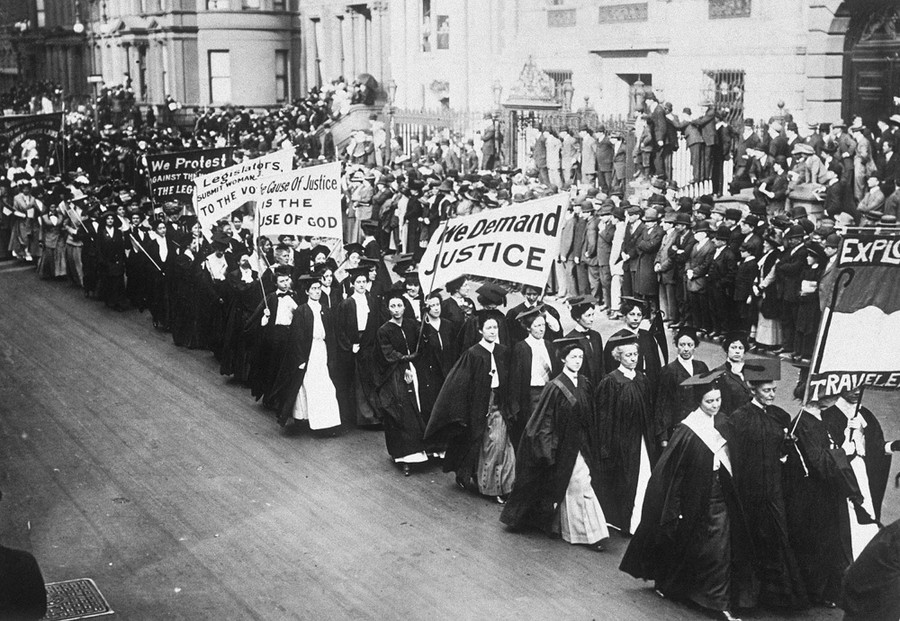
First, I want you to consider a few questions:
- What year did women in the United States achieved the right to vote in elections?
- What made some tactics that women used to change attitudes towards women’s suffrage?
- Why were they successful? Why were some not successful?
- Who were influential leaders in the women's rights movement?
During this Quest, you will learn about the history of woman's right movement and the methods these women used to gain their right to vote in the United States.
Task
Your task today is answer "How do reformers draw attention to their issues? "

In this lesson you, as the student, will take on the role of suffragette or suffragist.
suffragette - refers to a woman who advocates for women's right to vote.
suffragists - refers to anyone—male or female—who supported women's right to vote.
You will research and explore the strategies suffragettes/suffragists used to fight for the right for women to vote. Then create your own original document, to showcase what you have learned.
Process

- First read the task/rubric to make sure that you fully grasp what is expected of you for this assignment.
- Then you will pick what type of final project you would like to complete.
- Some examples you can choose from are:
- poster, cartoon, picket sign, simulated diary
- suffragette paraphernalia (button/sash/banner/postcard/etc.)
- Presenting a speech, declaration, performing a skit, song
- * If you want to do something else, please ask teacher permission. *
- Some examples you can choose from are:
- You will than view and explore the websites provided below, to learn more about the women’s rights movement, important people during this time period, and the many ways women used to spread the information and advocate for their campaign.
- https://www.womenshistory.org/celebrating-centennial/suffragist-biograp…
- https://www.loc.gov/classroom-materials/womens-suffrage/
- https://www.americanbar.org/groups/public_education/programs/19th-amend…
- https://dp.la/primary-source-sets/women-s-suffrage-the-campaign-for-the…
- https://www.archives.gov/education/lessons/woman-suffrage
- http://www.crusadeforthevote.org/primary-documents-1
4. After reviewing the websites, students can than begin to create their final project of their choosing.
5. After finishing their “item” they will present it to the class with a brief summary of what they learned in the process.
/cdn.vox-cdn.com/uploads/chorus_image/image/67219858/GettyImages_514698884.0.jpg)
Evaluation
|
CATEGORY |
4 |
3 |
2 |
1 |
|
Required Elements |
The item includes all required elements as well as additional information. |
All required elements are included on the item. |
All but 1 of the required elements are included on the item. |
Several required elements were missing. |
|
Graphics - Originality |
Several of the graphics used on the item reflect an exceptional degree of student creativity in their creation and/or display. |
One or two of the graphics used on the item reflect student creativity in their creation and/or display. |
The graphics are made by the student, but are based on the designs or ideas of others. |
No graphics made by the student are included. |
|
Graphics - Relevance |
All graphics are related to the topic and make it easier to understand. All borrowed graphics have a source citation. |
All graphics are related to the topic and most make it easier to understand. All borrowed graphics have a source citation. |
All graphics relate to the topic. Most borrowed graphics have a source citation. |
Graphics do not relate to the topic OR several borrowed graphics do not have a source citation. |
|
Content - Accuracy |
At least 3 accurate facts are utilized on the item. |
2 accurate facts are utilized on the item. |
Less than 2 accurate facts are displayed on the item. |
There are no accurate facts utilized on the item. |
|
Grammar |
There are no grammatical mistakes on the item. |
There is 1 grammatical mistake on the item. |
There are 2 grammatical mistakes on the item. |
There are more than 2 grammatical mistakes on the item. |
|
Use of Class Time |
Used time well during each class period. Focused on getting the project done. Never distracted others. |
Used time well during each class period. Usually focused on getting the project done and never distracted others. |
Used some of the time well during each class period. There was some focus on getting the project done but occasionally distracted others. |
Did not use class time to focus on the project OR often distracted others. |
|
Sharing with Class |
Uses loud voice and maintains eye contact with audience. |
Sometimes uses a loud voice and maintains eye contact with audience |
Uses a quite voice and only occasionally looks at the audience |
Voice is too quiet and no eye contact is made with audience |
|
Knowledge Gained |
Student can accurately answer all questions related to facts in the poster and processes used to create the poster. |
Student can accurately answer most questions related to facts in the poster and processes used to create the poster. |
Student can accurately answer about 75% of questions related to facts in the poster and processes used to create the poster. |
Student appears to have insufficient knowledge about the facts or processes used in the poster. |
Conclusion

At the end of this assignment, students will have learned more about women’s suffrage. From key leaders in the movement, to what these generations of women utilized to help secure women the right to vote. I hope you had fun making your final projects, and I’m extremely excited to see what you all came up with.

Credits
I would like to thank the authors of the websites, that helped provide the students with a better understanding of this extremely important moment in history. As well as my instructor, Dr. Baaden, who introduced me to what a WebQuest is and how to create one.
Thank you.
Permissions
I give permission for others to use and modify this WebQuest for educational, non-commercial purposes.
Teacher Page
Teachers- This assignment was designed to give the students a look into what generations of women strove for, their right to vote. This assignment can be used for students in the grades ranging from 4th to 6th, and will help them understand the methods reformers use to get their voices heard. This lesson will also give students an opportunity to utilize their creativity in their project.