
Introduction

Welcome: Immunity, Disease, and Disorders
Description: Web Quest for Life Science . Grade 7
Grade Level = 6-8
Curriculum: Science
Keywords: immunity; disease, vaccine, disorders, life science
Author: Shelly Langshaw
Welcome, junior immunologists! The human body can defend itself against pathogens. This defense system consists of both external and internal defenses. External defenses include the mucous membranes and tears, as well as our skin! The body's internal defenses include nonspecific and specific defenses. Immunity is the ability to resist or recover from infectious disease. Vaccines and memory cells can build us our body's immunity. There are many challenges to the immune system, some include allergies, cancer, immune deficiency disorders, and autoimmune disease.
Learning Objective: Students would have learned how to present an oral presentation, how to research information, how to organize it, how to think critically, and how to respond to questions with confidence about the Immunity, Disease, and Disorders.
Task
You will create a Google Sheets presentation on the three following topics:
- The Immune Response
- Causes of Infectious Disease & Challenges to the Immune System
- Reducing and Treating Infectious Disease
A thorough research should be performed BEFORE starting the presentation.
Process
A patient came into our office complaining of fatigue, dry cough, and headache. We want to help the patient relieve symptoms. In order to understand how the immune system is linked to infectious disease we will need to go to the medical library and do some research. To start, we need to understand how the immune system works.
Please research the following sections for your presentation.
The Immune Response
Immunology is the study of disease, specifically disorders of the immune system.
- Follow the link: https://www.cancerquest.org/cancer-biology/immune-system?
- Read and watch related videos of the following sections found on the tab to the left:
- The Immune System
- Within The Immune System read:
- The Innate Immune System
- The Acquired Immune System
- How the Immune System Sees the World
- Immune System and Inflammation Summary
- Read and watch related videos of the following sections found on the tab to the left:
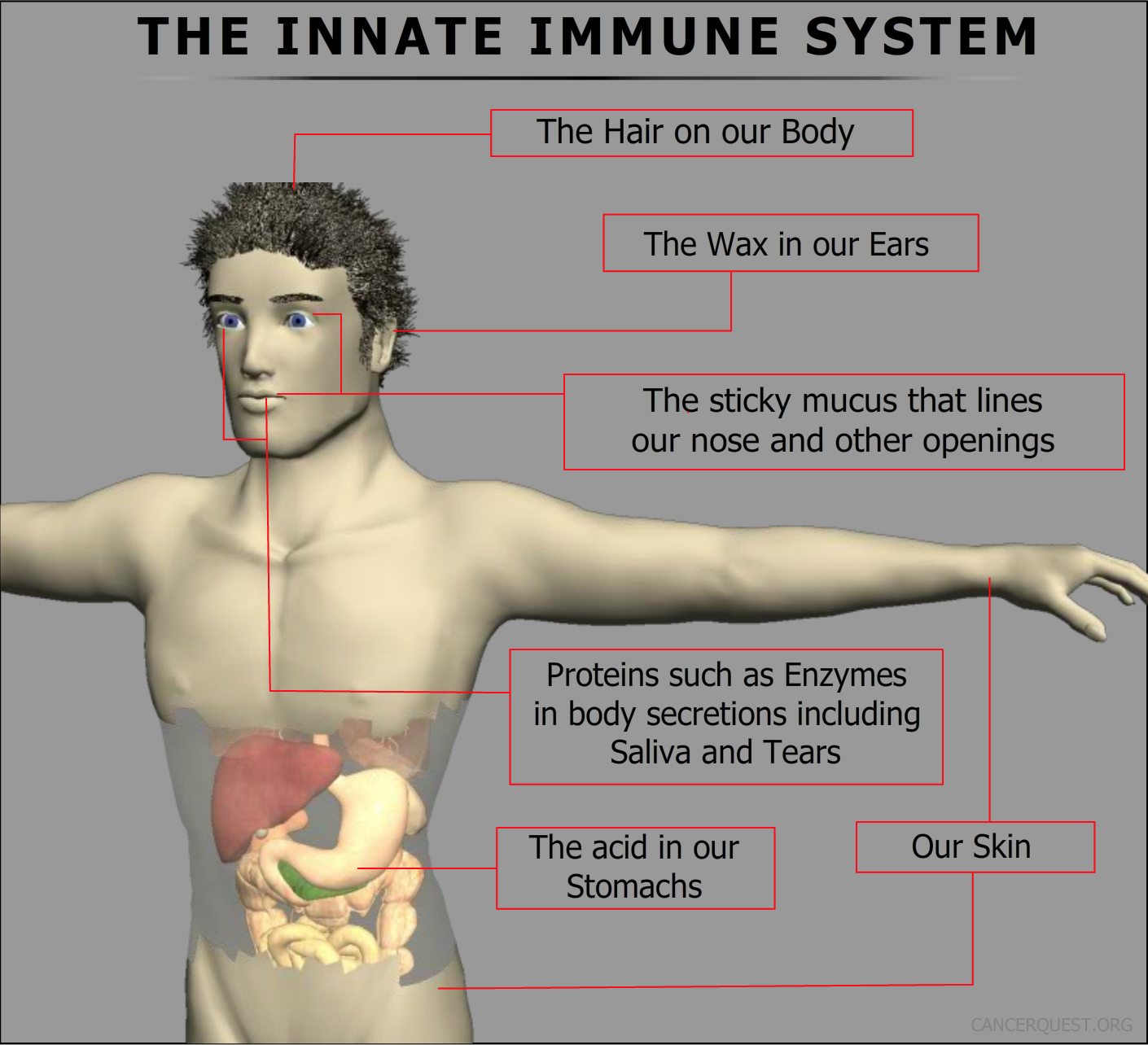
What other organs from other systems assist the immune system to keep us healthy. Watch the following video to find out!
To further understand how the immune system works, read and watch the related videos in the following link → https://kidshealth.org/en/teens/immune.html
Causes of Infectious Disease & Challenges to the Immune System
- Use this link: https://www.choa.org/medical-services/infectious-diseases to find out causes of infectious diseases and how these diseases challenge our immune system. Pick three from the list under the heading "What sorts of infectious diseases do the doctors at Children’s treat?" to summarize in your presentation.
Reducing and Treating Infectious Disease
Vaccines have been instrumental in treating and reducing infectious disease! Follow the link, https://www.healthypeople.gov/2020/topics-objectives/topic/immunization-and-infectious-diseases, to read "Immunization and Infectious Diseases". Pick three main ideas from the article to include in your presentation.
Reducing the transmission of disease is as easy as washing your hands! Watch the following video on how to correctly wash your hands to fight infectious disease.
Evaluation
- Each student will have 5 minutes to orally present their findings to their classmates.
- The presentation should be well organized with an introduction and a conclusion.
- The presentation should be rich in images and should not contain ANY paragraphs (bullet points required).
- A page with APA format citations should be present as the last slide.
- At the end of the presentation, each student who presents will be asked at least 2 questions from the other students.
| # | 10 | 8 | 6 | 4 | Score |
|---|---|---|---|---|---|
| Comprehension | Student is able to accurately answer almost all questions posed by classmates about questions from their presentation. | Student is able to answer most questions posed by classmates about information from their presentation. | Student is able to answer a few questions posed by classmates about their presentation. | Student is unable to answer questions posed by classmates about their presentation. | |
| Time Limit | Presentation is 5- minutes long. | Presentation is 4 -3 minutes long. | Presentation is 3 - 2 minutes long. | Presentation is less than 2 minutes. | |
| Vocabulary | Uses vocabulary appropriate for the audience. Extends audience vocabulary by defining words that might be new to most of the audience. | Uses vocabulary appropriate for the audience. Includes 1-2 words that might be new to most of the audience, but does not define them. | Uses vocabulary appropriate for the audience. Does not include any vocabulary that might be new to the audience. | Uses several words or phrases that are not understood by the audience. | |
| Grammar | Little (1-5) to no grammatical errors. | 6-10 grammatical errors. | 10 - 15 grammatical errors. | More than 15 grammatical errors. | |
| Content | Shows a full understanding of the topic. | Shows a good understanding of the topic. | Shows a good understanding of parts of the topic. | Does not seem to understand the topic at all . | |
|
Total Score: __/50 |
Conclusion
Yeah, you have gotten this far and I hope you have learned many interesting facts. I cannot wait to hear your presentations!
❌ Photo unavailable
Credits
Resources:
cancerquest.org (2022). The immune system. Emory Winship Cancer Institute. Retrieved from https://www.cancerquest.org/cancer-biology/immune-system
choa.org. (2022). Infectious diseases in kids. Childrens Healthcare of Atlanta. Retrieved from https://www.choa.org/medical-services/infectious-diseases
healthypeople.gov. (2022). Immunization and infectious disease. Office of Disease Prevention and Health Promotion. Retrieved from https://www.healthypeople.gov/2020/topics-objectives/topic/immunization-and-infectious-diseases
Hirsh, L. (2022). Immune system (for teens). Nemour's Childrens Health. Retrieved from https://kidshealth.org/en/teens/immune.html
Houghton Mifflin Harcourt. (2019). HMH Florida Science: Life Science. HMH.
Teacher Page
Welcome: Immunity, Disease, and Disorders
Description: Web Quest for Life Science . Grade 7
Grade Level = 6-8
Curriculum: Science
Keywords: immunity; disease, vaccine, disorders, life science
Author: Shelly Langshaw
Standards:
SC.6.L.14.5 Identify and investigate the general functions of the major systems of the human body (digestive, respiratory, circulatory, reproductive, excretory, immune, nervous, and musculoskeletal) and describe ways these systems interact with each other to maintain homeostasis.
SC.6.L.14.6 Compare and contrast types of infectious agents that may infect the human body, including viruses, bacteria, fungi, and parasites.
SC.6.N.1.1 Define a problem from the sixth grade curriculum, use appropriate reference materials to support scientific understanding, plan and carry out scientific investigation of various types, such as systematic observations or experiments, identify variables, collect and organize data, interpret data in charts, tables, and graphics, analyze information, make predictions, and defend conclusions.
HE.6.C.1.3 Identify environmental factors that affect personal health.
HE.6.C.1.4 Recognize how heredity can affect personal health.
HE.6.C.1.5 Explain how body systems are impacted by hereditary factors and infectious agents.
HE.7.C.1.3 Analyze how environmental factors affect personal health.