
Introduction
THE ART OF SPEECH
ART ET POUVOIR: FICTIONS ET REALITES
How is political power staged?
-
Question yourself
-
How important are speeches in the making of a president?
-
Is the messenger more important than the message?
-
Write a presidential speech and give advice to the president.

Getty Images/John Lamparski
"Alexandria Ocasio-Cortez, the Representative from New York's 14th district, attends the Women's March 2019
"You can’t just give a speech and expect people to fall down and agree with you."
Hilary Clinton, politician
Task
The Great Dictator, Charlie Chaplin, 1940

Roy Export S.A.S.
The Great Dictator, Charlie Chaplin, 1940
Chaplin's The Great Dictator is a satirical attack on Adolf Hitler and his Nazi regime. A Jewish barber gets mixed up with a fascist ruler, Adenoid Hynkel (Hitler). At the end, the barber delivers a speech about peace and unity to the people – one of the most famous monologues in cinematic history.
Annoter
Donald Trump, National Security Strategy Speech, 2017

Getty Images/Joe Raedle
A nation without borders is not a nation.
A nation that does not protect prosperity at home
cannot protect its interests abroad.
A nation that is not prepared to win a war
is a nation not capable of preventing a war.
A nation that is not proud of its history
cannot be confident in its future.
And a nation that is not certain of its values
cannot summon the will to defend them.
Donald Trump, National Security Strategy Speech, 2017
-
to prevent [sth] = to stop [sth]
-
to summon = to gather
-
will = determination
Annoter
The Great Dictator Clip
Words you'll need
-
gentile non juif(ive)
-
to despise mépriser
-
to provide [sb] with [sth] fournir [qqch] à [qqn]
-
greed l'avarice
-
goose-step = a Nazi march
-
bloodshed un carnage
-
bitterness l'amertume
-
to drill = to practise
-
cattle du bétail
-
cannon fodder de la chair à canon
-
to do away with [sth/sb] se débarasser de [qqch/qqn]
There's a better way to live
The scene takes place in Detroit, in a run-down neighborhood which is being regenerated by people who have come from all over the country. People are watching a football game in the hall of a big factory when someone starts speaking…
A voice came into the room through a kind of speaker system. “I figured I'd wait till half time,” it said. “I know when I can't compete. But now that everybody's in a good mood.” And a few people cheered. […] Obama had come.
Walking with the microphone in hand, he said, “We got in, I don't know, about eight a.m. this morning, and the first thing I said was, take me to these neighborhoods, take me to these streets, so we drove off, with about eighteen cars, one after the other, and by this point it was about nine thirty, and I knew we had got to the right place, because there were guys working, building, wearing those hard hats and dirty day-glo jackets, climbing on roofs and digging foundations, on Saturday morning, and the other half of the folks I saw were sitting in Joe Silver's café drinking lattes.”
People laughed […]. There were also hecklers. Someone called out, “The United States of Detroit,” which didn't mean much to me then and doesn't now. But Obama stopped and started again.
“Now I know there are folks here today who don't agree with everything I do, and I don't expect you to. But there are things we can agree on. That the American Experiment ain't over yet. And that's not because we're sitting around on our butts, waiting for the results to come in. The people rebuilding Detroit, and some of you are in this room right now, are still tinkering with it, still adapting it, still moving forward. You have come here from Albuquerque and Chicago, from Queens and from Cleveland and from San Diego. You have come from Mexico and Poland and Sudan and from right here in Detroit. You have come because you lost your job or you couldn't get a job or you had to work three jobs just to put food on the table. Because your health insurance ran out or your mortgage was worth more than your home. Because the school you sent your kids to couldn't afford to buy books or because the part-time job you got in college turned out to be the best thing you could find after earning your degree. You have come because there was a voice in your head saying, You don't have to live like this. There's a better way to live. This voice has called people to America for over four hundred years. It calls to us now…” and so on. Eventually he said, “But stick around, I'm just the warm-up act.” […]
We caught up with him shaking hands. There were maybe fifteen, twenty people who wanted his attention, and he stood there in his open-necked shirt, looking the part but not saying much. He looked tired, too, like he'd been wound up and was winding down. “I've got to get this stuff off my face,” he said at last and rubbed his palms against his cheeks and held them up. “I hate TV, please excuse me.” He headed for the exit […].
You Don't Have to Live Like This, Benjamin Markovits, 2015

The Obama Years: The Power of Words, réalisation Jody Schiliro, diffusion Smithsonian Channel (2017)/DR
Poster for the documentary The Obama Years: The Power of Words, 2017
-
a day-glo jacket = a fluorescent jacket
-
a heckler un perturbateur
-
to tinker with [sth] bricoler [qqch]
-
a mortgage un prêt immobilier
-
eventually = in the end
-
to look the part être habillé(e) pour l'occasion
-
wound up nerveux(euse)
-
to wind down = to relax
Annoter
Stuff you should know
US Presidents and speeches
Over time, delivering speeches has become an important part of the American presidency. For example, presidents have to deliver an inaugural speech after every election, a State of the Union address at the beginning of every year and the Fourth of July speech on Independence Day. President Obama became famous for his oratory skills. His popularity increased due to slogans such as “Yes We Can!” during his 2008 campaign.
Annoter
Focus on the poster
-
Focus on Barack Obama's face. What do you notice?
-
What aspects of his personality does it highlight?
-
How does it relate to the text of the poster?
-
Read the text
-
What happens in this extract?
-
Focus on Obama's fictional speech. What is his message?
-
Does the Obama in the text match the one in the picture?
-
Read the text again. What are the strategies used by Obama to capture the public's attention?
-
How did the audience react to his speech? Do you think Obama reached his goal?
Train for your BAC
Du doc à l'axe - Art et Pouvoir
How does this text illustrate the link between performance and politics?
VOCAB
Nouns
-
empathy l'empathie
-
an orator = a public speaker
-
a spokesperson un(e) porte-parole
-
a storyteller = someone who tells stories
-
sympathy la compassion
Adjectives
-
articulate qui s'exprime bien
-
casual décontracté(e)
-
inspirational inspirant(e)
-
solemn = serious
-
warm = affectionate, enthusiastic
Verbs
-
to captivate captiver
-
to empathize with [sb] = to understand [sb]'s feelings
-
to galvanize [sb] = to encourage [sb] to take action
-
to seek rechercher
-
to take [sth] into account tenir compte de [qqch]
HOW TO...
Explain your intentions
-
At first, I intended to…
-
Originally, my plan was to…
-
What I meant was…
-
Actually, what I wanted to show was…
-
Eventually, I opted for…
Training Task
You are B. Markovits, the author of the novel, and you have received an email from a newspaper journalist who wants to know what your intentions were when writing this passage. Answer him in 100 words.
Poster for the first season of the series House of Cards, starring Kevin Spacey

Photo 12/Alamy / Photo12
Poster for the first season of the series House of Cards, starring Kevin Spacey
House of Cards is set in Washington D.C. and follows the story of Congressman Frank Underwood (Kevin Spacey), a Democrat from South Carolina, and his ambitious wife Claire Underwood (Robin Wright). The series deals with themes of merciless pragmatism, manipulation and betrayal in order to gain and retain power.
Focus on the quote and the poster
-
Read the quote and its caption.
-
What message do you think Lincoln tried to convey?
-
Now read it aloud. What's the tone of the speech?
-
-
Focus on the poster.
What kind of fictional president do you think he must be? How can you tell?
Watch the video
-
What message is the main character trying to convey?
-
List the pronouns that he uses. What does it reveal about his personality?
-
Describe the actor's voice and body language and the camera work. What effect do they have?
-
Now focus on the images presented in the speech.
-
What do they reveal about the character?
-
Focus on the end of the video. How did it make you feel?
-
-
After a few minutes, what do you remember most about the trailer?
Train for your BAC
Du doc à l'axe - Art et Pouvoir
What does this video say about the differences between what politicians say and what they mean?
Nouns
-
a glimpse un aperçu
-
a roughneck = a tough person
-
slit eyes = half-closed eyelids
-
a villain un(e) méchant(e)
Adjectives
-
cold-hearted = without compassion
-
dignified = with dignity
-
a drawling [voice] une [voix] traînante
-
a low-pitched [voice] une [voix] grave
-
ruthless = without pity
-
still = immobile
Others
-
convincingly = with conviction
-
eloquently = expressively, fluently
-
hardly à peine
-
threateningly de façon menaçante
Talk about a video
-
close-up un gros plan
-
a wide shot un plan large
-
a tracking shot un travelling
-
a still frame un plan fixe
-
to zoom in on [sb/sth] zoomer sur [qqn/qqch]
-
to pan out faire un zoom arrière
Training Task
Write a very short speech and then perform it focusing on your delivery (body language / gestures, look, tone…). Prove that what you say is as important as the way you say it.
Abraham Lincoln, 1865
With malice toward none; with charity for all; with firmness in the right, as God gives us to see the right, let us strive on to finish the work we are in; to bind up the nation's wounds; to care for him who shall have borne the battle, and for his widow, and his orphan—to do all which may achieve and cherish a just and lasting peace, among ourselves, and with all nations.
Abraham Lincoln, 1865

Getty Images/Bettmann / Bettmann Archives
This is the sentence that closed President Lincoln's 2nd Inaugural Address, delivered on March 4th, 1865, shortly before the end of the American Civil War (fought between Northern and Southern States) and the end of slavery.
-
to strive on = to make a great effort
-
to bind up wounds panser des blessures
-
to bear (bore, borne) porter
-
lasting durable
House of cards,2016
Words you'll need
-
to deserve mériter
-
to put [sth/sb] first = make [sth/sb] a priority
-
to put [sth/sb] back on track remettre [qqch/qqn] sur les rails
-
to be willing to = to be ready to
-
to take one's licks = to be hit several times
-
to take [sth] for granted tenir [qqch] pour acquis
Annoter
Stuff you should know
The Lincoln Memorial
The Lincoln Memorial was built in Washington D.C. to honour Abraham Lincoln. Very popular with tourists, it contains a large seated sculpture of Abraham Lincoln and inscriptions of two of his most famous speeches (“The Gettysburg Address” and his second inaugural address). It has been the site of many famous speeches, including MLK's “I Have a Dream” speech.

Istock/Meinzahn / Getty Images/iStockphoto
Annoter
How important are speeches in the making...
Ronald Reagan on the set of the TV show General Electric Theater, 1954
An actor, turned senator, turned president, Ronald Reagan managed to transform his popularity on the silver screen into a long-lasting presidency. He was praised for his oratory skills but his war on drugs was often considered to target minorities.

Photo12/Alamy
Ronald Reagan on the set of the TV show General Electric Theater, 1954
Get ready
-
Look at Reagan's photo. What does it tell you about him?
-
Link the photo to the title of the text. What could the extract be about?
-
Read the caption and check your hypotheses.
The Supreme Actor
Newspaper editor Doremus Jessop is attending a political rally in New York for Senator Buzz Windrip, who is running for president as a Democratic nominee.
Doremus thought he was being bored until he discovered that, at some moment which he had not noticed, he had become absorbed and excited.
Something in the intensity with which Windrip looked at his audience, looked at all of them, his glance slowly taking them in from the highest-perched seat to the nearest, convinced them that he was talking to each individual, directly and solely; that he wanted to take each of them into his heart; that he was telling them the truths, the imperious and dangerous facts, that had been hidden from them.
“They say I want money – power! Say I've turned down offers from law firms right here in New York of three times the money I'll get as President! And power – why, the President is the servant of every citizen in the country, and not just of the considerate folks, but also of every crank that comes pestering him by telegram and phone and letter. And yet, it's true, it's absolutely true I do want power, great, big, imperial power – but not for myself – no – for you! – the power of your permission to smash the Jew financiers who've enslaved you, who're working you to death to pay the interests on their bonds; the grasping bankers – and not all of ‘em Jews by a darn sight! – the crooked labor-leaders just as much as the crooked bosses, and most of all, the sneaking spies of Moscow that want you to lick the boots of their self-appointed tyrants that rule not by love and loyalty, like I want to, but by the horrible power of the whip, the dark cell, the automatic pistol!”
He pictured, then, a Paradise of democracy in which, with the old political machines destroyed, every humblest worker would be king and ruler, dominating representatives elected from among his own kind of people, and these representatives not growing indifferent, as hitherto they had done, once they were far off in Washington, but kept alert to public interest by the supervision of a strengthened Executive.
It sounded almost reasonable for a while.
The supreme actor, Buzz Windrip, was passionate yet never grotesquely wild. He did not gesture too extravagantly; only […] he reached out a bony forefinger which seemed to jab into each of them and hook out each heart. It was his mad eyes, big staring tragic eyes, that startled them, and his voice, now thundering, now humbly pleading, that soothed them.
He was so obviously an honest and merciful leader; a man of sorrows and acquaint with woe. […]
But what Mr. Windrip actually had said, Doremus could not remember an hour later, when he had come out of the trance.
It Can't Happen Here, Sinclair Lewis, 1935
It Can't Happen Here was published during the rise of fascism in Europe. The character of Buzz Windrip seems to have many inspirations: Hitler, Mussolini but also American politician Huey Long. Governor of Louisiana from 1928 to 1932, Long used similar tactics and rhetoric, while ruling and preparing to run for the 1936 presidential election. Today, Donald Trump is often compared to Buzz.
-
to run for president être candidat(e) aux présidentielles
-
a crank = a bad-tempered person
-
to pester= to annoy, to bother
-
a bond une obligation [financière]
-
a darn sight = a large amount
-
labor-leader un(e) représentant(e) syndical(e)
-
hitherto = until now
-
to jab into piquer
-
to soothe = to appease
-
woe = unhappiness
Get your facts right
-
Read the text. Summarize Buzz Windrip's message and his goals.
-
Explain Windrip's strategies to captivate his audience.
-
How does Doremus react to Windrip's speech? Does his opinion change during the speech?
Annoter
Feed back!
Answer the questions about this text using what you have learnt in each feed.
- Compare and contrast the extract from Markovits's novel and this one. What do they illustrate about the link between fiction and figures of power?
- Read the last paragraph of the text again. Compare it with the House of Cards trailer. What do they have in common? What do they reveal about politicians' skills?
Nouns
-
anti-semitism = hostility towards Jews
-
a belief une croyance, une conviction
-
xenophobia = hatred of foreigners
Adjectives
-
blunt = direct
-
fooled berné(e), dupe(e)
-
mesmerized = fascinated, hypnotized
-
over-the-top = excessive, exaggerated
-
spiteful mauvais(e), malveillant(e)
Verbs
-
to get rid of [sb/sth] se débarasser de [qqn/qqch]
-
to resort to [sth] recourir à [qqch]
-
to shift = to change
-
to target viser
Others
-
conversely à l'inverse
-
insidiously sournoisement
Process
Write the President's Speech
The president is launching a competition for young writers. To enter, you must write a speech for him/her. Include notes and comments which will provide him/her with advice and help to make the speech more convincing.

AFP/Getty Images/The White House / THE WHITE HOUSE
Obama working on Health Care Speech during his first presidency
Annoter
Stage 1
Brainstorm together
-
Decide on the main themes and ideas that need to be included in the speech.
-
Then think of keywords or catchphrases to make the speech memorable.
-
Hope, destiny, freedom…
-
“Keep the American Dream alive!”
-
“Where there's a will, there's a way!”
-
Annoter
Stage 2
Organize your thoughts
Focus on the main themes, ideas and your keywords to create an outline of the speech. Start writing complete sentences out of the first draft.
-
“A sad reality: America is in a miserable state right now… But America has always found ways to rise again.”
Annoter
Stage 3
Do it with style
Write the full version of the speech.
– Who's your target audience?
– Make references to a specific context but also to fundamental American or universal values.
– Quote other Presidents' words or actions.
– Explain his/her plans for the future, the first actions that he/she will take after this speech…
– Add details that will make the speech more memorable (an anecdote, a joke…).
Annoter
* Bonus *
Give advice to the president
-
Give the president some insight on your creative process: state your intentions and the reasons behind your main ideas.
-
“I think this is a very important point to adress, as your electorate is…”
-
-
Add notes and comments in a different color to help with his/her delivery and performance (tone, rhythm, emotions, mood, etc.).
-
“Here you need to lower your voice and slow down because this is a dramatic passage.”
-
“There you stop talking and look everyone in the eye, as if you know every single spectator.”
-
TIP
Proofread your speech and your notes and if you can, ask someone else to read them to give you some feedback!
Evaluation
Les niveaux attendus dans les 4 compétences, c'est à dire:
la compréhension écrite
l'expression écrite
la compréhension orale
l'expression orale
sont les suivants:
/image%2F0804598%2F20210922%2Fob_8030fd_niveaux-attendus.png)
/image%2F0804598%2F20210922%2Fob_c74b1f_les-niveaux-de-a1-a-c2.png)
Voici les grilles officielles du CECRL (Cadre européen Commun de référence pour les langues) qui seront utilisées par ton professeur d'anglais cette année pour t'évaluer:
GRILLE D'ÉVALUATION DE L'EXPRESSION ECRITE
/image%2F0804598%2F20210922%2Fob_222e81_1-grille-ee-bac-2021.png)
GRILLE D'ÉVALUATION DE L'EXPRESSION ORALE
/image%2F0804598%2F20210922%2Fob_9ce81c_1-grille-e-o-bac.png)
GRILLE D'ÉVALUATION DE LA COMPRÉHENSION ÉCRITE
&
GRILLE D'ÉVALUATION DE LA COMPRÉHENSION ORALE
/image%2F0804598%2F20210922%2Fob_f5c85e_grille-ce-et-co.png)
Voici les types d'évaluation qui te seront proposées cette année:
/image%2F0804598%2F20210922%2Fob_357fed_types-d-e-valuation.png)
DU NOUVEAU: L'ATTESTATION DE LANGUES!!!
/image%2F0804598%2F20210922%2Fob_fa86f4_attestation.png)
/https%3A%2F%2Fwww.super-bac.com%2Farticles%2Fwp-content%2Fuploads%2F2020%2F12%2Flangues-min.jpg)
Une attestation de langues vivantes en terminale | superBac
Publié le 09 décembre 2020 Mis à jour le 16 juillet 2021 Adeline A. À partir de 2021, tous les élèves de terminale se verront délivrer une attestation de langues vivantes, qui déterminera l...
https://www.super-bac.com/articles/e3c/attestation-langu
Skill Booster BAC:Mettre en relation un document avec L'axe du programme
Lors de l'épreuve orale, tu vas sélectionner un axe du programme parmi trois proposés. Tu découvriras ensuite deux supports en lien avec l'axe choisi. Après les avoir observés, tu vas devoir expliquer en anglais (en 5 minutes) quel document parmi les deux proposés illustre le mieux l'axe choisi et pourquoi.
Quels peuvent être les 2 supports ?
-
Soit 2 citations
-
Soit 2 images
-
Soit 1 citation et 1 image
Réfléchis bien avant de te lancer
-
Choisis le support qui te parle le plus. Les documents proposés seront forcément reliés à l'axe, mais l'oral ne dure que 10 min au total et tu n'auras pas de temps de préparation. L'important est donc de te projeter immédiatement et d'imaginer comment expliquer le lien à l'axe.
-
Pense à tous les éléments du support qui pourront nourrir ta réflexion : le thème, le type de support, le message transmis, les faits culturels, historiques ou sociétaux en rapport avec le monde anglophone que tu peux identifier.
Étudie le support en lien avec l'axe
-
Problématise tout de suite ta pensée. Surtout ne te limite pas à une description du support. Quelles questions ce document soulève-t-il ? Quels problèmes soulève-t-il ?
-
Ne perds jamais de vue l'axe. Dès que tu as un moment d'hésitation, reviens-y pour ne pas le perdre de vue.
-
Trouve des idées pour justifier ton choix de support (lien avec l'axe plus explicite, écho avec ce que tu as vu en classe, soulève des questions plus intéressantes…). Explique aussi pourquoi tu n'as pas choisi l'autre support (message peu clair, plutôt lié à un autre axe…).
Expose clairement tes arguments
-
Structure ta présentation.
-
Présente le support (type, auteur, origine, époque, cible…) et justifie ton choix.
-
Concentre-toi sur le message que le support fait passer ou le thème qu'il illustre.
-
Conclus en explicitant clairement son lien avec l'axe.
-
-
Développe tes arguments en privilégiant une communication claire, précise et illustrée. Commente certains détails, interprète les intentions derrière le choix du support, donne des exemples… N'oublie pas de structurer ton discours avec des mots de liaison.
Annoter
"I tell the president to start speeches in the most organic way possible. You wouldn't start a conversation by saying ‘As John F. Kennedy once said…', so you shouldn't start a speech that way either."
Jon Favreau, Barack Obama's ex-Director of Speechwriting, interviewed for British GQ, 2016
Imagine-toi en situation d'examen : tu as choisi l'axe Art et Pouvoir, et la citation de Jon Favreau.
1
► Repère les mots de la citation en lien avec l'axe.
| link with creation (art) → start + organic + that way | link with power → president + speeches |
Agrandir
► Repère les éléments qui pourront t'aider à cadrer ton analyse. N'oublie pas la source.
Obama → US / 2 terms : 2009-2017
Jon Favreau = somebody who wrote speeches for Obama
British GQ → an interview of somebody who became famous worldwide for his talent in speechwriting
2
► Quelles questions le support soulève-t-il ? Pour répondre, connecte les mots clés entre eux et reformule les idées à ta manière.
It's about the way a president should start a speech. Making speeches is like art, you have to be natural and creative.
► Justifie ton choix de support en donnant les « pros and cons » (le pour et le contre) des deux documents.
I picked this quote because Obama's speeches are very famous and I know his presidency and his slogan quite well, which means his speechwriter must have been very efficient.
3
► Dès le début, expose le lien entre la citation et l'axe et explique pourquoi tu as choisi ce document.
I think this quote best illustrates the topic “Art and Power” because…
► Commente la citation en passant du plus explicite (1er repérage) au plus implicite (2e repérage). Ne néglige pas les intentions (pour quoi ?) et le public visé (pour qui ?).
Firstly, it should be noted that the person who speaks is someone who used to write speeches for Obama. A major figure of power, J. Favreau put his talent and skills at Obama's service.
► Finis en illustrant clairement le lien entre la citation est l'axe.
This quote clearly shows that exerting power is like an art form due to the fact that…
Train for your BAC
Mets-toi en situation et exprime-toi pendant 5 min à partir de la
Credits
/image%2F0804598%2F20211028%2Fob_79260c_how-to-pronounce-ed.jpg)
TéléchargerCapture d’écran 2020-10-02 à 16
/image%2F0804598%2F20211028%2Fob_cf4d6a_capture-d-e-cran-2020-10-02-a-16.png)
TRAIN YOURSELF:
Pronounce the following verbs in the preterit using the correct ending /t/, /d/ or /id/
TéléchargerCapture d’écran 2020-10-02 à 16
/image%2F0804598%2F20211028%2Fob_1018d5_capture-d-e-cran-2020-10-02-a-16.png)
/image%2F0804598%2F20210519%2Fob_875ccb_capture-d-e-cran-2021-05-19-a-16.png)
TéléchargerSome useful linking words
List 1: Alphabetical order in English
TRAIN YOUR SKILLS
LINKING WORDS
Télécharger2 Train your skills Linking words worksheet
OTHER LISTS
List 2
List 3
TASK 1: Click on the link below and take the 30 sentences test:
Conjunctions online worksheet for Upper-Intermediate/Advanced. You can do the exercises online or download the worksheet as pdf.
TASK 2: The pleasure of learning a foreign language :-)
Take the following test!!!
Linking words, an interactive worksheet by florenceconrard
liveworksheets.com
TASK 3: Link the connectors:
B2 sentences
Linking words 2, an interactive worksheet by ewqua
liveworksheets.com
linking words, an interactive worksheet by spieddaignel
liveworksheets.com
Connectives and linking words, an interactive worksheet by Martadb
liveworksheets.com
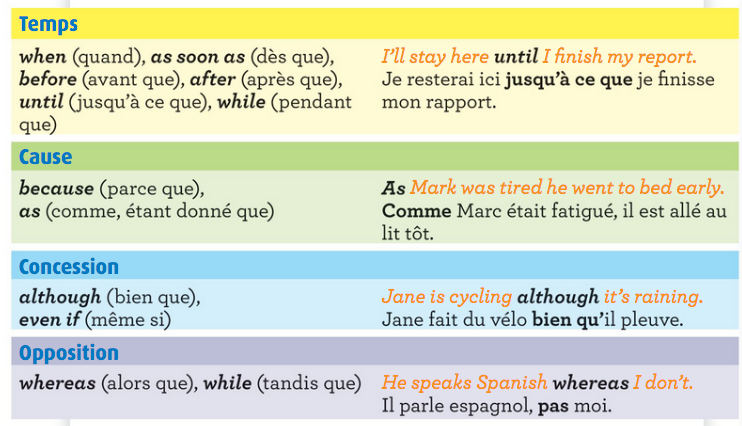
Grammar
La place des adverbes
Observe
-
I stood in exactly the wrong place.
-
The people are still debating.
-
Eventually he said, “I'm just the warm-up act.”
-
It sounded almost reasonable for a while.
-
I really want to know more about adverbs!
-
I'm not very interested in adverbs…
-
Honestly it's a fascinating subject!
Annoter
B
Retiens la règle
-
L'adverbe se place normalement devant ce sur quoi il porte. The people are still debating.
adverbe ➔
still
ce sur quoi il porte ➔
debating
-
Il peut porter sur un mot ou un groupe de mots : un groupe nominal, un verbe et son complément, un adjectif, toute une proposition…
Retiens aussi
-
Quand l'adverbe porte sur toute une proposition, il peut se trouver à la fin ou au début de la phrase.
I don't know much about adverbs, really.
-
Quand l'adverbe porte sur le verbe :
– on le place devant le verbe si celui-ci est constitué d'un seul élément,
– mais entre les éléments 1 et 2 si ce verbe est constitué de deux parties (ou plus).
I really enjoy grammar.
I don't really enjoy grammar.
I would really have appreciated another exercise on the subject.
Entraîne-toi
-
Complète ces phrases avec le bon adverbe.
only
just
also
precisely
perfectly
absolutely
-
I share your point of view. These are … the words I wanted to use.
-
You are … right. No one can deny it.
-
He wanted to end his speech …. He couldn't have tolerated any trouble.
-
She promised it wouldn't take too long. She … wished to add another argument.
-
Not … did they regret what they did, they … felt guilty.
-
-
Replace les adverbes au bon endroit (parfois plusieurs solutions possibles).
-
Abraham Lincoln is one of the most respected US presidents still.
-
“It's time to wake up”, angrily he said.
-
There was a huge crowd who attended the rally also.
-
I recommend you pay attention to his warning strongly.
-
-
Complète ces phrases avec le bon verbe.
executed
removed
heard
-
I clearly … what he said. There was no doubt.
-
This painting is amazing. It was beautifully ….
-
Delicately he … the mask he had been wearing.
-
-
Remets les phrases suivantes dans le bon ordre en te concentrant sur la place attribuée aux adverbes.
-
wrong • this • time • was • exactly • the
-
before • up • I • the • almost • end • gave
-
met • incredibly • it • the • I • time • him • first • was
-
stop • did • but • it • wanted • I • to • again • I
-
La pronounciation de la lettre H en anglais:https://www.anglaiscours.fr/prononcer-h-pluriels-sons-nasaux-en-anglais.html