
Introduction
Good Morning learners.
Today we are studying the States of Matter. In our previous lesson Matter and Material, we did an overview of the different types of Matter and how we can identify them.
In this lecture we'll look at the states of matter and their properties.
Watch my introduction video here: https://drive.google.com/file/d/19c94vfglraDVZYnLU-QcKP35bWT_mZSN/view?usp=sharing
Please watch the following video to get a broader understanding on the topic.
Task
Please watch the following videos and then complete the questions below.
Task 1
Due date: 28 August 2021
Total Marks: 20
Answer the following questions using the videos above as a guideline.
QUESTION 1
Below is a table with some different substances and their densities. Use this information to do the following calculations. When you are asked to perform calculations, show how you worked out each answer and do not forget to include the units in your answer.
|
Material |
Density (g/mol) |
|
Water (liquid) |
1.0 |
|
Ice |
0.917 |
|
Glass |
2.6 |
|
Salt |
2.2 |
|
Chalk |
2.36 |
|
Coal |
1.5 |
|
Cork |
0.25 |
-
- Arrange the materials from least dense to most dense.
______________________________________________________________________________
(2)
-
- You have a piece of coal and a piece of cork which are the same size. They have the same volume of 100 ml. Which one will have the greater mass?
______________________________________________________________________________
(1)
-
- Calculate the exact mass of each piece of coal and cork mentioned in question 1.2).
_______________________________________________________________________________________________________________________________________________________________________________________________________________________________________________________________________________________________________________________________________________________________________________________________________________________________________________________________________________________________________________________________________________________________
(6)
-
- You have a 500 g block of ice at home. What is the volume of the block of ice?
_______________________________________________________________________________________________________________________________________________________________________________________________________________________________________________________________________________________________________________
(3)
-
- When salt is added to a glass of water it sinks to the bottom of the glass. Explain, using the information in the table, why salt sinks to the bottom of the glass.
__________________________________________________________________________________________________________________________________________________________________________________________________________________________________________
(2)
(14)
QUESTION 2
The density of water is 1.0 g/cm3 . Based on the data below, predict the position of the objects in the beaker of water.

Write only a, b or c:
|
Object |
Density (g/cm3 |
Position |
|
Plasticine |
1.4 |
|
|
Gold |
19.3 |
|
|
Oil |
0.9 |
|

(3 × 2 = 6)
TOTAL: 20
Process
Term 2
Topic: States of Matter
Please watch the following video in order for you to understand the properties of matter and how it behaves in certain environments.
The following notes will give you deeper insight into the States of Matter.
States of Matter
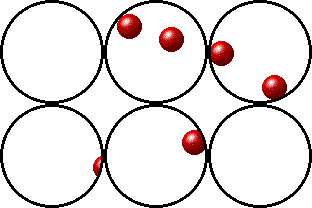
Gases, liquids and solids are all made up of microscopic particles, but the behaviors of these particles differ in the three phases. The following figure illustrates the microscopic differences.
 |
 |
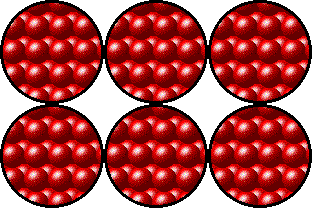 |
| Microscopic view of a gas. | Microscopic view of a liquid. | Microscopic view of a solid. |
Note that:
- Particles in a:
- gas are well separated with no regular arrangement.
- liquid are close together with no regular arrangement.
- solid are tightly packed, usually in a regular pattern.
- Particles in a:
- gas vibrate and move freely at high speeds.
- liquid vibrate, move about, and slide past each other.
- solid vibrate (jiggle) but generally do not move from place to place.
Liquids and solids are often referred to as condensed phases because the particles are very close together.
The following table summarizes properties of gases, liquids, and solids and identifies the microscopic behavior responsible for each property.
| Some Characteristics of Gases, Liquids and Solids and the Microscopic Explanation for the Behavior | ||
|---|---|---|
| gas | liquid | solid |
| assumes the shape and volume of its container particles can move past one another |
assumes the shape of the part of the container which it occupies particles can move/slide past one another |
retains a fixed volume and shape rigid - particles locked into place |
| compressible lots of free space between particles |
not easily compressible little free space between particles |
not easily compressible little free space between particles |
| flows easily particles can move past one another |
flows easily particles can move/slide past one another |
does not flow easily rigid - particles cannot move/slide past one another |
The notes below will elaborate on the states of matter.
The solid state
Solids keep their shape and cannot be compressed. Let us see if the particle model can help us understand why solids behave in this way.
In a solid, the particles are packed close to each other in fixed positions. They are locked into place, and this explains why solids have a fixed shape. Look at the following images of sodium chloride (table salt). Do you remember the formula for sodium chloride?
|
Macroscopic view of sodium chloride |
Submicroscopic view of sodium chloride |
|
|
|
|
Table salt crystals are hard and have a fixed shape. |
Can you see how the chloride atoms (purple) alternate with the sodium atoms (yellow) in a fixed arrangement? |


Take a good look at the picture of the particles in a solid (table salt) above. You will see that they are packed in a regular arrangement. There are very small spaces between the particles in a solid.
Particles are held together by forces of attraction. In solids, these forces are strong enough to hold the particles firmly in position.
Does that mean the particles in a solid do not move at all? No. The particles in a solid move a little bit. They vibrate in their fixed positions. The more energy the particles have, the faster and more strongly they vibrate.
Do you see how we have used the particle model of matter to explain the properties of solids that we can observe? For example, the particles in solids are closely packed and have strong forces between them explains why solids have a fixed shape and you cannot compress them.
The liquid state
An important characteristic of liquids is that they flow. They fill containers they are poured into. Liquids are also not very compressible. How can these properties be explained?

Orange juice is a liquid, which can be poured.
In the liquid state, particles do not have fixed positions. They move about freely, but they stay close together because the forces of attraction between them are quite strong, but not as strong as in solids.
Have you noticed how a liquid always takes the shape of the container it is in? Within the liquid, the particles slip and slide past each other. This is why liquid flows. Their particles are free to move around, filling the spaces left by other particles. Look at the image of the juice being poured. Let's zoom in and have a look at what the particles are doing as the juice is poured.

The particles in a liquid have small spaces between them, but not as small as in solids. The particles in a liquid are loosely arranged which means they do not have a fixed shape like solids, but they rather take the shape of the container they are in.
The speed at which the particles move around inside the liquid depends on the energy of the particles. When we heat a liquid, we are giving the particles more energy and speeding them up.
In gases, the particles move at even greater speeds.
The gaseous state
Gases spread out quickly to fill all the space available to them. Think of when you blow up a balloon. The air that you blow into the balloon fills up the whole balloon. A gas will fill the entire space that is available to it. This is because the particles in a gas have no particular arrangement.
Gases do not have a fixed shape. Think about the balloon again: the gas fills the entire space inside the balloon. You can squeeze the balloon, changing the shape.

Gases fill the space available to them.

Gases do not have a fixed shape.
Gas particles move very fast, much faster than in solids and liquids. The particles in a gas possess a lot of energy.
Have you ever tried to compress the gas in a syringe or in a bicycle pump? Why do you think you can compress the gas?

In gases, the forces between particles are very weak. This explains why the particles in gases are not neatly arranged. They are not held together tightly and there are large spaces between them. These spaces are much larger than in the solid and liquid state.
Gases can be compressed, because their particles can be forced closer together. Look at the photo of a scuba diver underwater. Do you see the tank on his back? He uses this tank to breathe underwater. A scuba diver can stay underwater for almost an hour. How do you think he can get enough air to breathe for a whole hour from a small tank like that? Discuss this with your class.

A scuba diver underwater with a tank of air. http://www.flickr.com/photos/57527070@N06/5337280707/
Let's summarize what we have learned about what the particle model of matter tells us about solids, liquids and gases.
Evaluation
MEMORANDUM
QUESTION 1
-
- Arrange the materials from least dense to most dense.
Cork ; Ice ; Water ; Coal ; Salt ; Chalk ; Glass üü (2)
-
- You have a piece of coal and a piece of cork which are the same size. They have the same volume of 100 ml. Which one will have the greater mass?
Coal ü (1)
-
- Calculate the exact mass of each piece of coal and cork mentioned in question 1.2).
|
Dcoal=mV 1,5=m100 m=1,5×100 m=150g |
Dcork=mV 0,25=m100 m=0,25×100 m=25g |


(6)
-
- You have a 500 g block of ice at home. What is the volume of the block of ice?
Dice=mV
0,917=500V
V=5000,917 ü
ü
V=545,26 ml üü (3)
-
- When salt is added to a glass of water it sinks to the bottom of the glass. Explain, using the information in the table, why salt sinks to the bottom of the glass.
Salt sinks to the bottom of the glass of water because salt has a greater density than water. The density of salt is 2,2 g/ml and the density of water is 1,0 g/ml üü (2)
(14)
QUESTION 2
|
Object |
Density (g/cm3 |
Position |
|
Plasticine |
1.4 |
b üü |
|
Gold |
19.3 |
c üü |
|
Oil |
0.9 |
a üü |
(6)
TOTAL: 20
Rubric:
*Marks awarded for correct definition.
*Marks awarded for correct formula used.
*Marks awarded for sensible explanation.
Conclusion
We have reached the end of the lesson. Thank you for your participation.
Please review the notes and videos you've received today. We will be conducting an investigation on the topic at the end of the week.
Stay healthy and safe.
Credits
Teacher Page
If you have any uncertainties please do not hesitate to contact me.
I am available to address your concerns. On my email my response times are 8am-4pm, Mon- Fri.
my contact details are as follows:
Jayme Jacobs
jaymejacobs219014043@gmail.com
0817455998