
Introduction
Hearing is the ability to detect the mechanical vibrations referred to as sound. Hearing impairment is commonly known as ‘deafness’. It is a hidden disability; it is difficult to identify a child with hearing impairment until interacting with him/her or noticing hearing aids. Aids may not be conspicuous as some hearing aids are very tiny and placed in or behind the ear or have surgically implanted cochlear implants. And, not all individuals with hearing impairments wear hearing aids. The most prominent feature of this impairment is the difficulty in hearing, understanding and using spoken language. Those who are born with this impairment or acquire it at a very young age may not have heard any language at all, even their mother tongue!
Hence, they do not learn and use spoken language automatically. Those who have acquired this impairment later in life may have a better understanding of language, but may still experience difficulties in using spoken language to communicate. Helen Keller quotes, “Blindness separates people from things; while deafness separates people from people”. It is vital to note that hearing impairment does not create insurmountable barriers. Due to technological developments the impact of impairment on the child can be reduced dramatically. The philosophy of and policies promoting inclusive education lead to improved access and participation in schools. If teachers and parents work together cohesively and systematically, Toolkit for Master Trainers in Preparing Teachers for Inclusive Education for Children with Special Needs children with hearing impairment can acquire language and achieve their academic goals. A lack of awareness often perpetuates prejudice and disregard of the rights and capabilities of people with hearing impairment. The fundamental issue of ‘communication barriers’ is not realized and therefore many, even in this era of communication technology, may label children with hearing impairment as ‘dumb’!
What is Hearing Impairment?
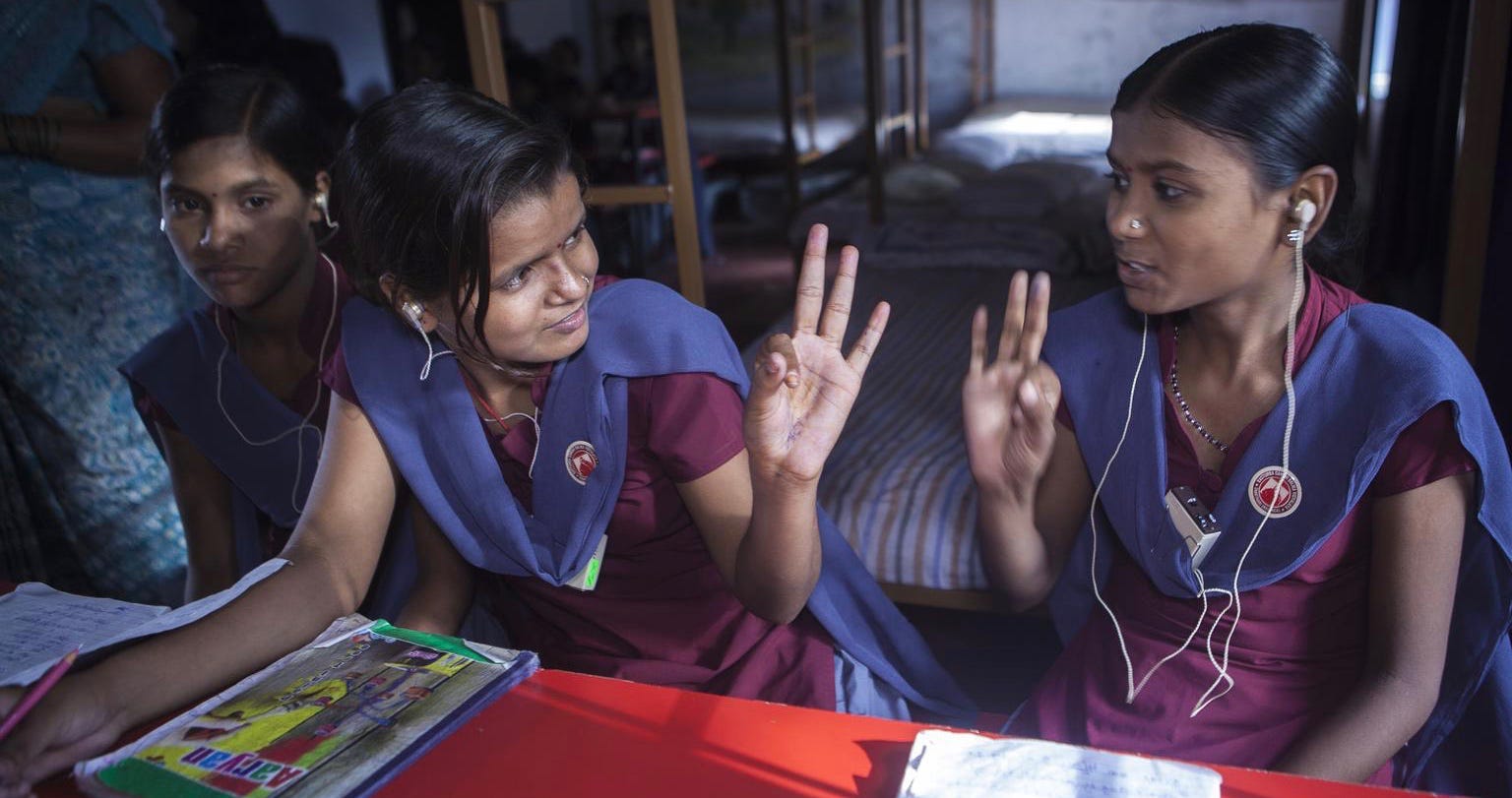
The Persons with Disabilities Act (1995) states that “Hearing Impairment means loss of 60 decibels or more in the better ear in the conversational range of frequencies”. Three aspects emerge from this definition:
1. Hearing loss in the better ear: Like the differences in eye sight in both eyes, hearing levels differ in both ears. The definition directs us to consider hearing loss in the better ear.
2. More than 60 decibels (dB): The level of hearing is measured in decibels, the unit of sound. The definition directs assigning a disability certificate to those who have a hearing loss in the better ear of more than 60 dB. This means their hearing thresholds lie above 60 dB.
3. Conversational range of frequencies: If we measure our normal speech it seems to fall under three frequencies: 500, 1000 and 2000 Hertz (Hz). The definition directs us to consider hearing thresholds at these frequencies.
Relevant Terms
Deaf refers to hearing impairments that preclude successful processing of linguistic information through audition, with or without a hearing aid. A person who is termed as ‘deaf’ usually has a profound hearing loss (beyond 90 dB) and is pre-lingual.
Hard of hearing refers to impairment in hearing that does not entirely prevent practical communication by speech. Thus, the person who is hard of hearing generally communicates by using speech. Using a hearing aid and/or by residual hearing, he/she is enabled to process linguistic information successfully through audition.
Residual hearing refers to the hearing that remains after a person has experienced a hearing loss. It is suggested that the greater the hearing loss, the lesser the residual hearing.
Audiogram is a graphical representation of what the person is able—and unable—to hear. It is a graphical display of a hearing test. As seen in figures 2 and 3 below, two components are graphed: frequency or the pitch as measured in Hertz (Hz) is on the X axis and intensity or loudness measured in decibels (dB) is on the Y axis. The red line represents hearing in the right ear and the blue represents hearing in the left ear.
Objectives :
- To enhance teacher knowledge about the social and learning needs of student with hearing impairment
- To develop an understanding about the different challenges faced by children with hearing impairment in the classrooms and beyond
- To develop an understanding of creating enabling environments for learning in the classroom and beyond
- To develop skills for curriculum transaction.
Task
teacher divieded b.ed student in group and tell them to find out teaching strategies for Hearing Impaired students and you will be creating a lesson plan suitable for children and students with special needs. Make sure you take into consideration the hearing impaired,

Process
In order to create a lesson plan, please go to the website below and begin creating your own, special needs appropriate lesson plan. You can make a lesson plan for any grade level. You may also have a lesson plan that requires teacher assistants or aides to help them through the activity.
Have fun and make sure all children can be included! :) :)
https://www.adcet.edu.au/inclusive-teaching/specific-disabilities/deaf-hearing-impaired
https://dsel.education.gov.in/sites/default/files/publication/module5.pdf
Evaluation
Your rubrics will vary depending on what type of lesson plan you create. Make sure you make the rubrics appropriate for your students and age appropriate. Below you will find a sample rubric in case you need some helpful tips!
LESSON PLAN RUBRIC (points possible: 100)
|
|
Exceeds Expectation |
Meets Expectations |
Needs Improvement |
Does Not Meet Expectations |
Points Earned |
|
Purpose-Goals
10 points |
Matched and clearly connected to KS Standards; Major concepts and assumptions of learning are developmentally appropriate (10-9 points) |
Matched but not clearly connected to KS standards; Most concepts and assumptions of learning are developmentally appropriate (8-6) |
Not adequately matched or connected to KS Standards; Concepts and assumptions of learning are sometimes not clear or not listed (5-3) |
Not matched or connected to KS Standards; Concepts and assumptions of learning are not clear or not listed (2-0) |
|
|
Objectives * Subject matter knowledge, skills and application
Reasoning ability
20 points |
Objectives are obviously observable and measurable; Clearly stated application of subject matter knowledge and skills; Includes the three domains; cognitive, affective, psychomotor – across all reasoning levels; lower, middle, high (20-19 points) |
Objectives are somewhat observable and measurable ; Stated application of subject matter knowledge and skills; Some domains are included, but not all three or not across all levels (17-15) |
Objectives are either not observable or not measurable; Minimal application of subject matter knowledge and skills; Domains and levels are addressed limitedly
(14-8) |
Objectives are not observable and also are not measurable; Application of subject matter knowledge and skills not evident; Domains and levels are not addressed (14-0) |
|
|
Anticipatory Set
5 points |
Lesson is creatively opened by tapping interest & prior knowledge, and procedures are described (5-4 points) |
Some attempt to open lesson by tapping interest & prior knowledge, and describe procedures (3-2) |
Limited attempt to tap interest & prior knowledge, and describe procedures (1) |
Does not tap interest & prior knowledge, and describe procedures (0) |
|
|
Procedures
20 points |
Detailed all content and resources required for instruction; Includes a variety of teaching strategies using Multiple; Intelligences theory; Used multiple methods or inquiry for student learning incorporating Bloom’s taxonomy; effective use of technology (20-18 points) |
Detailed some content required for instruction; Some teaching strategies included with use of MI theory; Some methods of student inquiry listed; some open ended questions included; appropriate use of technology (17-15) |
Limited details provided to teach content; Teaching strategy not clear or MI theory not evident; Limited methods of student inquiry used; lower level questioning; some use of technology
(14-12) |
Details are not provided to teach content; Teaching strategy not clear or MI theory not evident; Methods of student inquiry not evident; lower level questioning; limited use of technology (11-0) |
|
|
Special Accommodati ons
20 points |
Specific strategies designed to promote success for all students based on Time- Circumstances, Tasks, Communication, Response Modes; Differentiated Instruction clearly evident (20-18 points) |
Strategies designed to allow success for most students based on Time- Circumstances, Tasks, Communication, Response Modes; Some Differentiated Instruction evident (17-15) |
Some strategies not specific enough to support student learning based on Time-Circumstances, Tasks, Communication, Response Modes; Limited evidence of Differentiated Instruction
(14-12) |
Strategies not specific enough to support student learning based on Time- Circumstances, Tasks, Communication, Response Modes; No evidence of Differentiated Instruction (11-0) |
|
|
Closure
5 points |
Summary provided to reinforce learning and link to future learning (5-4 points) |
Some summary provided to reinforce learning (3-2) |
Limited use of summary to reinforce learning (1) |
Summary not evident or does not reinforce learning (0) |
|
|
Assessment
20 points |
Appropriate and connected to all objectives Specific description of both formative and summative assessments; Details at least two different ways to represent learning; e.g. concept map, quiz, reflective response (20-18 points) |
Appropriate; connected to some objectives; Plans for both formative and summative assessment; States at least two different ways to represent learning; e.g. concept map, quiz, reflective response (17-15) |
Connected to objectives to a limited degree; Plans for either formative or summative assessment; States one way to represent learning; e.g. concept map, quiz, reflective response (14-12) |
Not connected to objectives or not appropriate; Does not include plans for either formative or summative assessment; Does not include any ways to represent learning (11-0) |
|
|
*Objectives are evaluated in each education course as specific to requirement and content. |
Total Points Earned: |
|
Conclusion
Write a two page reflection paper on five things your learned about special education in general or a specific learning disability. Make sure to cite the resources used and add any of your own that you find.
Credits
I would like to show my gratitude Ms. arundhati chavan, Course Instructor, on SNDT University for giving me a good guideline
Teacher Page
name of the teacher: khan nasim bano.
qulification: M.Ed.