
Introduction
https://roundtherocktx.com/wp-content/uploads/2017/04/poetry-reading.jpg

In today's lesson, we will be making use of your previous knowledge and skills on poetry, to which this lesson will be linked.
WHAT IS POETRY?
Poetry is a literary form of work, an artistic kind of writing, that aims to stir a reader's emotions and imagination. The poet does this by carefully arranging and choosing language for its definition, sound, tone, mood and rhythm. Some poems, for example nursery rhymes are humorous yet simple.
WHAT IS A SONNET?
A sonnet is a 14 line poem, written in iambic pentameter. The sonnet derives from the Italian word "sonetto", which means a little song or sound. The most popular and simplest form of a sonnet is known as the Shakespearan, Elizabethan or English sonnet, but several other types exist. William Shakespeare is the writer of the Shakespearean sonnets.
Please have a look at the following website and make yourself familiar with a sonnet's structure and form. Pay special attention to iambic pentameter.
https://www.thoughtco.com/what-is-a-sonnet-2985266
Task
https://historythings.com/wp-content/uploads/2016/10/globe-reuters.jpg
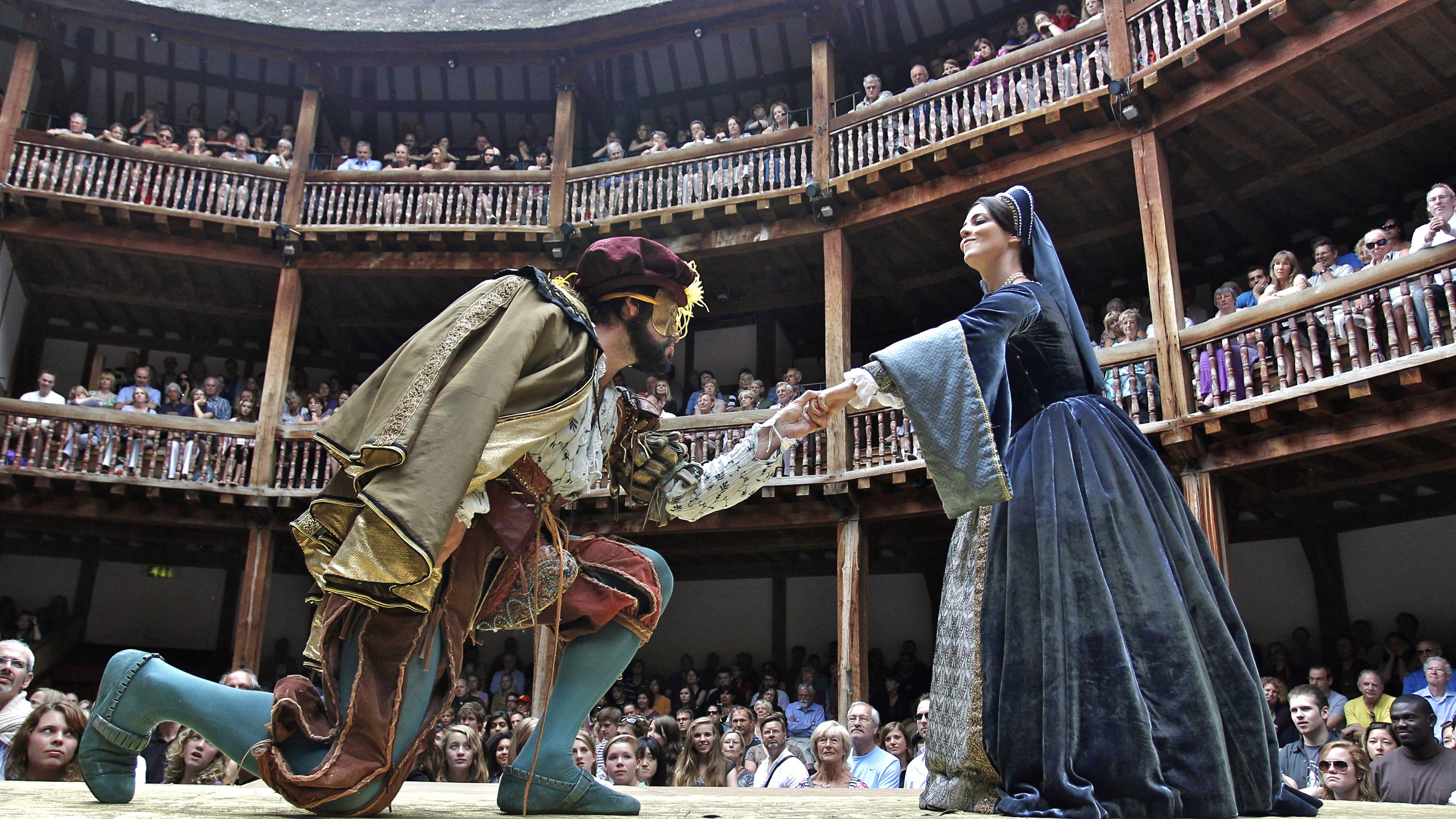
Learners, you need to work in pairs to analyse and annotate the sonnet that is provided to them. They are instructed to identify the various figures of speech in sonnet 18.
Please go to the following website to access sonnet 18.
http://www.shakespeare-online.com/sonnets/18.html
After you have completed the annotation and analysis in your pairs, you need to complete the worksheet that is based on the poem. Please remain in your pairs to complete this activity.
You are advised to make use of the video below for guidance when completing the activity.
https://www.youtube.com/watch?v=bDpW1sHrBaU
Process
SONNET 18 WORKSHEET
INSTRUCTIONS FOR WORKSHEET ACTIVITY:
1. Write your answers in the back of your English workbook.
2. Answer ALL the questions.
3. Write your answers in FULL SENTENCES. This EXCLUDES question 9.
QUESTIONS:
1. “Shall I compare thee to a summer’s day?” - Line 1, what type of question is this? (clue: does it need an answer?)[1]
2.1. What is the main use of imagery throughout the sonnet? [1]
2.2. How is this image depicted? [1]
3. Identify TWO uses of personification in line 11 – “Nor shall death brag thou wand’rest in his shade.” [2]
4. “But thy eternal summer shall not fade” – line 9.
4.1. Identify the figure of speech. [1]
4.2. Explain your answer in 4.1. [1]
5. “When in eternal lines to time thou grow’st.” What could these “eternal lines” be? [1]
6. Identify the two main themes in the sonnet. [2]
7. How is the verb “shall” used in three different tones in lines 1, 9 and 11? [3]
8. The word “temperate is ambiguous.
8.1. Do you think this means “self-restraint? Does this mean that the lover has a more even temper than summer? Or does it mean both? [1]
8.2. Explain your answer in 8.1. [1]
9. Provide THREE synonyms for the word ow’st in line 10. [3]
10. “Rough winds do shake the darling buds of May.”
10.1. What does this mean? [1]
10.2. Is this still summer? [1]
TOTAL MARKS: 20 MARKS
Evaluation
The following are the answers to the above worksheet questions. I will now evaluate your answers to ensure that you have understood the work that has been covered. I also want to make sure that you have understood the questions and that you have answered them correctly.
MEMO FOR SONNET 18 WORKSHEET
INSTRUCTIONS TO THE MARKER:
1. No marks should be deducted for spelling errors.
2. Accept any suitable answer.
ANSWERS:
1. This is a rhetorical question. [1]
2.1. Shakespeare makes use of nature as the main imagery throughout the sonnet. [1]
2.2. The image and beauty of nature is compared to his beloved’s beauty. [1]
3. This is firstly personification because death is described as “his”. Secondly, death has the human ability to brag. [2]
4.1. This is a metaphor. [1]
4.2. This is a metaphor because the lover’s beauty is compared to an eternal summer without the use of the words “like” and ‘as”. [1]
5. These eternal lines could be the poet’s verses. / The children the youth hope to have. / Wrinkles that represent aging. / Going in the opposite direction of time, being timeless. . [1]
6. The two main themes in the sonnet are summer and nature.
7. In the first line, the word “shall” is referring to the speaker’s uncertainty. In line 9, shall represents a definite promise. Lastly, the eleventh line portrays a command for death to be quiet. [3]
8.1. The word temperate means both self-restraint and that the lover has a more even temper than summer. [1]
8.2. The lover has self-control and therefore has a more even temper than summer. [1]
9. Synonyms for ow’st: [3]
- Own
- Possess
- Have
10.1. The writer is referring to the month of May OR The writer is referring to the May tree that flowers in England at this time of year. [1]
10.2. No, this is no longer summer because May month is spring in England. [1]
TOTAL MARKS: 20 MARKS
Conclusion
https://d.ibtimes.co.uk/en/full/1478075/new-years-eve-fireworks.jpg

!!! WELL DONE GRADE 11 POETS, YOU HAVE SUCCESSFULLY COMPLETED THE TASK!!!
Please prepare yourselves for the next lesson. In preparation, you must study and read through the notes, worksheets and websites from today's lesson, because you will be given a short test on poetry in next week.
Credits
NAME: DENIELLE HAILEY BOOYSEN
STUDENT NUMBER: 217042201
REFERENCES:
https://roundtherocktx.com/wp-content/uploads/2017/04/poetry-reading.jpg
https://www.thoughtco.com/what-is-a-sonnet-2985266
https://historythings.com/wp-content/uploads/2016/10/globe-reuters.jpg
http://www.shakespeare-online.com/sonnets/18.html
Teacher Page
B. ED SPFET: FOURTH YEAR EDUCATION STUDENT
CONTACT EMAIL ADDRESS: 217042201booysend@gmail.com