
Introduction
Gooday grade 9 learners
In this chapter you will learn the key differences between Series connection and a parallel connection.
Points to keep in mind from previous lesson
A simple circuit always consists of
- a cell
- a switch
- connecing wires
- and a lamp.
Click on the link below and watch the video of simple circuits to recap.
https://www.youtube.com/watch?v=j0zf-otH3cY
Task
Here are some things to think of when looking at series and parallel connection.
1.The key differences you see between a series circuit and the parallel circuit.
2. What are the similarities between a series and a parallel circuit.
3. The advantages/disadvantages for both connections.
You may refer to the video below for more information on series and parallel circuits.
Process
Instruction: Read through the information given to get a clear understanding of series and parallel connections.
Series Circuits
Nodes and Current Flow
Before we get too deep into this, we need to mention what a node is. It's nothing fancy, just representation of an electrical junction between two or more components. When a circuit is modeled on a schematic, these nodes represent the wires between components.
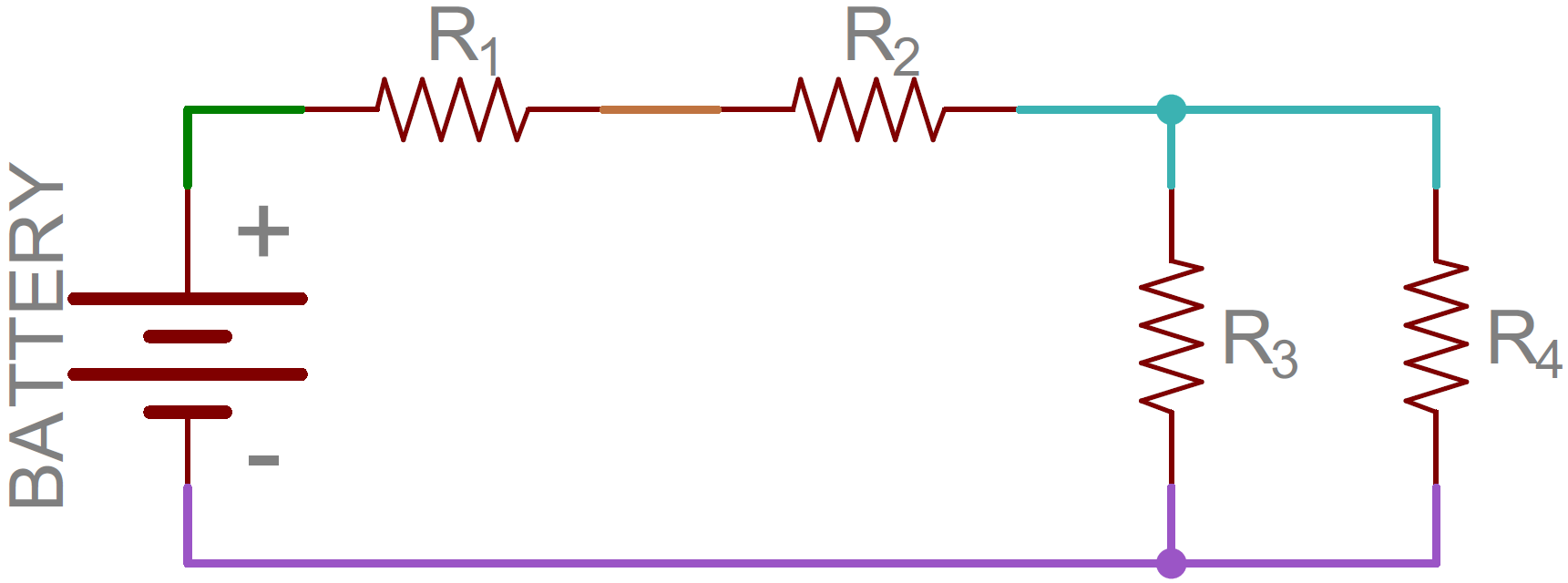
Example schematic with four uniquely colored nodes.
That's half the battle towards understanding the difference between series and parallel. We also need to understand how current flows through a circuit. Current flows from a high voltage to a lower voltage in a circuit. Some amount of current will flow through every path it can take to get to the point of lowest voltage (usually called ground). Using the above circuit as an example, here's how current would flow as it runs from the battery's positive terminal to the negative:
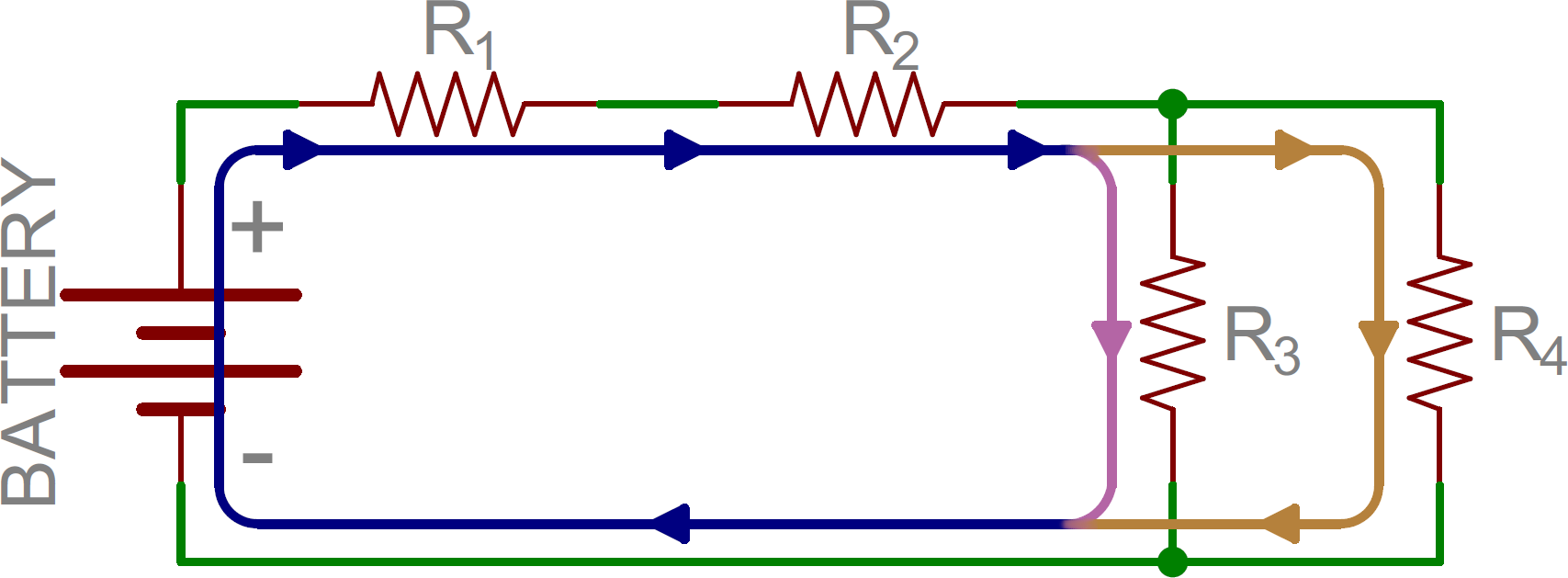
Current (indicated by the blue, orange, and pink lines) flowing through the same example circuit as above. Different currents are indicated by different colors.
Notice that in some nodes (like between R1 and R2) the current is the same going in as at is coming out. At other nodes (specifically the three-way junction between R2, R3, and R4) the main (blue) current splits into two different ones. That's the key difference between series and parallel!
Series Circuits Defined
Two components are in series if they share a common node and if the same current flows through them. Here's an example circuit with three series resistors:
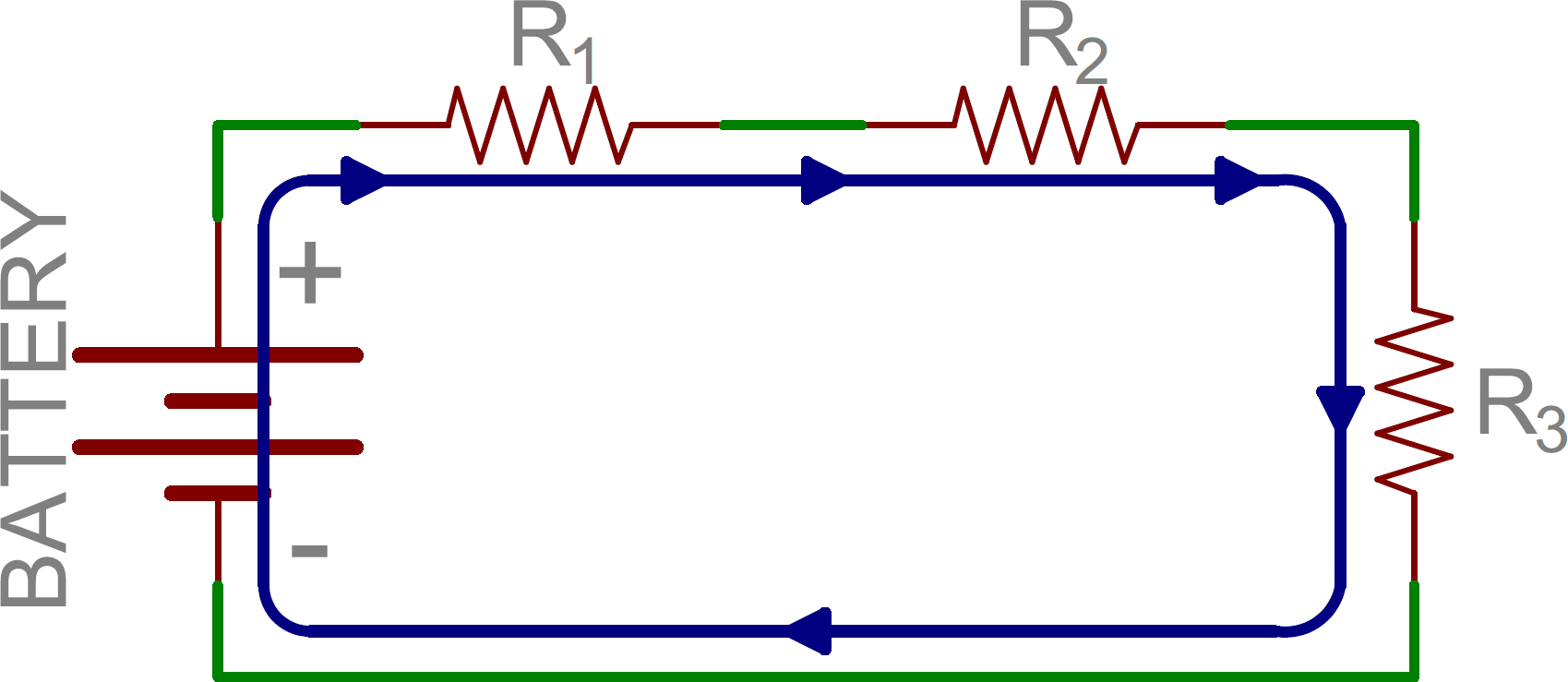
There's only one way for the current to flow in the above circuit. Starting from the positive terminal of the battery, current flow will first encounter R1. From there the current will flow straight to R2, then to R3, and finally back to the negative terminal of the battery. Note that there is only one path for current to follow. These components are in series.
Parallel Circuits
Parallel Circuits Defined
If components share two common nodes, they are in parallel. Here's an example schematic of three resistors in parallel with a battery:
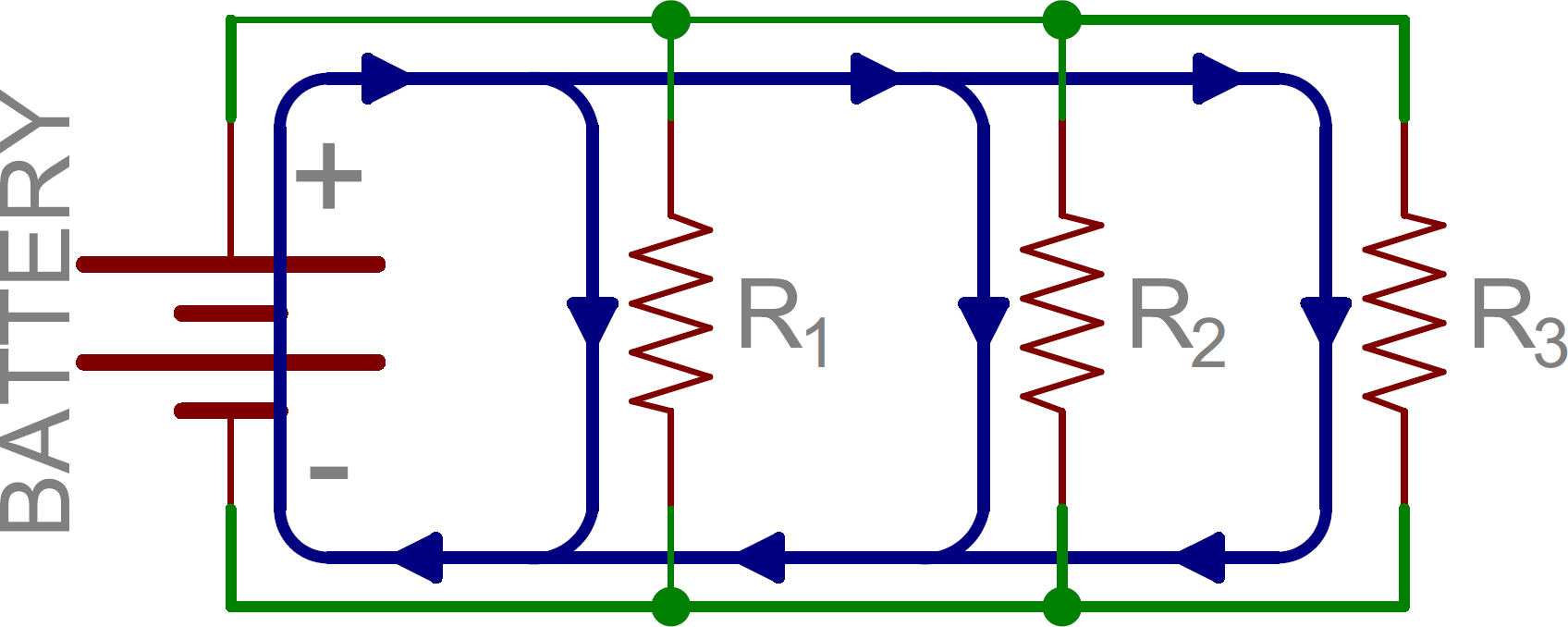
From the positive battery terminal, current flows to R1... and R2, and R3. The node that connects the battery to R1 is also connected to the other resistors. The other ends of these resistors are similarly tied together, and then tied back to the negative terminal of the battery. There are three distinct paths that current can take before returning to the battery, and the associated resistors are said to be in parallel.
Where series components all have equal currents running through them, parallel components all have the same voltage drop across them -series: current::parallel: voltage.
Evaluation
Instructions
Use the information given to you and study the image below and answer the questions that follow.

1.Explain the key differences you see between a series circuit and the parallel circuit.
2. What are the similarities between a series and a parallel circuit.
3. Describe what you think the advantages/disadvantages are for both connections.
Conclusion
Homework: Complete the following worksheet to the best of your ability.
NB: Use the information and videos to help complete the tasks and submit you work to me before the next lesson.
